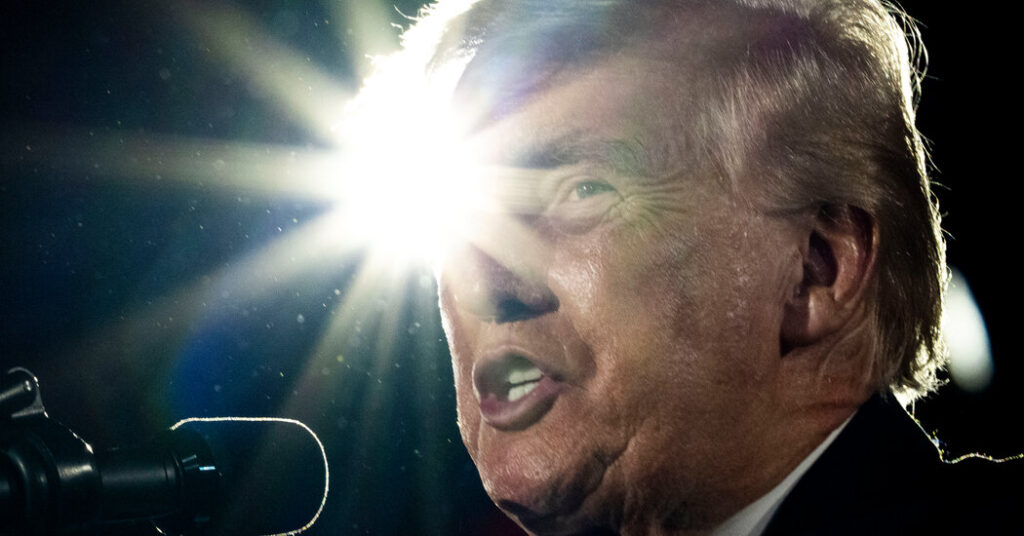
President Trump’s war with Iran is testing the limits of his unorthodox diplomatic style as he grasps for a deal to end the conflict shaking the Middle East and the global economy.
As the war stretches longer than Mr. Trump seems to have anticipated, he appears to be casting about for a diplomatic offramp even as he threatens to escalate the conflict.
In a social media post on Thursday, Mr. Trump seemed confounded by the challenge, calling Iranian officials “very different and ‘strange’” and claiming that they were “begging” for a deal while insisting that they “better get serious soon.”
It is unclear who in the Trump administration may be in charge of talking with a battered Tehran’s surviving leadership. On Tuesday, Mr. Trump said that Vice President JD Vance and Secretary of State Marco Rubio would join his special envoy Steve Witkoff and his son-in-law Jared Kushner in any negotiations. “They’re doing it, along with Marco, JD, we have a number of people doing it,” Mr. Trump said.
Mr. Vance is a past opponent of U.S. intervention in the Middle East generally and Iran in particular. Mr. Rubio, by contrast, is an Iran hawk who has publicly defended Mr. Trump’s decision to attack the country.
That jumble of emissaries — a friend, a family member, a dove and a hawk — reflects Mr. Trump’s improvisational approach to foreign dealings and his disdain for career diplomats and their often cumbersome protocols. The picture is further muddied by Mr. Trump’s stream-of-consciousness commentary on social media and before the TV cameras during which he declares, revises and sometimes reverses his threats and demands.
The situation is testing the bravado many Trump officials expressed about their early foreign policy initiatives. “Turns out a lot of diplomacy boils down to a simple skill: don’t be an idiot,” Mr. Vance posted on social media last March, in praise of Mr. Witkoff.
Iran has publicly rejected a 15-point cease-fire proposal circulated by the United States but is privately considering meeting with unspecified U.S. negotiators in Pakistan in the coming days.
Daniel Kurtzer, a former U.S. ambassador to Israel under President George W. Bush, rated Mr. Trump’s Iran diplomacy a failure, in part because the president seems unsure of his own goals. “Trump says he wants to de-escalate, but does he even know what that means?” Mr. Kurtzer added that the 15 demands Mr. Trump has submitted to Tehran “are nonstarters, because they would require Iran essentially to give up on everything.”
Mr. Kurtzer also blamed Mr. Trump for sidelining career diplomats, cutting key policymaking jobs and largely placing his Middle East diplomacy into the hands of Mr. Witkoff and Mr. Kushner, who have backgrounds in real estate. That has left Mr. Trump without skilled teams of experts to help guide him out of the current crisis, Mr. Kurtzer said.
“If you’ve hollowed out the State Department and substantially reduced the size of the National Security Council and fired some of your top generals, and if so much of what you’re doing is about political loyalty, then maybe there isn’t that reservoir of expertise to draw on,” he said.
Many foreign diplomats share the concern that America’s diplomatic machine is malfunctioning. “America has lost control of its own foreign policy,” the foreign minister of Oman, Badr Albusaidi, wrote in The Economist magazine last week.
Mr. Albusaidi suggested that Mr. Trump could not solve the problem on his own. “The question for friends of America is simple,” he said. “What can we do to extricate the superpower from this unwanted entanglement?” In a reflection of that sentiment, several nations including Oman, Egypt and Pakistan have sought to mediate new talks between Washington and Tehran.
Mr. Albusaidi is one of many who have been questioning whether Mr. Trump missed an opportunity to avoid war when he sent Mr. Witkoff and Mr. Kushner for last-ditch negotiations with Iran over its nuclear and missile programs. Critics charge that Mr. Witkoff and Mr. Kushner were out of their depth and too quick to conclude that Tehran was not open to a deal.
During an appearance on “The Daily Show” with Jon Stewart on Monday, Jake Sullivan, who spent four years as President Joseph R. Biden Jr.’s national security adviser, said Mr. Witkoff and Mr. Kushner had bungled a meeting in late February with Iranian officials in Geneva that Mr. Trump had cast as a last chance to avoid war.
“Just a few days before we started bombing Iran, the Iranians put a proposal on the table in Geneva that went a long way towards resolving the nuclear issue,” Mr. Sullivan said. “And my understanding is that our side, our negotiators simply didn’t understand what they were being offered, and they ignored it, and decided to go ahead and strike.”
Mr. Sullivan attributed that understanding to “a mismatch between that and what the mediators, Omani mediators, said was actually on the table.”
Trump officials strongly dispute that, saying Tehran refused to budge on basic U.S. demands, including that Iran agree to zero uranium enrichment on its soil.
But Mr. Sullivan is hardly alone in raising concerns about Mr. Trump’s diplomatic acumen. In an interview last week with PBS’s “Firing Line,” Jim Mattis, who served as defense secretary for much of Mr. Trump’s first term, said the president had failed to use America’s nonmilitary power wisely.
“‘Targetry’ does not take the place of strategy,” Mr. Mattis said. “Right now, whether or not we have a strategy to actually use diplomacy, economics,” and the help of European allies whom Mr. Trump has alienated, “is still to be proven,” he added.
One particular quirk of Mr. Trump’s diplomatic approach is the minimalist role of his State Department and its leader, Mr. Rubio.
Since taking on a second job last year as Mr. Trump’s national security adviser, a demanding White House staff position, Mr. Rubio has visited foreign capitals far less often than his recent State Department predecessors. He has not been to the Middle East since a brief October stop in Israel. (Mr. Rubio canceled a planned return trip there this month when war broke out.) His last foreign trip was a one-day visit to St. Kitts and Nevis for a Caribbean security conference in late February.
Mr. Rubio has held numerous phone calls with officials in the Middle East and elsewhere since the war in Iran began, according to the State Department.
But during past Middle East crises, U.S. secretaries of state have typically raced across the region to build personal trust and glean insights in ways that veteran diplomats say requires in-person interaction.
Mr. Rubio typically visits the State Department “almost every day,” he told Politico in June, but added that he spends more time at the White House during times of conflict. He suggested in December that he had less need for travel because “we have a lot of leaders constantly coming here” to visit Mr. Trump at the White House.
Mr. Rubio plans to attend a Friday gathering of Group of 7 foreign ministers in France, in what the State Department said would be a one-day trip.
He has also said he is unbothered by the heavy diplomatic responsibilities Mr. Trump has assigned to Mr. Witkoff and Mr. Kushner, saying that they check in with him regularly.
But the war with Iran reveals the risk in what Aaron David Miller, who served as a Middle East negotiator under several presidents of both parties, calls Mr. Trump’s “huge break with convention and common sense.”
“That the secretary of state is playing a subordinate role and not managing the administration’s most serious foreign policy crisis attests to how dysfunctional the decision-making process is,” he added. “Because there’s no structure, it also allows Iran to try to pick and choose which U.S. officials they want to talk to.”
A Trump administration briefing on the talks, held for reporters soon after the war began, offered some fodder for those who question Mr. Witkoff and Mr. Kushner’s role in crisis.
The two men were joined in Geneva by the head of the International Atomic Energy Agency, the Argentine diplomat Rafael Grossi, but no American technical experts.
During the briefing, a senior Trump administration official said it was “surprising” that Iran had insisted in Geneva that it enjoyed an inalienable national right to enrich uranium that it would never surrender — even though Iran has declared that position for decades.
The official, who spoke on the condition of anonymity, also repeatedly misstated the abbreviation for Mr. Grossi’s agency, which has long played a crucial monitoring role within Iran, as the “I.E.A.E.” or “I.E.A.”
But the official nonetheless expressed confidence in his own expertise. Referring to a document presented by the Iranian negotiators, the official said: “I went through it. I know enough about nuclear that I was able to absorb.”
“It all smelled fishy,” the official concluded.
That view was relayed to Mr. Trump, who launched his attack the next night.
Michael Crowley covers the State Department and U.S. foreign policy for The Times. He has reported from nearly three dozen countries and often travels with the secretary of state.
The post Standoff With Iran Raises Fresh Doubts About Trump’s Freestyle Diplomacy appeared first on New York Times.