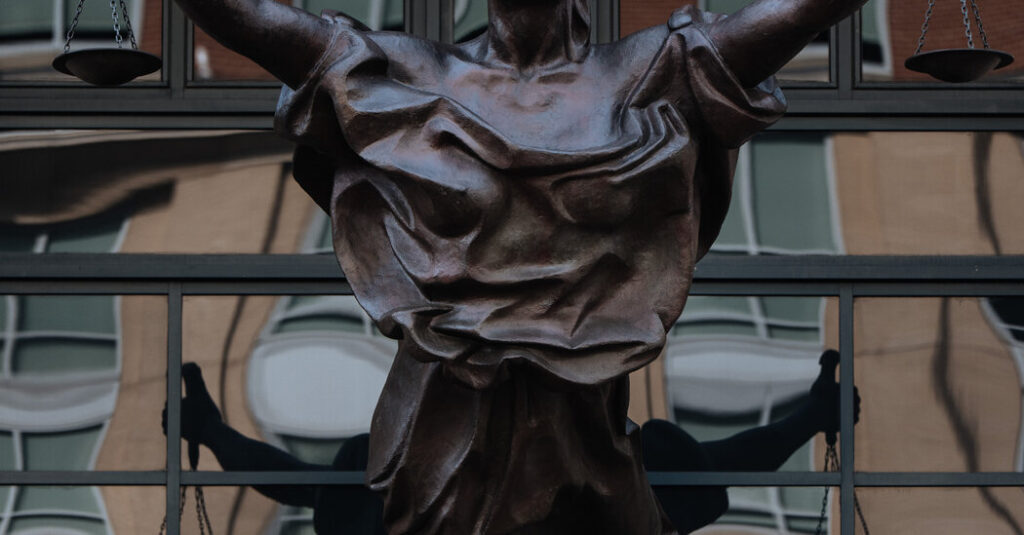
Judges are turning up the volume.
One compared her district’s ballooning caseload to a demigod’s battle against a mythological monster.
Another sought to buttress his argument against National Guard deployments to U.S. cities with a YouTube link to a 1970 protest song.
A third compared the Trump administration’s rewriting of American history to the Ministry of Truth in George Orwell’s novel “1984.”
More and more federal judges have been setting aside their profession’s traditional, restrained style of opinion writing in favor of an emotive, populist approach, giving full vent to the intensity of their concerns about cases flooding their dockets since President Trump returned to office.
In many instances, the writerly flourishes and flashy citations appear to be symptoms of a growing sense among district-court judges that President Trump’s second term is an all-hands-on-deck constitutional emergency. That feeling of alarm runs all the way up to the Supreme Court, where Justice Ketanji Brown Jackson wrote that one decision from the conservative majority was “an existential threat to the rule of law.”
In interviews, judges and legal experts said the increasingly hot rhetoric from the judiciary has been helpful in underscoring judges’ belief in the urgency of the courts’ role as a check on Mr. Trump’s expansive interpretation of presidential power.
But more quietly, some judges and experts have worried that the heated rhetoric may also come with risks.
The public could perceive rulings as motivated by political animus, instead of the basic application of law to the facts of a case. District court judges who take an unnecessarily adversarial stance could provoke appellate courts to overturn their rulings. And if strident writing becomes the new normal, some judges expressed worry that a more restrained, technical style could be misinterpreted as a sign that they do not have broader concerns.
Some current and former judges who spoke on the condition of anonymity in order to avoid the appearance of criticizing their colleagues said they worried some of their colleagues might just be taking Mr. Trump’s bait.
“The risk is being the boy who cried wolf,” said Noah Feldman, a professor at Harvard Law School and the author of a book on Franklin Roosevelt’s Supreme Court nominees. “If you say that the republic is collapsing in every single case, will anyone listen when the republic really is collapsing, and the Supreme Court says so?”
Umpires or Players?
For years, Chief Justice John G. Roberts Jr. has likened judges to umpires, humbly calling balls and strikes. “Nobody ever went to a ballgame to see the umpire,” he told the Senate at his 2005 confirmation hearing.
Those values of sober neutrality are embedded in an official writing manual for federal judges that counsels against “pomposity,” and “advocacy.”
“Judges should put aside emotion and personal feelings,” it suggests, and avoid “a contentious or adversarial tone” toward the losing party.
But the Trump administration has been repeatedly pushing the courts to approve its aggressive reinterpretation of existing laws governing birthright citizenship, wartime deportations, National Guard deployments and the arrest and detention of immigrants. The administration has also tried to deploy presidential emergency powers in nonemergency contexts.
And Mr. Trump has tried to pressure the judiciary through personal attacks on many judges and justices who rule against him.
In response, some judges have used their opinions to declare that the moment calls for plain-spoken warnings.
Trump Administration: Live Updates
Updated
- The war will push U.S. inflation above 4 percent this year, according to a new O.E.C.D. forecast.
- U.S. military kills 4 people in a boat strike in Caribbean.
- Trump calls for a law cracking down on crime and ‘rogue judges.’
“Antiseptic judicial rhetoric cannot do justice to what is happening,” Judge Joseph R. Goodwin of the Southern District of West Virginia wrote last month. The tactics being deployed by Immigration and Customs Enforcement, he wrote, are “an assault on the constitutional order” and “beyond the reach of ordinary legal description.”
Judge Goodwin followed that overture with 33 pages of facts and arguments. In his view, the administration’s policies of sweeping arrests by masked immigration agents and holding detainees without bond were cut-and-dried violations of the Constitution. “No court has yet been required to state the obvious,” he wrote. “This court is now required to say it.”
An opinion last year from Judge William G. Young of the District of Massachusetts, about the administration’s crackdown on noncitizen student protesters, opened with an image of scrawls from a vaguely threatening anonymous postcard he had received in his chambers, and then quoted Ronald Reagan and his own wife’s criticisms of Mr. Trump.
“I fear President Trump believes the American people are so divided that today they will not stand up, fight for, and defend our most precious constitutional values so long as they are lulled into thinking their own personal interests are not affected. Is he correct?” Judge Young asked in conclusion.
Like Judge Young, Judge Fred Biery of the Western District of Texas ranged far beyond the facts at issue when he ordered the release of an asylum seeker from Ecuador and his 5-year-old son. He cited Magna Carta, quoted at length from the Declaration of Independence and wrote that the administration’s “perfidious lust for unbridled power” was “bereft of human decency.”
Mr. Trump has “forced judges to be in a position that they’ve never been in before,” said Nancy Gertner, a retired federal judge and lecturer at Harvard Law School. “The distance between what he’s trying to do and what is lawful is so great, and the language of these opinions reflects that. So it’s not that there are rogue judges. There is a rogue president.”
But for Edward Whelan, a conservative legal commentator and former Justice Department official, judges who go further than “dispassionately deciding the specific case in front of them” are overstepping their role. “Once you get into other questions — should the judge be sending a signal or warning of the apocalypse — that’s not judging. That’s something different,” he said. Mr. Trump escalated his attacks on Wednesday night, calling on Republican lawmakers to pass a crime bill that “cracks down on rogue judges.” He said at a National Republican Congressional Committee event in Washington that these judges “are criminals.”
Barroom Talk and Fire Alarms
The judges responding to Mr. Trump are not the first to use fiery language in their opinions.
When his landmark majority opinion in Roe v. Wade, which recognized a constitutional right to abortion, seemed to be at risk, Supreme Court Justice Harry A. Blackmun declared, “I fear for the future” in 1989 and “I fear for the darkness” in 1992.
Among conservative jurists, Justice Antonin Scalia’s dissents were renowned for their biting critiques of the majority, once comparing his colleagues’ writing “to the mystical aphorisms of the fortune cookie.”
But the rise in outspoken opinions across the district courts has little historical precedent, judges and experts said.
The trend has sparked sharp criticism from Mr. Trump’s allies, who have tried to brand outspoken judges as politically motivated “activist judges.” Responding on social media to Judge Biery’s ruling, Chad Mizelle, a former chief of staff to Attorney General Pam Bondi, noted its inclusion of “random Bible verses” and called it “unhinged.” More generally, he said in a text message, some judges were engaging in “performative buffoonery” as part of a “reactionary, ‘orange man is bad’ tribalism.”
Even those who find strident opinion-writing understandable acknowledge that there may be a trade-off between candor and impact.
Marin K. Levy, a professor at Duke Law School, said judges were within their rights “to get the public’s attention to try to exert some pressure on the political branches.”
“If you’re repeatedly engaging in alarm-sounding, the force of that alarm is going to be diminished over time,” she said. “But just because there have been several fires doesn’t mean that you shouldn’t sound the alarm for the next one.”
Some conservative appellate judges, many of them Mr. Trump’s appointees, have also used vociferous language in a different way, to mock their colleagues’ reasoning and sound off about what they call the “woke” agenda and various culture-war issues.
The almost satirical style sparked debate across the legal community earlier this month, when Judge Lawrence VanDyke repeatedly used a profanity to refer to male genitalia in a dissent from a ruling on a transgender discrimination case. He wrote that his use of “indecorous language,” helped “bear the truth.” Twenty-seven of his colleagues from the U.S. Court of Appeals for the Ninth Circuit disagreed, admonishing him in their opinion for “vulgar barroom talk” that “makes us sound like juveniles, not judges.”
Rather than focusing on raising the public’s level of alarm, some judges have used their rulings to try to engage directly with the executive branch.
In his opinion on the deportation of Kilmar Armando Abrego Garcia last year, Judge J. Harvie Wilkinson III of the U.S. Court of Appeals for the Fourth Circuit warned of the judiciary and the executive “grinding irrevocably against one another in a conflict that promises to diminish both.” The judiciary, he said, would be diminished by “constant intimations of its illegitimacy,” while the White House would “lose much from a public perception of its lawlessness.” “There is still time,” he wrote, referring to “our good brethren in the executive branch.”
Other judges have used their opinions to meticulously document questionable behavior by the executive branch in order to lay a factual foundation for their rulings. Judge James E. Boasberg began an opinion by quoting a litany of rants from Mr. Trump about Jerome H. Powell, the Federal Reserve chair, to establish the reasonableness of questioning the Justice Department’s true motives in investigating him.
When it comes to responding to attacks, there are signs that the courts may be giving judges more leeway to express themselves outside of written opinions. In guidance issued last month, the judiciary’s ethics committee said that the code governing judges’ behavior allowed “measured defense of judicial colleagues from illegitimate forms of criticism” and from attacks that “risk undermining judicial independence or the rule of law.”
The new guidance was evident last week, when Judge Beth Bloom of the Southern District of Florida said the current moment “presents a strong case for why engagement is not only appropriate, but is necessary.”
The event was an online forum on threats against judges, called “The Bench Breaks its Silence.”
The post Some Judges See Risks in Fiery Opinions Warning of Threats to Democracy appeared first on New York Times.