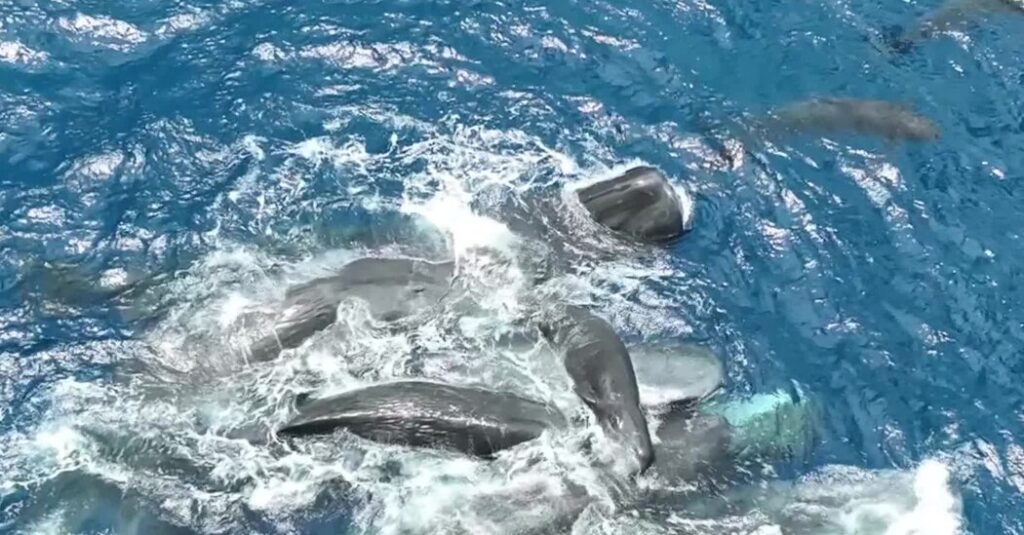
At first, the researchers on the boats didn’t understand what they were witnessing in the waves below. A group of 11 sperm whales huddled together at the surface, strangely still and taking occasional shallow dives. After about an hour, the animals seemed to start thrashing, and a plume of blood reddened the water. The researchers feared trouble, maybe a shark attack. But it was something else.
Suddenly, a much smaller, 12th whale appeared, lifted to the surface by the others so it could breathe.
The event, analyzed in two studies published on Thursday in the journals Science and Scientific Reports, provides the latest evidence in a growing body of research indicating that humans are not the only species in which mothers receive some form of help during and after birth.
“I don’t think it’s midwives or doulas in our human perspective, but there was definitely assistance and support for both the mother and the calf,” said Alaa Maalouf, one of the authors and a specialist in machine learning and robotics with Project CETI, the nonprofit whale research group that happened upon, documented and analyzed the birth.
Notably, half of the whales attending were not related to the mother. The participation of non-kin is significant to scientists because it suggests that social reciprocity, as opposed to a singular drive to continue a genetic line, may play a role.
Relatively little is known about birth in most wild animals, because it is rarely seen outside of captivity, which fundamentally changes behaviors. Many social animals, like lions and chimpanzees, seek isolation to give birth. (Scientists believe this may be motivated, at least in part, to avoid male aggression toward the young.)
Scientists long assumed that humans were the only species to receive assistance. Human childbirth is an exceptionally difficult affair because of the structure of the pelvis and the size of the infant’s head.
“One thing we have learned is that whenever you say that something is unique to humans, we always find that that’s not the case,” said Wenda Trevathan, a biological anthropologist and professor emerita at New Mexico State University who studies childbirth. Now, scientists have documented animals offering protection and other forms of assistance for birthing mothers in a number of species, including certain primates, dolphins and even rodents.
In whales, it appears that baleen species are more solitary during birth and that the mother alone raises the calf to the surface to breathe, said David Gruber, a marine biologist who leads Project CETI. But for some toothed species, like sperm whales, birth is a collective experience.
Long hunted for their oil and made famous by “Moby-Dick,” sperm whales were devastated by commercial whaling and are currently classified as vulnerable. Project CETI focuses on the species with an audacious mission: leveraging artificial intelligence to decode their clicking vocalization, with the goal of interpreting it into human language.
Some experts take issue with the very premise, saying that the sequences of clicks, called codas, may be more like music than translatable words. But the effort has attracted an impressive group of scientists across fields as diverse as marine biology, machine learning, linguistics and cryptology. In 2024, the group published findings of a “sperm whale phonetic alphabet.” (CETI stands for Cetacean Translation Initiative and plays on SETI, the scientific effort to detect extraterrestrial life.)
The birth they documented took place in July 2023 off the coast of Dominica in the Caribbean. Thanks to the technology on hand, it was captured by two drones in the air, acoustic recorders in the water and photographs from the boats, giving scientists a wealth of information to examine. Shane Gero, a marine biologist with the group who has studied the whales in question since 2005, identified the individuals and provided their family trees.
He has followed the mother, known as Rounder, since she was nursing from her own mother, Lady Oracle, who was present at the birth and particularly attentive to Rounder before the delivery, he said.
Whales are born tail first, which makes sense given that they cannot breathe underwater. In what Dr. Gero described as a miracle, Rounder rolled as her calf’s tail, or flukes, emerged, so the drone captured that moment. Delivery took place 34 minutes later.
The Science paper used machine learning to quantify the event and analyzed whether the whales’ spacing, orientation and physical touching were statistically significant or could be attributed to chance.
They found that the whales oriented to the mother during labor and to the newborn after delivery. Sperm whale calves cannot immediately swim effectively, and a core group of individuals — Rounder, her sister Aurora, and a young, unrelated whale named Ariel — spent the most time lifting the newborn. But every whale in the group acted as “a primary supporter” at some point, including the sole male, an adolescent named Allan who was starting to leave the group to embark on a largely solitary life, as male sperm whales do. But he appeared at the birth.
The calf was rarely left untouched, and it was usually being touched by at least two whales simultaneously.
According to the paper’s abstract, the team’s analysis indicated that a female family member had “led birth assistance” before the delivery. The paper details the close proximity of that whale, Lady Oracle, to Rounder, and drone video shows Lady Oracle rolling with Rounder as the calf emerges. But the paper itself does not flesh out further evidence of predelivery assistance.
The Scientific Reports paper analyzed vocalizations over the event. The scientists found changes in click patterns, duration and density at various times.
“It is great to see this rare sighting of a sperm whale birth documented so comprehensively, particularly in relation to the reaction of the other whales to the birth of a new calf,” said Philippa Brakes, a behavioral ecologist and marine biologist who is co-chair of a new International Union for Conservation of Nature group on nonhuman culture and was not involved with the studies.
“What is particularly interesting is that the researchers documented how individuals from a normally separate social unit were engaged with the birth,” Dr. Brakes said. “This seems to indicate a layering of cultural and innate behaviors that are context-specific, which would be interesting to explore more.”
Project CETI scientists continue to analyze the event, including other species that were present, among them short-finned pilot whales. Were they attracted to the blood and considering an attack? Curious about the commotion? Or something else?
From the sperm whales, at least, Dr. Maalouf takes inspiration.
“Aside from science, I think of it as a great lesson for us humans,” he said. “At least in the most vulnerable times, it’s nice to stick with each other and help each other rather than being against each other.”
Catrin Einhorn covers biodiversity, climate and the environment for The Times.
The post Scientists Filmed a Whale Birth. The Surprise: Mom Had Many Helpers. appeared first on New York Times.