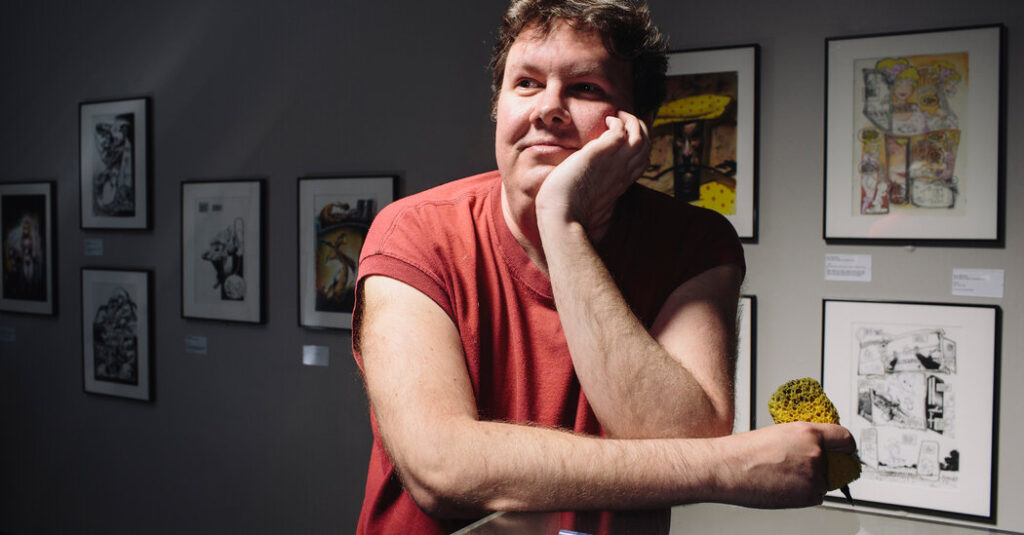
Sam Kieth, a comic book cartoonist who created The Maxx, a surreal series about characters leading dual lives — in the real world and in a subconscious realm — and who cocreated the popular series Sandman, died on March 15 at his home in Sacramento. He was 63.
His death was confirmed by his wife, Kathy Kieth. He had been diagnosed with Lewy body dementia in 2023.
At a quick glance, The Maxx, which debuted in 1993 in Image Comics and ran for five years, might have been mistaken for a typical superhero comic, but Mr. Kieth’s bold art aesthetic and exploration of mature themes gave it an adult edge.
At the center of the story is a woman named Julie, a rape victim who creates a subconscious world in which she feels safe. Mr. Gone, a serial rapist who had attacked Julie, can enter that haven. When Julie hits a homeless man in an automobile accident, the man is transformed into the Maxx, who becomes her behemoth protector in both worlds, a creature in a purple and yellow costume who has sharp white teeth and hands with middle digits shaped like claws.
MTV adapted The Maxx for a 13-episode animated series in 1995. At the time, in an interview in Wizard, a magazine devoted to the comic book industry, Mr. Kieth explained the general concept behind the series:
“The closest thing I could think of was that it’s Don Quixote, a person stuck in an unpleasant real world who dreams of a world where he has control and power, but keeps returning to unpleasant reality.”
Though The Maxx was Mr. Kieth’s brainchild, he worked with the writer William Messner-Loebs for most of the comic book series, until he felt confident enough to handle the scripting himself.
Mr. Kieth caught early notice for his work in an issue of The Incredible Hulk and for his depiction of Wolverine in Marvel Comics Presents, a comic book anthology series. He was then recruited to Image Comics by the co-founder Jim Lee in 1992.
“Sam had hit big with his rendition of Wolverine in Marvel Comics Presents,” Mr. Lee said in an interview. Wolverine was typically depicted as short, squat and strong. Mr. Kieth’s version of the character was impossibly muscled and had a feral energy.
“I thought it would polarize the audience,” Mr. Lee said. “Most people loved it because it was so different and original.”
The goal of Image Comics was for its artists and writers to have creator control of their characters and to enjoy the financial rewards. “Sam was the one who lived the dream,” Mr. Lee said. Mr. Kieth owned the character, he had complete creative freedom, and he profited from the MTV adaptation. Mr. Lee added, “I had such admiration and respect for what he did — and a tinge of jealousy.”
Samuel Coleman Kieth, an only child, was born in Sacramento on Jan. 11, 1963. His father, Samuel E. Kieth, was a barber and an aspiring artist, and his mother, Sammie (Robertson) Kieth, was an employment representative for the state of California, among other jobs.
Mr. Kieth, who wanted to be a comic book artist from an early age, dropped out of high school in 10th grade and began phoning comic book editors in New York, asking if work was available, his wife recalled. He married Kathy Frye in 1982, and they worked odd jobs as Mr. Kieth pursued his artistic ambitions.
In addition to his wife, he is survived by his mother.
Mr. Kieth’s first professional comic book credit, published by Comico in 1983, was a 10-page story, which he wrote and drew, about a killer rabbit. He found more regular work on the series Mage, written and drawn by Matt Wagner; Mr. Kieth inked several issues, beginning in 1985.
His first breakthrough came in 1988 with the fantasy series Sandman, written by Neil Gaiman. Mr. Kieth, the artist Mike Dringenberg and Mr. Gaiman together created the series, which went on to critical acclaim.
Mr. Kieth drew the first five issues of Sandman and seemed to be most in his element — drawing strange, misshapen creatures of the night — in issue No. 4, when the main character travels to hell. In that issue, Mr. Kieth drew a two-page spread in which Sandman and Satan are surrounded by a horde of demons.
In 2010, in an interview with Digital Spy, an entertainment news site, Mr. Kieth was humble about his contributions to Sandman. “All I did was draw a guy in a black robe, and they said, ‘Yes, that’s the character,’ so I got the credit for it,” he said.
Mr. Gaiman remembered being with his editor Karen Berger when she made an expensive phone call to Mr. Kieth to offer him the Sandman assignment. “We were in England, and the next thing I know, she’s making an international call to America, which at the time was very fancy,” he said in an interview.
But Mr. Kieth was not easily persuaded.
“I just remember having the strangest conversation with Sam,” Mr. Gaiman continued, “because he’s like, ‘OK, who dropped out? You don’t really want me.’ I could never tell if it was low self-esteem in reality or low self-esteem being deployed as a weapon.”
It ended up being a lucrative gig for Mr. Kieth. Creator credit comes with financial rewards when the property is developed into other media and when the work is reprinted. “We’re still getting royalties,” Kathy Kieth said.
In 1993, Mr. Kieth’s art was featured in a group show at Four Color Images gallery in Lower Manhattan. (A visit to the gallery by Abby Terkuhle, the president of MTV Animation, led her to develop The Maxx for the cable network.)
In 2013, Mr. Kieth won Comic-Con’s Inkpot Award for lifetime achievement, and his work was the subject of a 30-year retrospective at the Cartoon Art Museum in San Francisco.
That same year, his mother asked him to participate in an event at World’s Best Comics and Toys, a store in Sacramento, so that she could watch him interacting with fans.
“He said, ‘Mom, probably only two people are going to show up’,” Ms. Kieth recalled.
The signing began at 11:30 a.m. and ended at 10:30 p.m.
“People flew in from Texas, from Oregon, from Washington,” she said. “It was just a constant line all day long.”
George Gene Gustines has been writing about comic books for The Times for more than two decades.
The post Sam Kieth, Creator of Surreal Comic Book Series The Maxx, Dies at 63 appeared first on New York Times.