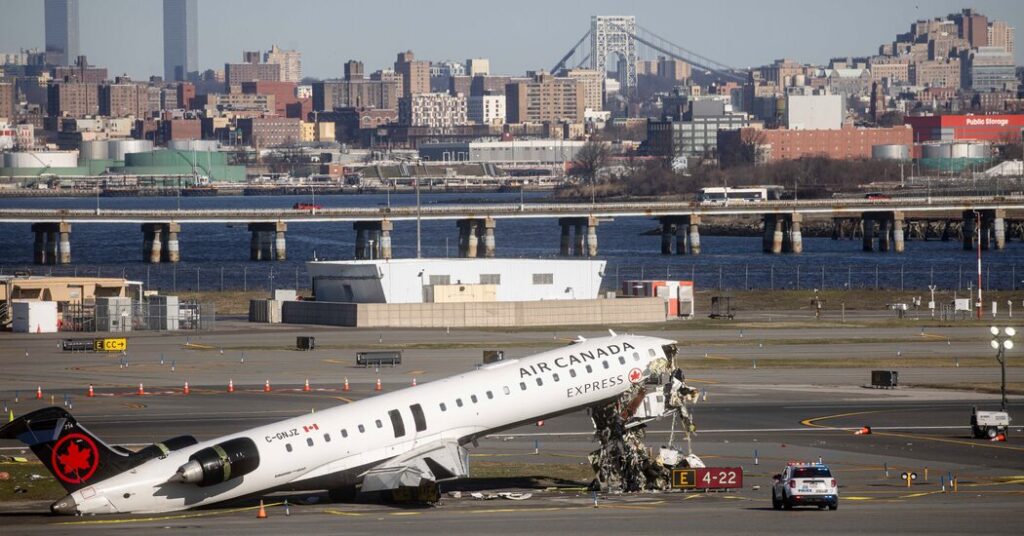
Fears about airport runway safety have been high for years, but federal data and interviews with aviation experts suggest that LaGuardia Airport, where a plane and fire truck crashed into each other on Sunday, did not stand out as a significant source of concern.
The Federal Aviation Administration has been working for years to reduce incidents when people, vehicles or aircraft enter runways when they aren’t supposed to, threatening catastrophic consequences like Sunday’s accident involving an Air Canada Express jet that killed two pilots.
Those efforts gained renewed momentum after several high-profile examples in 2023 of what the industry calls “runway incursions” at airports serving New York, Austin, Boston and other cities. The number of incursions fell 8 percent last year, reaching the lowest level since 2020, the F.A.A. said in a statement.
The agency tracks such close calls and its data shows that LaGuardia has had two since 2001. The most recent, in 2016, occurred when a departing jet and arriving one came within 275 feet of each other near the intersection of the airport’s two runways. Among the nation’s 25 busiest airports, most reported one to four close calls each over the same period, according to a review of the data by The New York Times.
“As far as the runway safety areas, I wouldn’t characterize LaGuardia as any better or any worse than a whole lot of other airports,” said John Cox, an aviation safety consultant who flew to and from the airport hundreds of times when he was a pilot for US Airways.
Mr. Cox and other aviation experts said that LaGuardia could be a demanding airport for pilots because its relatively small yet one of the busiest in the country.
The airport, which opened commercial operations in 1939, is boxed in between water and densely populated neighborhoods of Queens, the New York City borough. Its runways are 7,000 feet long compared with runways as long as 11,000 feet and 14,500 feet at Newark Liberty International Airport and Kennedy International Airport — the two other large airports in the New York area.
But because of the heightened demands of flying at LaGuardia, the pilots, air traffic controllers and other aviation professionals who work there tend to be seasoned.
But while experts said that LaGuardia’s safety record did not stand out for concern, pilots had filed complaints to a federal database in recent years about controllers who appeared to be overburdened, echoing concerns around the country. Some also said the airport had weak ground lights that complicated navigating through awkward taxi routes on the ground.
In June, one airline captain wrote that pilots were used to “making it work even when we know we’re going to need something” and that pilots weren’t able to make requests “because it’s so busy, or even if we do, they can’t give it to us.”
Sean Duffy, the secretary of transportation who oversees the F.A.A. and its air traffic control division, said this week that LaGuardia was “a well-staffed airport,” with 33 controllers and seven more in training, just shy of a target of 37 fully certified controllers. There were two controllers in the tower control room on Sunday night, according to the National Transportation Safety Board, which is leading the investigation.
Most air traffic control facilities have been understaffed for years, contributing to grueling workloads. Efforts to hire and train more professionals have fallen short over the past decade, according to a December report by the Government Accountability Office. Over that period, the number of flights in the United States had increased 10 percent, while the number of controllers had declined about 6 percent.
The problem was on notable display last spring, when limited staffing contributed to extensive delays at Newark. The F.A.A. has said it is initiating plans to “supercharge” hiring and training, aiming to add 8,900 air traffic controllers through 2028.
“This administration is working all avenues from increasing starting salaries for controllers to streamlining the hiring process to effectively bring about the golden age of travel and ensure America has the safest airspace in the world,” the F.A.A. said in a statement.
Another concern about LaGuardia has been its runway status lights that automatically turn on when it is unsafe to cross a runway. Some pilots said they were often dim or seemingly not working.
“The portion of the runway status light system visible to aircraft departing 13 appears to have been disabled,” one airline pilot wrote in August, referring to the number by which one of the airport’s runways is known. “In the past, this system provided an additional layer of safety to prevent runway incursions. Now, I never see it light up anymore.”
The runway status lights at LaGuardia appeared to be functioning before the collision, but investigators are seeking to confirm that, the safety board said this week.
Aviation safety experts note that the pilot reports, filed to a NASA database, are anonymous and unverified. LaGuardia has received about 50 of the voluntary reports in the past five years, in line with its size among the 25 busiest airports.
Ronald Reagan Washington National Airport, which has fewer flights than LaGuardia, has had about 50 percent more reports in recent years. An American Airlines plane trying to land at Reagan crashed into a military helicopter in January 2025, killing everybody on both aircraft. Pilots and safety experts had long raised concerns about the possibility of such a crash.
The F.A.A.’s runway incursion data is reviewed and documented by the agency’s safety team and is primarily based on required reporting by air traffic control personnel. The numbers are updated with a lag and the details the agency offers about each incident can be limited.
After the string of close calls in 2023, the F.A.A. assembled a safety review team and awarded $200 million in grants to airports for improvements. In a report last year, the inspector general of the Transportation Department said that the agency had made progress, but that it still had work to do.
In typical years, there are 10 to 20 runway incursions that the F.A.A. describes as “close calls,” serious episodes where there was either “significant potential for collision” or a collision was narrowly avoided. Last year, there were 14 such episodes, nine of them attributed to air traffic controllers.
Certain technologies hold promise for improving runway safety, according to the report. They include surveillance systems that use radar and satellite technology to clearly show ground traffic to air traffic controllers and runway status lights. According to the report, which was published last March, fewer than 50 U.S. airports had the surveillance technology and only about two dozen had runway status lights. LaGuardia has both.
But, the National Transportation Safety Board, which is investigating the crash on Sunday night, said this week that the fire truck did not have a transponder, unlike similar vehicles at airports across the United States, which would have made it difficult for the airport’s early-warning systems to track its position.
Aircraft manufacturers Airbus and Boeing and equipment suppliers like Honeywell are working on tools that can alert pilots to planes and other vehicles on airport runways, too.
Niraj Chokshi is a Times reporter who writes about aviation, rail and other transportation industries.
The post Safety Experts Considered LaGuardia Challenging but Not an Outlier appeared first on New York Times.