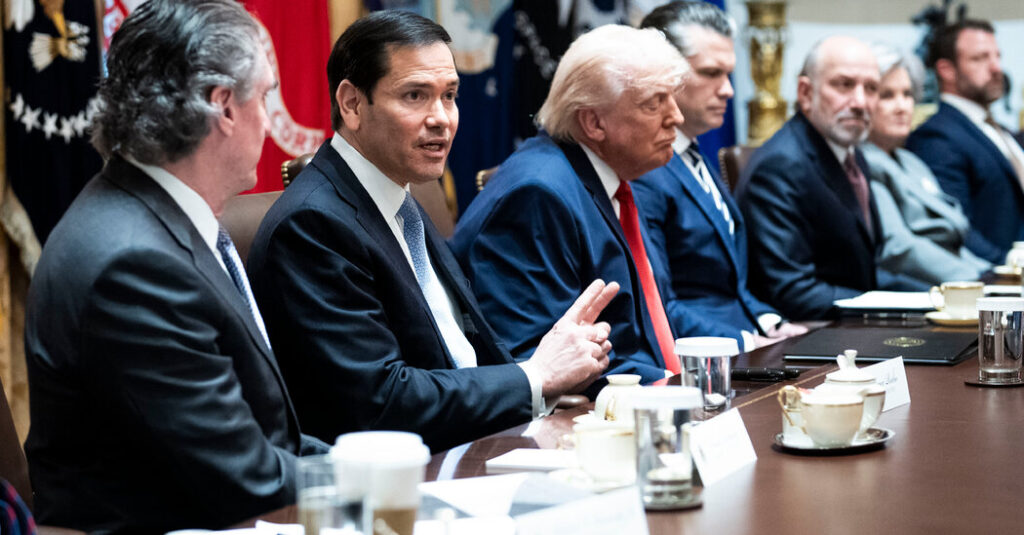
Secretary of State Marco Rubio said European and Asian allies of the United States should help with securing the Strait of Hormuz for the shipping of global oil and gas supplies as President Trump extended a deadline he had given to Iran to fully reopen it.
“Well, it’s in their interests to help,” Mr. Rubio said of allied countries on Thursday just before flying to France for a meeting of top diplomats from the Group of 7 nations. “Very little of our energy comes through the Strait of Hormuz. It’s the world that has a great interest in that, so they should step up and deal with it.”
He added that it was notable that Iran recently has allowed a few tankers to pass through the strait, which the Iranian military has effectively closed to most Western-affiliated ships since the start of the war on Feb. 28. With around a fifth of the world’s oil and gas supplies passing through the strait, the chokehold on global shipping has led to a surge in global oil and gas prices.
Mr. Trump said earlier Thursday that Iran had allowed eight ships to pass through the strait as a “gift,” or gesture of good faith ahead of any negotiations. Earlier this week, he gave Iran a deadline of Friday to allow full passage of ships through the waterway, but he said on Thursday afternoon that he would extend the deadline for 10 days, until April 6 at 8 p.m.
“There’s a growing amount of energy that’s flowing pretty great,” Mr. Rubio told reporters. “Not as much as could be flowing, but some of it has picked up.”
Mr. Rubio, who is also the White House national security adviser, said that intermediary nations were passing messages between the United States and Iran, and “progress has been made” on resolving the war. When the United States sent Iran a 15-point plan to end the war, it was Pakistan that delivered the proposal, said two officials briefed on the diplomacy.
Asked whether negotiators for the warring parties would meet in person soon, Mr. Rubio said: “We’ll see. We’ll see how it turns out. I don’t want to prejudge it. I don’t want to predict.”
Mr. Rubio said the president had good reason to make remarks earlier that expressed skepticism of NATO allies.
“Right now, he’s just making the observation that I think there was a couple of leaders in Europe who said that this was not Europe’s war,” Mr. Rubio said, referencing the earlier complaints made by the president. “Well, Ukraine is not America’s war, and yet we’ve contributed more to that fight than any other country in the world. So it’ll be something to examine. The president will have to take into account down the road.”
Mr. Trump has beseeched leaders in Europe and Asia to send warships to help ward off Iranian attacks in the Strait of Hormuz, but the leaders have ignored him or said no. European allies have grown deeply suspicious of Mr. Trump, following rounds of tariff announcements, Mr. Trump’s threats to seize Greenland and his efforts to form a partnership with President Vladimir V. Putin of Russia.
European and Asian officials also point out that Mr. Trump and Prime Minister Benjamin Netanyahu of Israel started the war without consulting with other leaders.
China is among the Asian nations that Mr. Trump has called on for help, but Iran is letting ships with oil bound for China pass through the strait. And China officials assess that America getting mired in another war in the Middle East is of strategic benefit for their nation, even if the conflict causes gyrations in energy markets.
When asked about his assessment of Russia’s support for Iran in the war, Mr. Rubio said, “I think Russia’s primarily concentrating on the war they have going on right now,” referring to Russia’s full-scale invasion of Ukraine. “Beyond that, I don’t have anything to add right now.”
U.S. officials say Russia has provided intelligence to Iran during the war, including satellite imagery showing the locations of American warships and military personnel.
Edward Wong reports on global affairs, U.S. foreign policy and the State Department for The Times.
The post Rubio Says Allies Should Help Secure Strait by Iran for Oil and Gas Ships appeared first on New York Times.