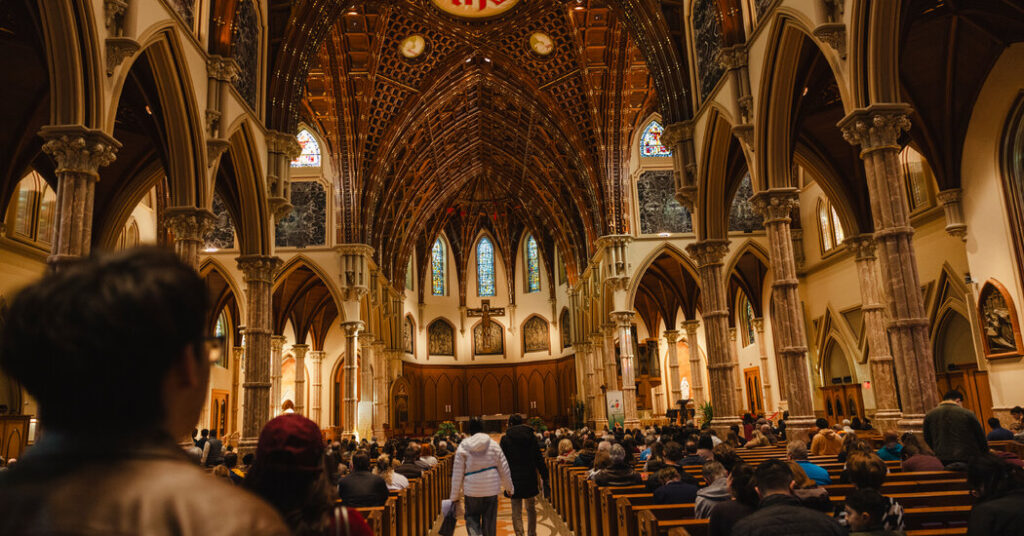
People are joining the Roman Catholic church in surprising numbers.
This Easter the Archdiocese of Detroit will receive 1,428 new Catholics into the church, its highest number in 21 years. The Archdiocese of Galveston-Houston will have its most in 15 years. In the Diocese of Des Moines, the count is jumping 51 percent from last year, from 265 people to 400.
The first year after the election of Pope Leo XIV, the first pontiff from the United States, many Catholic churches across America are welcoming their highest numbers of new Catholics in recent years. The newcomers are set to officially be received into the church during the Easter Vigil Mass, the night before Easter Sunday on April 5.
Bishops are buzzing about the surge, and confounded by what is behind it.
“Of course we think the Holy Spirit is,” Cardinal Robert McElroy of Washington said. “But we are kind of stymied.”
His own archdiocese is set to have 1,755 people enter the church this Easter, up from last year’s 1,566, which had already been the highest number in at least 15 years, according to the archdiocese’s records. Others have noticed similar trends.
“‘What is your number? What is your number?’” Cardinal McElroy recounted a huddle of bishops asking one another between sessions at a recent conference.
Each diocese has its own process for tracking conversion data, making a reliable, real-time accounting difficult. The Times gathered data from two dozen dioceses, including some of the country’s largest, like Los Angeles and Phoenix, as well as rural and smaller ones like Gallup, N.M., and Allentown, Pa.
Each reported a significant jump.
Respondents pointed to a range of possible reasons, including the desire for community, social and political instability, outreach to young people and technological change.
“In our age of uncertainty, and in our age of great anxiety, is a thirst and hunger for God and stability that faith brings to people’s lives,” said Archbishop Mitchell Thomas Rozanski of St. Louis, where the reported numbers have not been this high since 2016.
Two significant societal shifts have upended human sense of community in recent years, pushing people toward Catholic faith, he said.
“I think technology has isolated us from one other. I think that Covid just really magnified that isolation,” he said. “We are realizing many of the ills of our society, particularly anxiety and depression, come about from that isolation.”
He has found the loneliest group of people entering the church to be those ages 18 to 35, a cohort several dioceses noted had experienced particular growth.
Many dioceses said that there had been a drop during the coronavirus pandemic, when many in-person church activities stopped. But in many cases, this year’s numbers go beyond making up for that dip. In Philadelphia, the new total is double what it was in 2017. In Newark, 1,701 people will join the church this Easter, compared with 1,000 in 2010.
The broader Christian population in the United States has been stable for several years after years of decline, according to a survey from the Pew Research Center last year.
Orthodox Christianity has also experienced a striking influx of new adherents recently. It is unknown if the same trend is playing out across all organized religions.
In interviews, people joining the Roman Catholic church described their reasons as highly personal, not necessarily connected to Leo’s election.
Jacqueline Chavira, 41, from Grants, N.M., is joining the church this Easter with her two children. She had been baptized as a child but never confirmed as a Catholic, and instead grew up as a Jehovah’s Witness. She pulled away from all of it as a young adult, she said, but something changed when she became a mother.
“There was a void in me that I couldn’t fill,” she said. Then she met her fiancé, who is Catholic, started going to Mass with him, and wanted to have a Catholic marriage. Pope Leo had nothing to do with her decision, she said.
“For me it is way more personal, way smaller, just having my kids the way I want to raise them, the way I want to run my home with my husband, and live our lives,” she said.
Only 8 percent of the roughly 53 million Catholic adults in the United States are converts, according to a Pew Research Center study last year that found that marriage was a main reason for joining. Other reasons included spiritual fulfillment, friends and family.
Joining the Catholic Church as an adult typically involves a process of taking classes known as the Order of Christian Initiation of Adults. Occasionally, it can instead involve a more private, bespoke study, as was the case for America’s most high-profile convert Vice President JD Vance, who joined the church in 2019 at the age of 35.
The path and rituals can differ slightly, depending on whether one has no previous connection to the church, has already been baptized, or is coming from a different branch of Christianity.
The night before Easter Sunday, at the annual Easter Vigil Mass, newcomers receive sacraments of baptism, confirmation and eucharist, and are officially initiated into the church.
In some cases, new media and online voices have outstripped local church leaders as formative forces.
For Jesse Araujo, 19, in Pahrump, Nev., a rural part of the Archdiocese of Las Vegas, the biggest influence in drawing him to the faith was listening to Catholic podcast stars he found on YouTube, like Father Mike Schmitz. He went to Mass only a few times before joining the O.C.I.A. process.
“A lot of people spend their time scrolling through TikTok — my version of that is apologetics,” he said, referring to speakers who make arguments for faith.
He felt an obligation after learning about the sacraments.
“I follow Jesus — Jesus left a church, I should follow that church,” he said. Now both of his parents are taking O.C.I.A. classes, too, he said, which made him feel a sense of pride.
In Detroit, Sharon Kalil, 26, will enter the church this year through the Cathedral of the Most Blessed Sacrament.
She was raised Jewish and described her young adult self as atheist, but last summer she started visiting churches. “It’s hard to explain — it just really felt like a calling on my heart,” she said. When her friend who had recently converted invited her to visit the cathedral, a priest and a deacon personally welcomed her.
The first time she decided to pray, she prayed that she and her husband, who is not Catholic, would conceive amid fertility struggles. The next day she found out she was pregnant, and it felt like a divine sign, she said. When she later miscarried, the only place she wanted to be was in church.
“The way the community just wrapped me in prayer, wrapped me in love, and had supported me through that difficult time, really just affirmed that I was in the right place,” she said.
Amen-Ra Pryor, 23, a Ph.D. student in mathematics at Howard University in Washington, started his freshman year of college during the pandemic and struggled with depression and finding community. He grew up nonreligious and agnostic, but new friends introduced him to nondenominational churches.
Over time he began exploring “the deeper questions,” he said, “like, what does it mean to live a good life and to do good, and what is faith, and is faith reasonable?”
He started reading ancient philosophy from Christian thinkers, and watched YouTube videos from Catholic apologists, like the Thomist Institute and Taylor Marshall. When he moved to Washington, he started attending mass at St. Augustine’s, a congregation started by emancipated Black Catholics before the Civil War, where he will be formally received into the church at the Easter Vigil.
He is particularly drawn to the church’s teaching on suffering, which he said helps him get through difficult trials, and he appreciates going to confession. “To actually be able to audibly hear, ‘Your sins are forgiven,’ is also very important,” he said.
Already, the Diocese of Cleveland is preparing for next year.
“The next Rite of Election and call to Continuing Conversion will be at 10 a.m. on Saturday, Feb. 13, 2027 at Cleveland Public Auditorium,” a notice on its website stated. “Please plan now to attend!”
Elizabeth Dias is The Times’s national religion correspondent, covering faith, politics and values.
The post Roman Catholic Churches See a Surge of New Converts appeared first on New York Times.