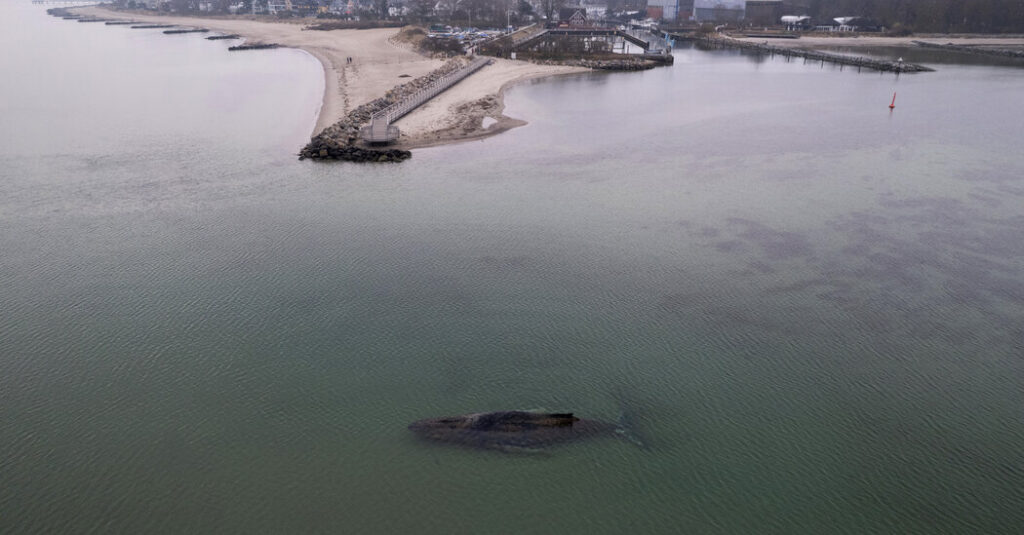
Rescuers were racing on Wednesday to save a 32-foot humpback whale that had been stuck for more than two days in the shallow waters off the Baltic coast in northern Germany.
The whale, most likely a juvenile male whose fin and a part of its back were poking out of the water, was making deep noises, said Carsten Mannheimer, the technical manager at the marine conservation organization Sea Shepherd.
“The whale can survive around five to six days in this state if he’s healthy enough,” said Mr. Mannheimer, who was part of the rescue efforts.
Marine rescuers said the whale, which could weigh 15,000 kilograms, about 33,000 pounds, would have a higher chance of survival if it swam into deeper waters in the Baltic Sea on its own, rather than being pushed or towed.
Members of the public spotted the whale early Monday and a team of experts arrived soon after. First, rescuers steered big boats near it to generate enough waves to keep its skin wet.
Next, from a small inflatable boat, four rescuers were able to remove a part of a fishing net in which the whale had been entangled. On its own, the whale turned around to face the other direction, but remained parallel to the coastline and was no closer to deeper waters, Mr. Mannheimer said.
On Monday night, at higher tide, the whale moved a few meters into deeper waters, but soon turned around and returned to the sand bank.
“It may be that he was swimming and noticed he was too weak and couldn’t hold himself over the water,” said Mr. Mannheimer, who has been involved in rescues of seabirds and seals, but never a whale. While whales are not typically seen in the Baltic, he said, occasionally they end up there after following food sources or a current.
On Tuesday, rescuers tried another approach. They used an excavator to try to suck sand from the bottom of the bay and create a trench in front of the whale, but they soon realized the sand was too compact to be moved. They ordered more powerful machinery, which arrived on Wednesday afternoon and was expected to be put to use early on Thursday.
Sven Partheil-Böhnke, the mayor of the municipality of Timmendorfer Strand, said he was unavailable to comment on Wednesday because he was at the site, where another rescue attempt was taking place.
Stephanie Gross, at the Institute for Terrestrial and Aquatic Wildlife in Hannover, said in interviews with local news outlets that it was possible the whale was too sick to swim on its own and might become stranded again. “This is nevertheless an attempt we want to make, and we’ll see what we can do without putting the animal at further risk or injuring it,” she said.
Lucy Babey, the deputy director of Orca, a British whale and dolphin charity, said it was imperative that members of the public stay away, since a crowd could add to the whale’s distress. “This animal needs to conserve as much energy as possible to have the best chance of swimming out to the deeper waters,” she said.
A major risk for the whale is that resting on a seabed puts huge pressure on its internal organs. “Every hour that goes past, it reduces the likelihood of the animal being able to swim out,” she said.
Jenny Gross is a reporter for The Times covering breaking news and other topics.
The post Rescuers Race to Save a 32-Foot Humpback Whale Stranded Off a German Beach appeared first on New York Times.