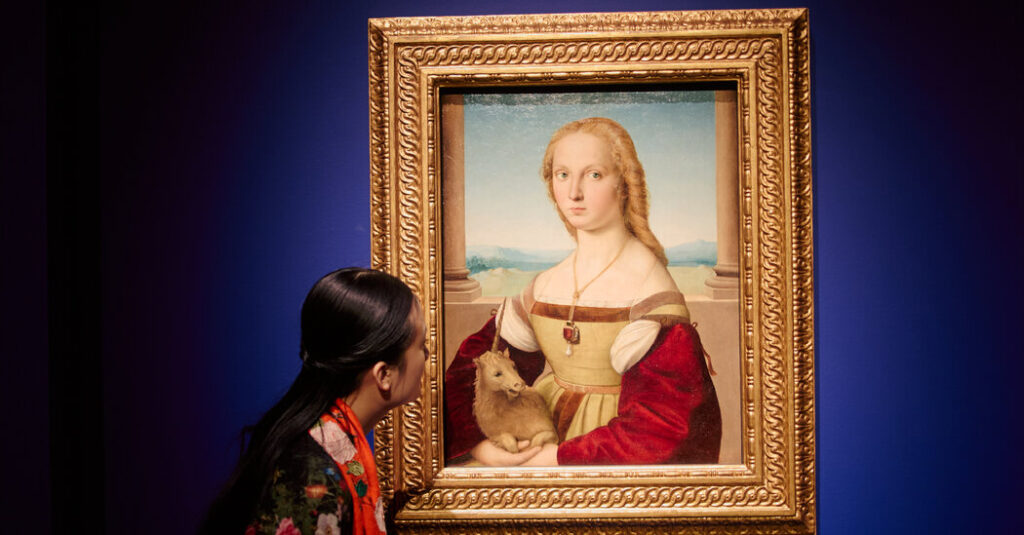
Why is she holding a unicorn?
A little baby unicorn: a foal with soft fur, a snub nose, a smooth muzzle, and a horn like a narwhal’s tusk spiraling up to heaven. The maiden that Raphael painted around 1505 cradles the critter, tender and tame. She’s sitting upright, at a slight angle, in this half-length profile. She’s gazing out and to the side: the same breath-of-life pose in which Leonardo placed a brunette named Lisa a few years before.
But why a unicorn? For status, perhaps: The mythological beast was an emblem of the Farnese family, one of Italy’s grandest dynasties. Or perhaps for marketing. Only a virgin could tame the dangerous unicorn, the legend went, and the wealthy sitter here was probably on the marriage market, advertising her chastity. (Always check the jewelry: a chunky ruby around her neck, but no ring on her finger.)
Look at the hands, though. How the maiden wraps her thumb and forefinger around the beast’s front hoof. The effortless show-off move of the unicorn’s tufted fur brushing her wrist. Virtue, purity, fecundity, charm: It’s as if Raphael is sabotaging himself. The blushing bride-to-be embodies feminine virtues to a degree present only in unicorn land. She is so beautiful she is not real.
The “Portrait of a Young Woman with a Unicorn” has traveled from Rome to New York for an exhibition of such sublimity and grace it is hard to square with the cold world outside. “Raphael: Sublime Poetry,” opening at the Metropolitan Museum of Art this weekend, is one of those blockbusters we used to take for granted in the United States — before the explosion of shipping and insurance costs, and less metaphorical explosions too — and, for the next three months, you have the chance to rediscover a Renaissance man who gave painting and drawing, tapestry and architecture, a radiance not reached since ancient times.
The show is a beauty, but not the kind you would chat up in a bar. Raphael’s is a forbidding, imposing beauty: the sort that seems to reflect the divine, and make us look puny by contrast.
A beauty and, if I may borrow for just a second the slang of the Silicon Valley low church, a unicorn itself. “Raphael: Sublime Poetry” took eight years to organize. It cost untold millions. It required five dozen lenders. No American museum, the Met says, has ever presented a full-scale exhibition on this prince of painters, and logistics are not the only reason.
In 1520, after Raphael died on Good Friday at the age of 37, Romans came out for a citywide deification ceremony that ended with his interment at the Pantheon. (“Why be surprised that you died on the day Christ died?” went one rather sacrilegious eulogy. “He was the God of Nature, you were the God of Art.”) For centuries after, his name was the supreme synonym for artistic genius.
But when classical ideals fell by the wayside, Raphael lost his pre-eminence too. Modern eyes gravitated to the sultry naturalism of Caravaggio, or the secular silences of Vermeer: neither a household name before 1900. Whereas this titan of the Renaissance came to seem just a little too perfect. His numerous sensitive depictions of the Madonna and Child, in particular, receded into Christmas-card staples. Teen tours at the Vatican now hustle through the Raphael Rooms, including the magisterial “School of Athens,” on their way to the Sistine Chapel and the gelato stand.
Reintroducing Raphael to contemporary audiences — our concentration shot, our Bible studies patchy, our palates scorched by sriracha — is the goal here of Carmen C. Bambach, a longtime Met curator. This is the last in a trilogy of shows she has organized of the three most renowned artists of the Italian High Renaissance. A Leonardo blockbuster opened in 2003. A hulking Michelangelo survey ran from 2017-18. (Donatello, the fourth Ninja Turtle, worked three-quarters of a century earlier.)
She does not try to make Raphael modern, except for a few unconvincing sallies comparing printmaking to social media. Her strategy is to re-humanize this lapsed god of painting by packing the gallery with drawings: 140 of them, alongside 33 paintings, to show the year-by-year, day-by-day work of a country boy who became the right hand of two popes. We’ll see, I guess, whether these draw the same pilgrims as Leonardo’s nifty inventions or Michelangelo’s brawny saints. For my own part, I left awe-struck, and intimidated too.
Because painting did not look quite so flawless when Raffaello di Giovanni Santi was born in Urbino in 1483. His father painted and wrote epic poetry, but two other influences in central Italy would be even more decisive. One was the court, which the duke of Urbino had turned into one of the most sophisticated and refined on the peninsula: a home for poetry, dance, masques and the patronage required for them. (An earlier son of Urbino is my No. 1 Renaissance man: Donato Bramante, friend of Raphael and architect of St. Peter’s.) Urbino in the late 15th century was a hilltop redoubt of a new humanism, reflected in this show through an architectural fantasia of a geometrically perfect city, not to mention the Met’s slightly campy exhibition design of cutout arcades.
The other was Pietro Perugino, in whose Umbrian studio Raphael learned both the fundamentals of painting and the workings of papal and ducal commissions. Looking at master and student side by side, you see how Raphael adopted Perugino’s precise line, his otherworldly clarity. But where Perugino hewed to an older hierarchy — Christ and Mary biggest, the angels and donors smaller; your spiritual significance determines your height — Raphael’s early altarpieces present a shocking new naturalism. Suddenly, the saints and sinners are scaled like humans are. Like they’re in real, tangible spaces: a technique he may have picked up from the new, Netherlandish art that the Urbino court collected in bulk.
He struck out on his own, he made grand altarpieces and smaller pictures for private worship, and at the turn of the 16th century he went up to Florence. All the artists there were talking about a painterly battle royale, as two giants of the trade labored over murals on opposite walls of the Palazzo Vecchio. In this corner: Michelangelo, whose mastery of anatomy and the male nude made the young Raphael jealous. In that corner: Leonardo, hasty, experimental, blasting through a dozen ideas in his sketchbook while Raphael was still working from exact preparatory drawings.
Neither mural survives. But Bambach evokes the influence of these older rivals on the young Raphael through dozens of sketches and cartoons — including an illuminating sequence of efforts to work out the figures in an Entombment, with Greco-Roman space-making and Leonardesque lines. Many famous Raphaels that didn’t travel — the “Madonna of the Meadow” in Vienna, the “Sistine Madonna” in Dresden, the later “Transfiguration” at the Vatican — are represented through drawings of greater or lesser refinement. The show can get very academic in these moments. Specialists are going to delight in fighting over attributions and dates, though you may wonder if you need to see yet another sheet of the Christ child’s stubby thighs. (The catalog, too, is a pitiless thing, with no individual entries for the show’s paintings and drawings; Bambach has written a single giant essay running almost 300 pages.)
Yet there are moments of harmony here between painting and drawing, between hand and mind, of such artless magnificence that the world goes thin. Raphael’s vivid “Alba Madonna,” from around 1510, luxuriates in the luscious blues of Mary’s mantle and the geometric balance of its circular composition. When I’ve seen it in Washington, it’s always struck me as flawless but also impenetrable, as perfect circles are.
Here at the Met, though, the “Alba Madonna” appears with an arresting and much more human preliminary study — for which the model for Mary is a young man, presumably an assistant in Raphael’s workshop. Left leg extended, right pulled back. Right arm outstretched, left elbow thrust out. The Mother of God appears ethereal, but the image was built from life.
The touch that makes Raphael’s Madonnas so tender can become provocative, and even lascivious, in his portraits. Facing the “Young Woman with a Unicorn” is another loan from Washington, of the debonair young papal banker Bindo Altoviti, turning his head back to us with androgynous wiles. Again, the real runs right into the ideal: Look at the care Raphael lavished on his wispy blond sideburn, the lips touched with vermilion. Altoviti is moving up, from Rome to Olympus. (Well, when you are young and rich and beautiful, you may as well flaunt it.)
Another classicization is his “Fornarina,” or female baker: a young woman raising a sheer veil to her still-uncovered breasts, in the manner of countless marble Venuses. Scholars assume the subject was Margarita Luti, one of Raphael’s models and mistresses, whose father ran a bakery.
He was still only 25 when he got to Rome, yet his reputation as a modernizer — plus the connections of Bramante: Urbino boys stick together! — convinced Pope Julius II to invite Raphael to decorate the room that would define his legacy for centuries. That was the Stanza della Segnatura, the first of four Vatican chambers now known as the Raphael Rooms (or just stanze), which the Met tries to evoke with projections at three-quarter scale. They cycle too fast — just 15 seconds per room — and the images appear bleached out, so before you enter the video reproduction, navigate the forest of drawings Bambach has gathered. Blind Homer looks skyward. Adam gazes back over his shoulder. Pythagoras and his disciples are ready to face Christ in heaven. In this room, at this time, where Raphael married the Bible to Greco-Roman antiquity, the past became not just something to emulate but to exceed.
Like I said, it’s intimidating — and we haven’t even come to the Sistine Chapel tapestries, magnificent visions of the Gospel so lush they drove the papacy of Leo X into bankruptcy. (But when you go broke there is always someone richer. The three tapestries here are second editions, made for the king of Spain.)
But the real challenge, and also the merit, of the Met’s Raphael blowout isn’t its quantity; it’s how it defies modern expectations. The sweet Madonnas and philosophizing Greeks we now find so removed from our time were once, in the early 16th century, endeavors to reinvent everything — ideal visions from “the firstborn among the sons of modern Europe,” as the Swiss historian Jacob Burckhardt called Raphael’s generation.
Because the whole point of the Renaissance, articulated in every stroke and scratch of this exhibition, is that the past could never be reattained, not as it was before. It was only a guide, a model, to live a finer life in your own times. When Plato and Aristotle stare you down at the Vatican, when the Madonna looks as serene as Lake Trasimeno, when a woman with a unicorn promises this world can be better, you are witnessing not antiquity being reborn but human nature itself. Only that rebirth, that inner renaissance, could give a pope the confidence to tear down St. Peter’s, and to let a young man loose on the walls.
Raphael: Sublime Poetry From March 29 to June 28. Metropolitan Museum of Art, 1000 Fifth Avenue, Manhattan; 212-535-7710, metmuseum.org.
Jason Farago, a critic at large for The Times, writes about art and culture in the U.S. and abroad.
The post Raphael and the Renaissance of Divine Beauty appeared first on New York Times.