Embedded in the DNA of the Public Theater is a belief in drama as a civic sacrament — of the stage as a place for contemplating democracy and what it means to be an American in the world. The new play “Public Charge” sits squarely in that tradition.
Written by Julissa Reynoso, a diplomat in the Obama and Biden administrations, and Michael J. Chepiga (“Getting and Spending”), it is a memoir of sorts — “inspired” by Reynoso’s years as a deputy assistant secretary of state under Hillary Clinton, and then as ambassador to Uruguay.
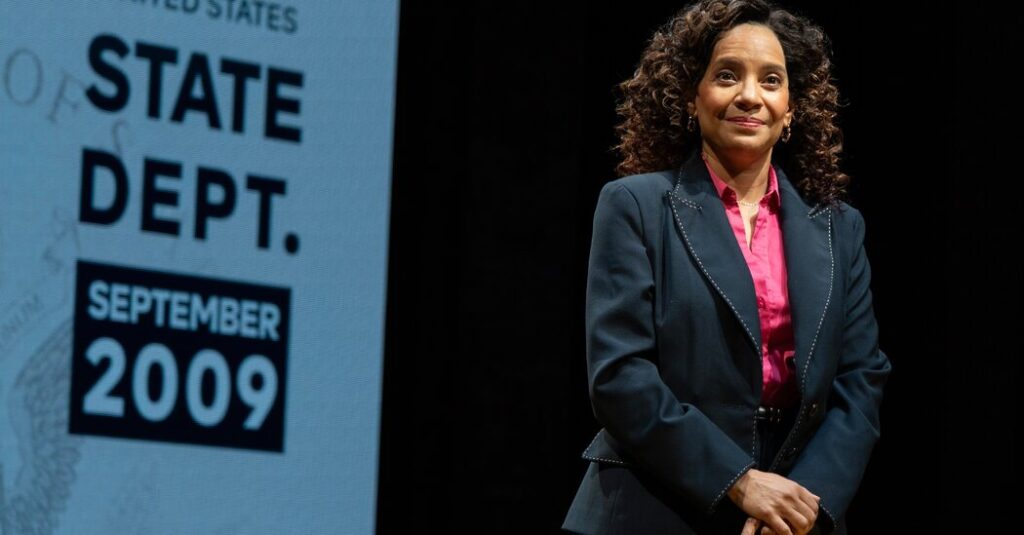
Directed by Doug Hughes with a clarity that elevates the text, and starring a warmly appealing Zabryna Guevara as Julissa, it turns out to be a pretty absorbing story. That’s especially true if you’re wonkily inclined or in need of reassurance that some people taking government posts do have service in mind. What this occasionally didactic show ponders, in part, is how to be a force for good for the country you love.
It gets off to a rough start, though, with the opening scene. It is 1981 in the Dominican Republic, and Julissa, 6, is visiting the United States Embassy with her uncle, seeking a visa to join her mother in the Bronx.
A consular official spits clichés about “welfare mothers” and “people like you on food stamps,” telling young Julissa that “in America we speak English.” He denies her application. In his judgment — and despite her mother having a job — Julissa is likely to become a public charge: “dependent on the United States government for her subsistence,” he says. (Reynoso was 7 when she immigrated in 1982.)
When we next glimpse Julissa, interviewing for a job at the State Department in 2009, she of course has a different kind of public charge in mind — the commands and obligations of the government. Ivy League-educated and unpretentious, she is so politically connected that the unseen Clinton has encouraged her to apply.
Trump Administration: Live Updates
Updated
- The war will push U.S. inflation above 4 percent this year, according to a new forecast.
- The U.S. military kills 4 people in a boat strike in Caribbean.
- Trump calls for a law cracking down on crime and ‘rogue judges.’
Julissa’s forbidding new boss, Cheryl (Marinda Anderson), and career officer underling, Ricardo (Dan Domingues), seem at first two-dimensional, but fear not: Like the show, their portrayals deepen rewardingly, growing funnier and more personable.
With Julissa assigned to oversee Caribbean and Central American affairs, Cuba emerges as a nexus in this sprawling play. Efforts to normalize U.S.-Cuban relations collide stubbornly with mutual suspicion around the release of prisoners — notably Alan Gross, the government subcontractor (for the United States Agency for International Development) arrested by the Cubans in 2009 and accused of spying.
Julissa’s conversations with Gross’s worried wife, Judy (Deirdre Madigan), are emotionally anemic, but they may improve as Madigan, who took over the role in previews, settles in.
After Julissa becomes ambassador to Uruguay, another potential prisoner release figures affectingly: that of a half-dozen men whom the United States has held without trial for more than a decade at Guantánamo Bay. She lobbies the sympathetic Uruguayan president, José Mujica (a lovely Al Rodrigo), to take them. He just wants to be sure that the prisoners truly wish to come. Armando Riesco is a standout as Chacha, the right-hand man who travels to Guantánamo Bay to ask.
Employing a cast of 12 that includes a fine Maggie Bofill as a Cuban deputy foreign minister, this might have been a cluttered-feeling play. But Hughes’s staging — like Arnulfo Maldonado’s set — has a pared-away meticulousness. The audience sits on two sides of the action in the Newman Theater, where the blocking and the placement of video screens aim for optimum inclusion. (Video is by Lucy Mackinnon.)
“Public Charge” is a sometimes awkward paean to getting your hands dirty, doing the intrinsically human work of diplomacy and trying to make positive change in a messy world. (A program credit notes that the play is “produced by special arrangement with” Clinton, which a Public spokesperson said meant she had granted permission for references to be made to her in the script.)
The play ends in late 2014, with Julissa surveying the political landscape, envisioning a future very different from what actually followed. The audience laughs ruefully, but her final line overrides defeatism.
“The best is yet to come,” she tells Ricardo. “You’ll see.” And she smiles so sunnily, so certainly, that we think: Maybe.
Public Charge Through April 12 at the Public Theater, Manhattan; publictheater.org. Running time: 1 hour 40 minutes.
The post ‘Public Charge’ Review: The World Is Messy. Being a Force for Good Is, Too. appeared first on New York Times.