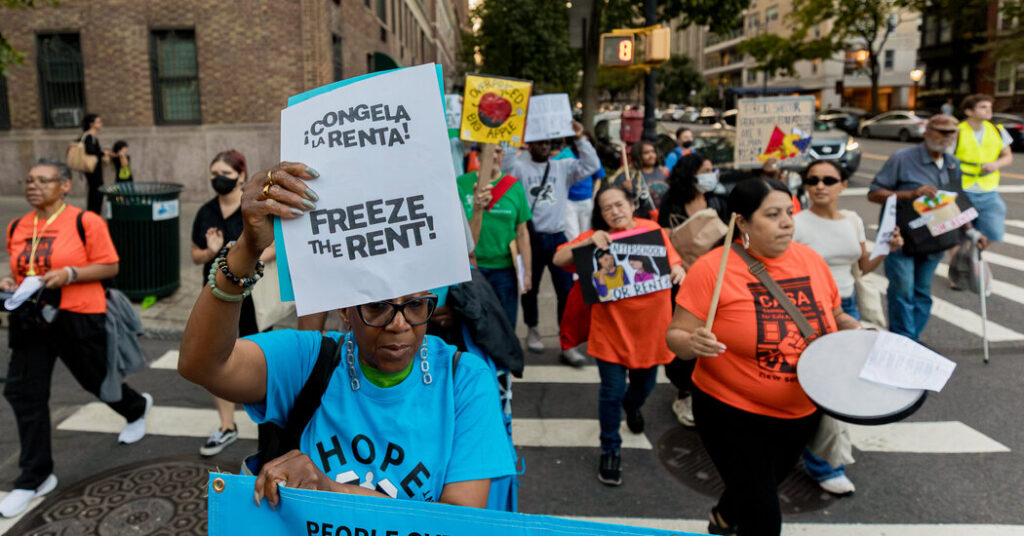
Mayor Zohran Mamdani’s plan to “freeze the rent” seemed straightforward enough during his campaign.
Rents in the city’s nearly one million rent-stabilized apartments would not increase at all during his first term, he said. To accomplish this, he planned to appoint people to the panel that decides on increases only if they shared his empathy toward tenants’ struggles.
“That’s the mayor’s power,” Mr. Mamdani said in June. “We have these tools. It’s just a question of, Do we want to do this?”
The reality may be far more complicated.
The nine-member panel, known as the Rent Guidelines Board, meets for the first time on Thursday, beginning a monthslong process that will ultimately decide whether a rent freeze is enacted. The members will face intense pressure to balance the interests of renters and landlords, all while knowing that their choices will be seen as a reflection of the mayor’s ability to enact his agenda.
Over the course of about a dozen meetings, the board will hear testimony from landlords, tenants, housing researchers, city officials and others, before taking a final vote in May or June.
Earlier this year, Mr. Mamdani appointed six of the panel’s nine members. His predecessor and political opponent, Eric Adams, had moved to thwart Mr. Mamdani by trying to stack the board himself before he left office, but he was unsuccessful.
The panel will consider how the city has grown increasingly unaffordable for renters — more than half are “rent-burdened,” meaning they spend at least 30 percent of their income on rent.
“I trust that they will consider all the factors facing the city’s rent-stabilized tenants and come to an appropriate decision,” Mr. Mamdani said in February when he announced the appointments. “Together we are building a city where every person can afford a roof over their head.”
But the panel will also take into account the fact that some landlords, particularly those with older or smaller buildings, are increasingly struggling, according to the panel’s own data and a growing number of housing experts.
At its meeting on Thursday, the panel is expected to analyze new data on property owners’ income and expenses, which is likely to show a big difference in the financial health of newer buildings in Manhattan and older buildings in other boroughs.
The real estate industry has accused Mr. Mamdani of seeking to exercise undue influence over an independent panel. (Since taking office, the mayor has backed away from explicit calls for a rent freeze, mostly saying that he thinks tenants “deserve” one.) While other mayors have faced similar accusations, landlords are widely expected to file a lawsuit if the panel does vote for a freeze this year.
Rent-stabilized apartments are home to a vast and diverse set of people. The system covers some 40 percent of all of the rental apartments in New York City. Tenants pay median rents of around $1,500 — $1,360 for studio apartments and nearly $1,530 for two-bedrooms, for example — compared with around $2,000 for market-rate apartments.
Like most rentals, the increases vary year to year and depend on whether a household takes a lease term of one or two years. But, for rent-stabilized apartments, those increases are restricted by law to a certain percentage, decided by the Rent Guidelines Board.
Most rent-stabilized apartments are occupied by lower- or middle-income people: The median household income for rent-stabilized tenants is about $60,000, compared with $90,800 for market-rate households, according to a 2023 city survey. More than one-quarter of all rent-stabilized households earn less than $25,000 a year.
But anyone can live in a rent-stabilized apartment, and the system covers the homes of higher-income people too.
About 7 percent of rent-stabilized households earn between $150,000 and $200,000, according to an analysis of city housing data by the Citizens Budget Commission, a nonprofit fiscal watchdog, and pay a median rent of about $1,870. Another one in 10 rent-stabilized households earn at least $200,000, according to the analysis, and their median rent is $2,200.
Developers often receive tax breaks in exchange for keeping newer, more expensive units rent-stabilized. According to the panel’s most recent analysis, the city added nearly 15,000 rent-stabilized units in 2024, which had a median rent of more than $3,100.
The rent was frozen on one-year leases three times in the past decade, including when the city was reeling from the Covid-19 pandemic. Last year, the panel voted to allow increases of 3 percent on one-year leases, and 4.5 percent on two-year leases, as property owners complained about needing more money to cover rising costs.
Rent stabilization was put in place in the mid-20th century to protect New Yorkers from sharp rent spikes when housing was scarce and landlords wielded a lot of power. It was meant to protect against eviction, displacement and instability.
Some pro-housing advocates have joined landlords in opposing rent control schemes. People tend to stay in the units a long time, reducing mobility and the overall supply of housing, which in turn makes housing more expensive, especially in the long run.
But tenants’ rights advocates say rent stabilization is necessary, because of how expensive market-rate housing is in New York City.
By law, the Rent Guidelines Board must consider the “economic condition of the real estate industry” and the cost of living in deciding whether rents can increase each year. The board’s decisions, though, tend to reflect the political priorities of the mayor.
Still, the panel’s yearly vote, and the meetings leading up to it, create a huge amount of tension between tenants’ advocates and landlord interest groups. The chair of the Rent Guidelines Board, Chantella Mitchell, who was appointed by Mr. Mamdani, declined to comment on the board’s plans for the year.
Mihir Zaveri covers housing in the New York City region for The Times.
The post Mamdani Promised to Freeze the Rent. Now the Fight Begins. appeared first on New York Times.