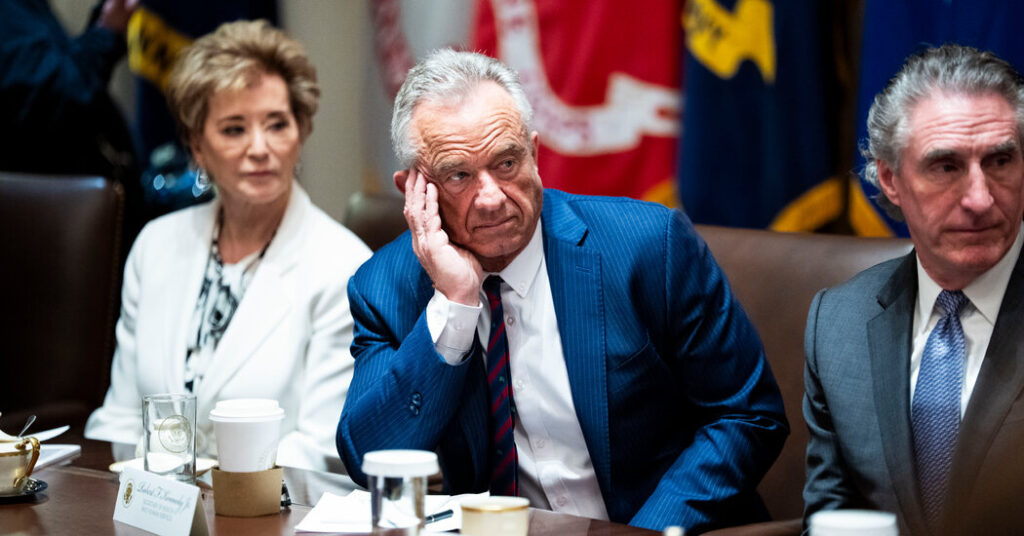
Health Secretary Robert F. Kennedy Jr.’s crusade to scale back Americans’ reliance on vaccines has collided with political and legal realities that have endangered the Senate confirmation of one top health official, delayed the nomination of another and diminished his clout in Washington.
A string of developments over the past several weeks have put Mr. Kennedy’s vaccine agenda at risk. The confirmation of Dr. Casey Means, President Trump’s nominee for surgeon general, is stalled on Capitol Hill, where three Republicans on the Senate Health Committee, including its chairman, have expressed concern about her views on vaccines.
On Thursday, Mr. Trump missed a deadline to nominate a permanent director for the Centers for Disease Control and Prevention, leaving the agency officially leaderless. The White House is trying to find someone who fits with Mr. Kennedy’s broader health agenda but whose views of vaccines are conventional enough to win Senate confirmation.
Last week, a federal judge blocked Mr. Kennedy’s changes to the childhood vaccine schedule. And on Wednesday, Dr. Jay Bhattacharya, who is running the C.D.C. even though his time as acting director has expired, made the new normal clear.
“I think it is vital that every kid in this country get the measles vaccine — absolutely vital,” he said, according to a recording obtained by The New York Times, adding, “Bobby’s fine with me saying that.”
All told, it is a major setback for Mr. Kennedy, whose Make America Healthy Again movement and his legion of mostly white, mostly female followers — the so-called “MAHA Moms” — helped power Mr. Trump to victory in 2024. Speculation has lately been swirling in Washington that he will leave his job running the Department of Health and Human Services, but his closest adviser, Stefanie Spear, dismissed it.
“In its first year, H.H.S. has driven the most sweeping public health reforms in modern history,” Ms. Spear said in an email statement, adding, “Secretary Kennedy is proud to serve and will continue to do so as long as he can be useful to the president and deliver results for the American people.”
When Mr. Kennedy abandoned his own independent presidential bid to join forces with Mr. Trump in August of 2024, the excitement around him in Republican circles was palpable. Conservatives who dismissed the first lady Michelle Obama’s healthy eating initiatives as “the nanny state” were suddenly talking about raw milk and organic food.
In the year that he has been secretary, Mr. Kennedy has leveraged his movement and his celebrity to make strides on policies unrelated to vaccines. He has persuaded leading food manufacturers to remove artificial dyes from their products and has convinced more than 50 medical schools to expand nutrition education for aspiring doctors.
He has revamped the nation’s dietary guidelines and initiated a review of infant formula to make it more nutritious. His spokesman, Andrew Nixon, says Mr. Kennedy is “focused on the priorities Americans consistently say matter most to them,” including improving nutrition, tackling chronic disease and lowering prescription drug prices.
His muscular physique (sculpted with the help of testosterone supplements) has become familiar to millions of Americans who follow him on social media, where he has drawn both adulation and scorn for his over-the-top videos, including a bare-chested workout with the singer Kid Rock and cartoonish segments portraying him as an action figure.
But Mr. Kennedy’s vaccine agenda — his insistence that vaccines are somehow linked to autism, despite a lack of evidence — has always been a bit of an Achilles’ heel.
His advisers tried to get him to downplay it during his confirmation hearings, worried that it would put off senators like Bill Cassidy of Louisiana, a Republican physician who is chairman of the Senate health committee and is a fierce advocate on vaccination. But Mr. Cassidy voted reluctantly to confirm Mr. Kennedy, and the secretary forged ahead.
Polls now show that Mr. Kennedy’s vaccine agenda is a dud, unpopular even with Republicans. And that has created discomfort inside the White House, which has made clear its desire for Mr. Kennedy to downplay talk of vaccines while emphasizing his more popular healthy-eating agenda.
“Our poll highlights strong bipartisan support for routine childhood vaccines in the nation’s most competitive House districts, with majorities across political affiliations acknowledging their benefits and safety,” the Republican pollsters Tony Fabrizio and Bob Ward reported in December.
They added that although the Make American Healthy Again agenda was “broadly popular” regarding food and agriculture, “vaccine skepticism stands as an outlier, rejected by most voters even within the MAHA movement.”
There is no indication of personal tensions or distance between Mr. Trump and Mr. Kennedy, and people in the secretary’s orbit say he maintains good relationships with Susie Wiles, the White House chief of staff, and Vice President JD Vance, who has embraced Mr. Kennedy’s MAHA agenda.
In an interview with STAT, Chris Klomp, who as the health department’s chief of operations is running the search for a new C.D.C. director, said he was approaching with a “very formal, very structured process,” and declined to say how his questioning of candidates might be different from Mr. Kennedy’s.
In the end, Mr. Klomp said, “it’s the secretary’s choice and the president’s choice.” But during an “Eat Real Food” rally in Austin, Texas, last month, Mr. Kennedy said the president gave him unusually broad discretion over personnel decisions after he won the White House a second time in November 2024.
“He allowed me to pick all of my agency heads, and that has never been done,” Mr. Kennedy said at the time. “H.H.S. secretary does not get to pick who’s head of C.D.C., F.D.A., N.I.H., et cetera. And he let me choose all of those people.”
Mr. Kennedy chose Dr. Martin Makary to lead the Food and Drug Administration, Dr. Mehmet Oz to run the Centers for Medicare and Medicaid Services, and Dr. Bhattacharya, who is now doing double duty running the C.D.C., as director of the National Institutes of Health. All continue to run those organizations.
The C.D.C., whose vaccine policy recommendations guide the work of doctors and insurance companies, has been an outlier.
The secretary’s first pick was Dr. Dave Weldon, a Republican former congressman from Florida, to run the agency. But Dr. Weldon’s history of raising questions about vaccine safety, including in the early 2000s after a British doctor published a now-discredited study claiming that measles vaccines were linked to autism, doomed his nomination.
“I was hoping to sort of be an honest broker or a friend to all parties, and to try to get some answers on what’s causing the autism epidemic, try to get some better research on vaccine safety, but not burn the house down,” Dr. Weldon said in an interview late last year.
Instead, the White House was forced to withdraw Dr. Weldon’s nomination at the last minute. Dr. Weldon said Mr. Cassidy, who is facing a tough primary challenge this year, refused to support him. Having backed Mr. Kennedy, the senator was apparently unwilling to support another candidate who openly questioned vaccines.
Susan Monarez, who had initially served as acting director, was confirmed by the Senate in July. But Mr. Kennedy pushed her out 29 days later over her refusal to accept, without question, the recommendations of Mr. Kennedy’s handpicked vaccine advisers.
The secretary came into office in the thick of the worst measles outbreak the nation has had in 20 years. Rather than promote vaccination, he advised parents to “do your own research” and consult their pediatricians. He fired the entire membership of the Advisory Committee on Immunization Practices, or A.C.I.P., and installed new ones.
Six medical organizations, including the American Academy of Pediatrics, sued. Judge Brian Murphy, of the U.S. District Court for the District of Massachusetts, ruled last week that Mr. Kennedy and his appointees had made “arbitrary and capricious” changes to the childhood vaccine schedule.
Judge Murphy also deemed the majority of the new A.C.I.P members unqualified. The best-known of them, Dr. Robert Malone, abruptly quit earlier this week, saying that the judge had “slandered me” and that he had better things to do. In a text message, Dr. Malone said he was not pushed out.
“Rfk specifically and repeatedly asked that I remain,” Dr. Malone wrote.
Some C.D.C. watchers worry that the White House will refrain from appointing anyone, so as not to stir up more controversy.
“We’ve seen this movie before,” said Richard H. Hughes IV, the lead counsel for the plaintiffs in the case before Judge Murphy. “It seems like the administration is disinterested in having an actual permanent leader at the agency.”
The position of surgeon general has been vacant since Mr. Trump took office. At her confirmation hearing one month ago, Mr. Cassidy grilled Dr. Means on “promotion of vaccine skepticism.”
Dr. Means, who has written extensively about the link between diet and chronic disease and has not made vaccination a central issue, said she supported vaccines but believed that parents should consult their pediatricians — answers that did not seem to satisfy him.
On Capitol Hill on Thursday, Mr. Cassidy did not answer a question about when he might schedule a committee vote on her confirmation. His Republican colleagues Senators Susan Collins of Maine and Lisa Murkowski of Alaska, who have both indicated that they are not ready to support Dr. Means, also did not answer questions.
But Senator Ron Johnson, a Wisconsin Republican who is a strong ally of Mr. Kennedy and a fellow vaccine skeptic, said he was worried about the future of the secretary’s vaccine agenda. “Big Pharma’s bought off the media,” as well as medical colleges, Mr. Johnson said, adding, “We’re up against powerful interests.”
Sheryl Gay Stolberg is a correspondent based in Washington for The New York Times, covering Health Secretary Robert F. Kennedy Jr. and President Trump’s health agenda.
The post Kennedy’s Vaccine Agenda Hits Roadblocks, Diminishing His Clout appeared first on New York Times.