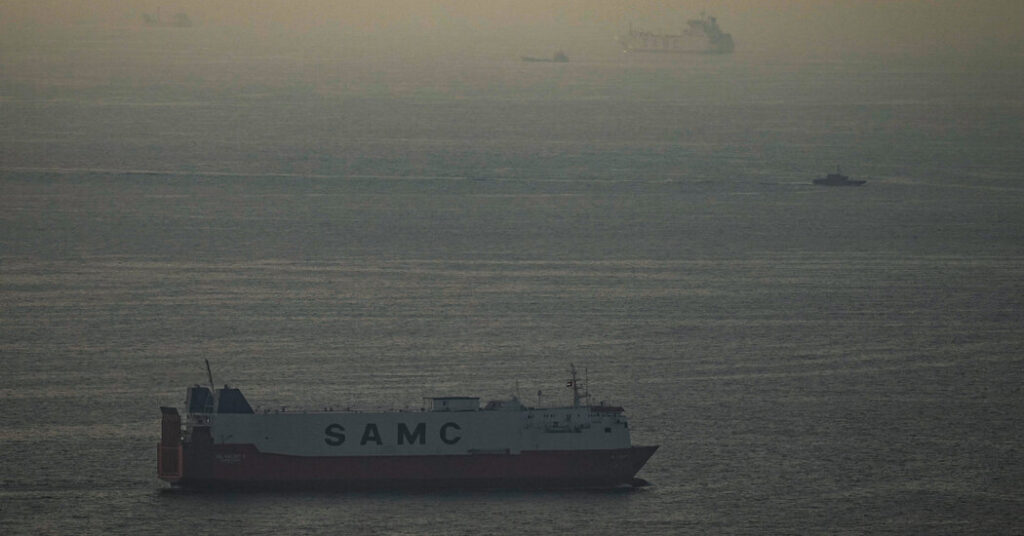
A month into its war with the United States and Israel, Iran is still using its stranglehold on the Strait of Hormuz to its advantage.
Fearing Iranian attacks, ship operators stopped sending their vessels through the strait. That has led to a sharp reduction in supplies of energy products — and a spike in oil and gas prices. The shortages have roiled the economies of many countries, especially those in Asia.
In recent days, Tehran has projected itself as the controller of the waterway, saying it will let ships from certain countries go through the strait, through which a fifth of the world’s oil and gas supplies travels in normal times. Iran has allowed the passage of a small number of ships, most apparently headed for Asia, but it has continued to threaten vessels linked to Israel, the United States and its allies.
Ship traffic through the strait is still at historically low levels. It is estimated that nearly 3,000 vessels are waiting nearby to pass through the strait, according to S&P Global Market Intelligence. Typically, roughly 120 ships pass through it each day.
On Thursday, President Trump said Iran had said it was going to let eight ships pass as a show of sincerity ahead of talks with the United States. Efforts to mediate a cease-fire have so far not been successful.
Every day tankers sit idle, the greater the stress on the global economy. And Iran’s policy of allowing a small number of approved vessels to transit the strait will not alleviate the pressures, shipping and energy analysts said.
“We have not yet seen a meaningful ramp-up,” said Ana Subasic, a trade risk analyst at Kpler, a maritime data firm. In the seven days through Wednesday, 28 vessels had made it through the narrow waterway, according to data from MarineTraffic, a division of Kpler. That number, which includes vessels trying to avoid detection, was up from 20 ships in the seven days through March 18.
Kpler says 18 ships in the Middle East have been attacked since the start of the war. Right now, there is not enough certainty to risk a passage, ship operators say.
“We’re looking for some kind of reassurances that the traffic can safely resume through the Strait of Hormuz,” said Jan Rindbo, the head of Norden, a Danish tanker company with seven vessels stuck in the Persian Gulf. “I think those signals are not yet there.”
In a letter circulated on Tuesday to members of the United Nations International Maritime Organization, Iran said that it would allow nonhostile vessels to go through the strait. It defined such vessels as those that “neither participate in nor support acts of aggression against Iran.” The definition excluded ships belonging to the United States or Israel.
Iranian officials had declared the strait open to certain ships before the letter.
Iran’s statements are “likely to encourage those states most exposed to shipping disruption to seek alternative mechanisms directly with Iran while the conflict is ongoing,” said Jack Kennedy, head of Middle East country risk at S&P Global Market Intelligence.
But while some shipowners may decide to take Iran up on its offer, many others will not because they can’t be certain their vessels won’t be targeted, analysts said. Iran may unilaterally determine that a ship has links to Israel or the United States and attack it.
“Because it is tricky to define ‘nonhostile’ vessels, I don’t expect companies to immediately start sending ships through the strait,” Noam Raydan, a senior fellow at the Washington Institute for Near East Policy, said in an email.
Another deterrent, she said, was Iran’s requirement that ships get permits, and that they coordinate with the country’s maritime authority. In normal times, vessels do not need Iran’s permission to go through the strait, which functions as an international waterway. “Iran is further complicating the shipping crisis,” Ms. Raydan said.
Shipping companies may also not want to pay fees to Iran. An Iranian parliamentary official recently said Iran was charging vessels $2 million to go through the strait.
Analysts said ships would be much more likely to return in large numbers if the United States and Israel agreed to a peace deal with Iran — but even then it could take weeks for tanker passages to return to normal.
The United States and Israel have been trying to destroy Iran’s navy and the weapons it can use to attack vessels. On Thursday, an Israeli airstrike killed an Iranian naval commander who played a pivotal role in shutting down the Strait of Hormuz, Israel’s defense minister said.
The United States has sent troops to the Middle East that in theory could be used to force a reopening of the Strait of Hormuz. But such operations might risk casualties and perhaps prompt Iran to attack more energy-producing facilities in the Gulf States.
Another complication for shipping is getting affordable insurance to cover the risks of sailing in a war zone. “War risk” insurance is available, but the cost of such coverage has soared, industry participants said.
Oscar Seikaly, chief executive of NSI Insurance Group, an insurance brokerage, said war coverage had leaped from almost nothing before the conflict to around 20 percent of the value of the ship or cargo. That was the cost of insuring a recent shipment of fertilizer from the Persian Gulf to Europe, he said.
Mr. Seikaly added that vessels would have to pay that rate each time they go through the Strait of Hormuz. He said statements from Iranian leaders saying the waterway was open to ships from countries not involved in war had prompted insurance companies to consider providing coverage during the war. “Otherwise, the insurance companies would have said, ‘No, I won’t do it for any cost,’” he said.
Shipping companies may be more likely to make the passage through the strait if they have a naval escort as protection. Three weeks ago, Mr. Trump said the United States might provide an escort. He later said other countries should assemble such a force.
The head of NATO said on Thursday that Europe needed time to “come together” to make sure the Strait of Hormuz is open for all countries.
Speaking in Brussels, Secretary General Mark Rutte said NATO members and other countries were planning how “to make sure that the Strait of Hormuz, the sea lanes, are open.” But he added that it was not clear when that might happen.
Shipping companies will feel most reassured by a peace or cease-fire agreement struck directly between the warring countries. But even then, it could take well over a month to get tankers moving at peacetime frequency, which means pressures in the oil and gas markets could remain for a while.
“Congestion levels will probably delay, or prevent, transits recovering to prewar levels for weeks,” Mr. Kennedy, the analyst, said.
Lynsey Chutel and Shirin Hakim contributed reporting.
Peter Eavis reports on the business of moving stuff around the world.
The post Iran Acts as Gatekeeper of Hormuz as War Drags On appeared first on New York Times.