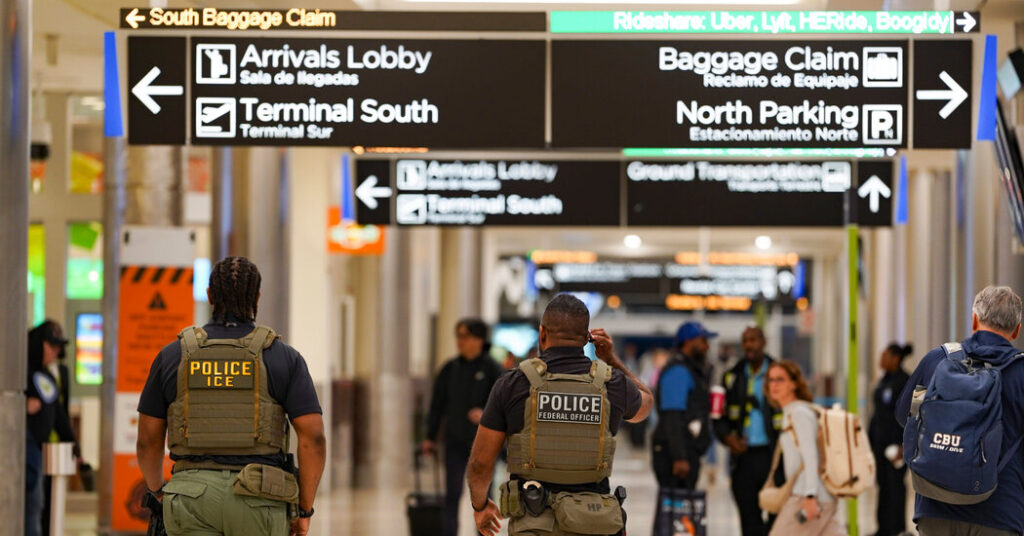
Immigration and Customs Enforcement agents stationed at several airports on Wednesday were checking travelers’ IDs and performing other screening duties alongside personnel from the Transportation Security Administration.
Those activities were largely a departure from the roles ICE agents had been performing since Monday at other major airports. They have been deployed ostensibly to ease the hourslong security lines amid a shortage of T.S.A. workers, but have largely patrolled hallways and stood watch.
At Hartsfield-Jackson Atlanta International Airport, ICE agents could be spotted instructing travelers to insert their IDs into card readers, verifying their identities on a computer screen and then waving people toward scanning equipment, T.S.A. officers nearby appeared to guide them.
At Phoenix Sky Harbor International Airport, armed ICE agents wearing ballistic vests checked IDs, looked at travelers’ documents and helped manage the flow of baggage on security conveyor belts. And a traveler at New York’s LaGuardia Airport said that an ICE agent checked his ID when he went through T.S.A. PreCheck.
The Department of Homeland Security confirmed that ICE agents were checking IDs.
“After receiving standard T.S.A. training curriculum,” ICE officers were “verifying identification using T.S.A. equipment and standard operating procedures,” the agency’s acting assistant secretary, Lauren Bis, said in a statement. She said the officers’ duties also included guarding entrances and exits, and crowd control.
But it was unclear on Wednesday afternoon exactly how many other airports were having ICE agents do similar screening work, whether that change was directly related to trying to ease wait times, and why ICE agents at some airports maintained more limited duties.
A T.S.A. worker and an airport security guard in Phoenix said that ICE agents had been doing those screening duties since Monday. At Chicago O’Hare International Airport, ICE agents’ presence appeared to be minimal, and they did not appear to be screening passengers.
Ms. Bis added in her statement that having ICE agents perform some screening functions would improve the situation.
“The more support we have available, the more efficiently T.S.A. can focus on their highly specialized screening roles to efficiently get airport security lines moving faster,” she said.
But it was unclear on Wednesday whether the move had a widespread effect on wait times.
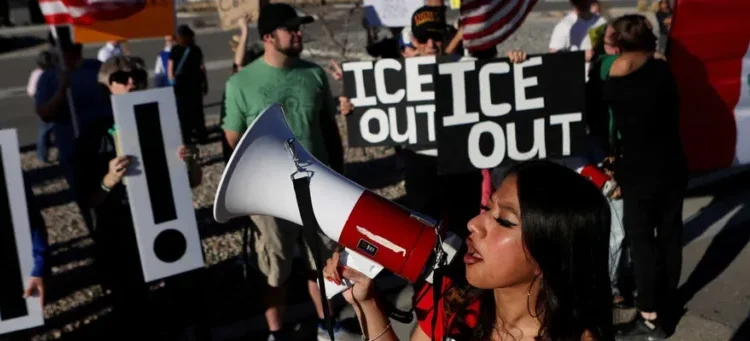
Some passengers worried that federal immigration agents were not qualified or authorized to carry out the responsibilities of T.S.A. officers. And some immigrants were concerned that they would be targeted by ICE.
Jennifer Carlin, a nonprofit worker from San Francisco, arrived five hours early to the Atlanta airport on Wednesday afternoon after visiting her son in Columbus, Ga. She still had hundreds of people ahead of her in line.
“You want people to feel confident when they’re coming to the airport to travel,” she said. “You want them to feel confident in the systems, the processes, the people, the security. And I think this is eroding some of the confidence in the American travel system.”
One traveler in Phoenix who did not want to be identified out of fear of repercussions wondered if agents were going to ask for a birth certificate and was afraid of being pulled out of line.
Heidi Altman, vice president of policy at the National Immigration Law Center, said the deployment to airports was an affront to Americans after they had “watched ICE agents terrorize their neighborhoods for over a year.”
The changes at some airports came as the shortage of T.S.A. workers inflicted more pain on American travelers. On Wednesday, Ha Nguyen McNeill, the acting head of T.S.A., told a House committee that security checkpoints at U.S. airports were experiencing “the highest wait times in history” because of the partial government shutdown of the Department of Homeland Security.
Some 50,000 T.S.A. officers have been working without pay since Feb. 14, when funding for D.H.S. expired over a congressional deadlock on immigration enforcement. More than 480 T.S.A. officers have quit, and absence rates have soared at major airports across the United States, Ms. Bis said.
More than 11 percent of officers called out sick on Sunday, the highest rate during this shutdown, according to D.H.S.
Over the last several days, Houston’s George Bush Intercontinental Airport, Louis Armstrong New Orleans International Airport, Hartsfield-Jackson, and Kennedy International Airport in New York have consistently held the highest T.S.A. absence rates in the nation, creating hourslong security lines and missed flights for travelers.
Though both work under homeland security, ICE personnel are being paid, while T.S.A. officers are not. T.S.A. workers would receive back pay for all their work once the shutdown ends. Democratic lawmakers and the union representing T.S.A. officers denounced the deployment of ICE to airports, calling it disruptive and unhelpful.
Nearly 50 air travel-related companies and organizations, including the Air Line Pilots Association, Airbus, the U.S. Travel Association and the unions representing flight attendants and air traffic controllers, issued a statement on Wednesday imploring lawmakers to end the D.H.S. shutdown.
“Congress must act now before our system breaks,” the statement said.
Reporting was contributed by David Iversen in Phoenix, Gabe Castro-Root in New York and Robert Chiarito in Chicago.
Christina Morales is a national reporter for The Times.
The post ICE Agents at Some Airports Begin Checking IDs in Security Lines appeared first on New York Times.