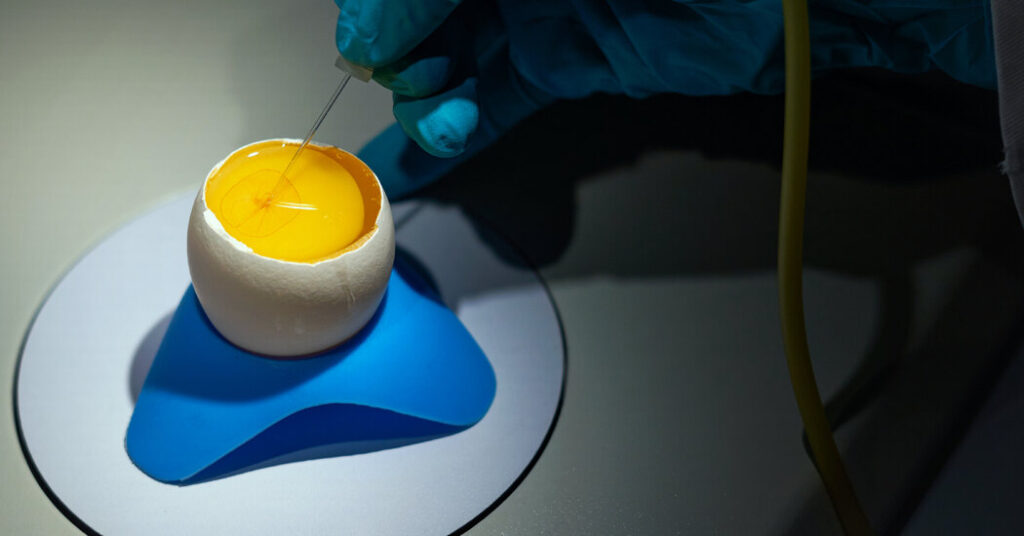
In front of Esther Oluwagbenga sits an egg perched on a blue tripod. A tiny triangular window has been cut into the shell. When Dr. Oluwagbenga positions the hole under a microscope, she reveals the chick embryo inside.
In its third day of existence, the embryo has developed into a diffuse cloud, with a pinhead-size heart beating at its core. Cells course through crimson arteries in fits and starts, like rush-hour traffic.
Dr. Oluwagbenga, a scientist at a biotech start-up called Neion Bio, is one of the few scientists in the world with the skill to make injections into a chicken embryo artery. “When I first saw someone do this, I was amazed,” Dr. Oluwagbegna says. “I really wanted to learn how to do this thing. But it was a lot more complex than I thought. I practice at least two times every week.”
To demonstrate this extraordinary operation, she takes a long plastic tube off a shelf hook and places one end in her mouth. The other end is tipped with a needle loaded with blue dye.
Looking at the embryo on a computer monitor, she guides the needle through the eggshell window, into the embryo and finally into an artery. With a gentle puff, she pushes the dye into the blood vessel. As the chick’s heart beats, its circulatory system transforms into a blue tapestry.
Dr. Oluwagbegna is applying this newfound skill to Neion Bio’s mission: to turn chicken eggs into drug factories. She and her colleagues are genetically engineering birds to produce medical compounds.
Scientists have tried for three decades to make drugs in eggs, but so far, the results have been meager. The Food and Drug Administration has approved only a single chicken-produced drug for use in the United States. Kanuma, a treatment for a rare liver disorder, received the green light in 2016 — with an annual cost per patient of $310,000.
But since then a series of discoveries have made engineering chickens less of a struggle. “It’s greatly improved,” said Ken-Ichi Nishijima, a biologist at Nagoya University in Japan.
Neion Bio, founded in 2024, emerged from stealth on Thursday to announce a deal to develop three compounds with a major pharmaceutical company. In the announcement, the company did not specify which drugs it would be working on.
Sam Levin, a co-founder of the company, said that using eggs to make drugs could potentially reduce their cost to one-tenth or even one-hundredth their current cost.
“It’s a medical supply chain that runs on grain and water,” he said.
Many of the world’s top-selling medications, such as the cancer drug Keytruda and the arthritis drug Humira, are large, complex proteins. Scientists can’t synthesize them with chemical reactions. Instead, they engineer cells from Chinese hamster ovaries to make the drugs.
The choice of Chinese hamster ovaries was a fluke of history. In the early 1900s, scientists at Beijing universities wanted animals to study. Unable to get lab mice from the West, they caught hamsters from the fields surrounding the city.
Eventually, the hamsters proved so useful that American scientists got hold of them. And in the 1950s, the geneticist Theodore Puck discovered that their ovary cells did something virtually unheard-of among mammal cells: They grew readily in a petri dish.
Scientists went on to use the ovary cells to study DNA, and in the 1980s, scientists discovered how to engineer them with extra genes and then harvest the proteins made from those genes.
Today, Chinese hamster cells grow in enormous steel tanks, generating Keytruda and many other drugs. But making drugs from these cells is no simple undertaking. “We end up building a Chinese hamster ovary around them,” Dr. Levin said.
To keep the cells thriving in their tanks, technicians must add a complex mix of ingredients and dispose of the waste that is cast off. Manufacturing a single gram of medicine can cost hundreds or thousands of dollars.
Even the facilities required to grow the cells have eye-watering price tags. Last year, Merck broke ground on a factory in Delaware to make Keytruda. The company will spend $1 billion to build it.
By the 1990s, some scientists were wondering whether chicken eggs might offer a better way to make some of those drugs. Unlike Chinese hamster ovary cells, chicken eggs are impressive protein producers. The white of a single egg contains a hefty six grams of protein. “Eggs can function as self-contained bioreactors,” said Jae Yong Han, a biologist at Seoul National University.
But turning eggs into drug factories was easier said than done.
“The technology was very difficult,” said Michael McGrew, a biologist at the Roslyn Institute in Edinburgh who is on the advisory board of Neion Bio. Most of the time, the technology failed to properly engineer the DNA of chickens, leading to years of trial and error to produce birds that could reliably make a drug.
Dr. McGrew helped usher in better methods. He took advantage of the fact that the progenitors of sperm and eggs circulate in the bloodstream in the early bird embryo, only later migrating into its sexual organs. Dr. McGrew pioneered methods for pulling these so-called primordial germ cells out of chick embryos and then growing them by the millions.
This advance allowed scientists to make precise manipulations to the DNA of the primordial germ cells. In recent years, a few scientists have started companies to take advantage of these new techniques, including Avinnogen, founded by Dr. Han, and Neion Bio.
To build their first flock of engineered chickens, the Neion Bio team inserted genes into primordial germ cells to produce a drug in egg whites. Dr. Oluwagbenga and her colleagues injected the tailored cells into the bloodstreams of chick embryos. They taped the eggshell windows shut and waited for the chicks to peck their way out.
The first chicks hatched in September. Now Neion has a flock of 50 engineered leghorn roosters.
The Neion Bio researchers are currently checking the sperm of the animals to make sure they carry the engineered genes. The roosters will then mate with ordinary leghorn hens.
“The next generation will be our chickens that produce our proteins,” said Sven Bocklandt, the chief scientific officer of Neion Bio.
The researchers have tailored the DNA of their chickens to produce abundant amounts of the proteins in each egg. Dr. Levin estimated that it would take just 3,900 hens to meet the global demand for Humira. And the cost of keeping them on farms would be one-hundredth the cost for a Chinese hamster ovary facility.
Dr. Nishijima, who is not involved in Neion Bio, said that the company’s plan was “commercially possible.” But he saw some hurdles to success. The five or six months it takes for a chicken to reach maturity is a long wait for companies wondering whether a living drug factory will work as planned.
“Time is a problem,” Dr. Nishijima said.
Dr. Bocklandt and his colleagues are doing experiments to address that challenge. Instead of manipulating chick embryos, they envision working with adult hens. They would inject viruses into the birds that would deliver genes to the glands that produce egg white proteins. Once those genes arrived at their destination, the chickens would immediately start producing the drug and packaging it in their eggs.
“Essentially, we’re working on a kind of gene therapy for chickens,” Dr. Bocklandt said.
Carl Zimmer covers news about science for The Times and writes the Origins column.
The post How to Turn a Chicken Egg Into a Drug Factory appeared first on New York Times.