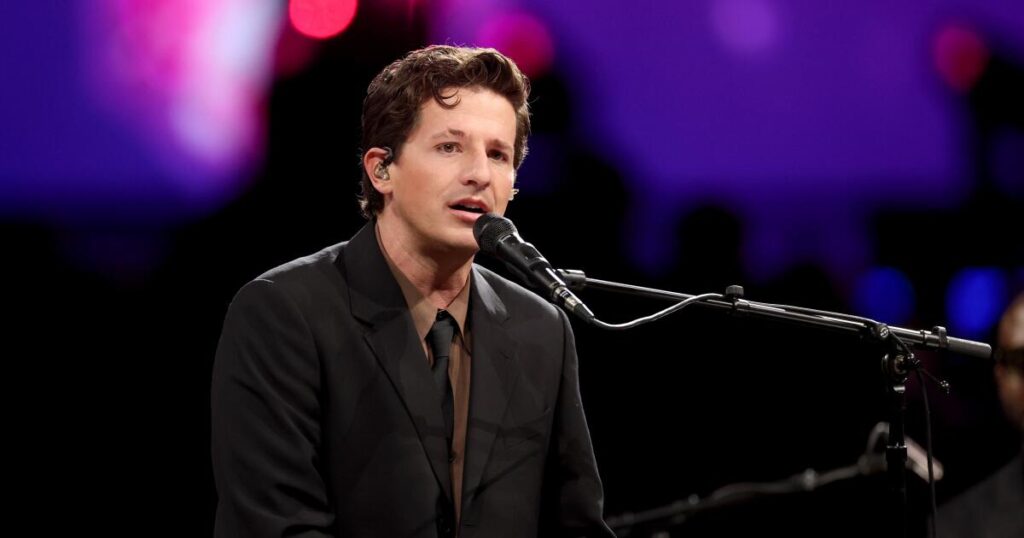
On a recent Friday morning, Charlie Puth sat in a green room at Spotify’s Los Angeles headquarters, sipping a can of La Croix as he pondered which was more likely to drop first: his new record or his first child.
“It’s quite possible it could be the same week,” he said.
Turns out the kid beat the music.
Puth announced on social media Monday that his wife, Brooke Sansone, had given birth to a baby boy, Jude, on March 13 — which made it a good thing that the 34-year-old pop singer had driven down from the couple’s home in Santa Barbara early this month for a busy day of album promo before activating Dad Mode for a while.
Due Friday, “Whatever’s Clever!” is Puth’s fourth LP since he broke out in 2015 with “See You Again,” his 14-times-platinum collaboration with the rapper Wiz Khalifa from the “Fast and Furious” movie franchise. Yet he says it’s the first one “where things are lining up musically in my life — like I’m living what the album is about.”
In “Changes,” the album’s opener, Puth anticipates the arrival of “new directions and lessons,” while “Home” rhymes “rose-colored lenses” with “white picket fences”; other tracks contemplate his relationships with his dad and his younger brother and look back to his upbringing in suburban New Jersey.
When he was younger, Puth said, he believed an artist was supposed to separate his life from his career. “Picture a hard drive,” said the singer, a graduate of both the Manhattan School of Music and Berklee College of Music. “One partition is your life, and you keep that private. The other partition is your career — that’s where you dye your hair a different color and you speak a little bit differently because you’re an artist.” He shook his head.
“My wife was the person who told me, ‘You just need to be you,’” he said, though he also credits Taylor Swift for changing his thinking when she shouted him out by name in the title track of 2024’s “The Tortured Poets Department.”
For the glistening, crisply detailed sound of “Whatever’s Clever!,” which the singer co-produced with BloodPop (known for his work with Justin Bieber and Lady Gaga), Puth took inspiration from vintage yacht rock and blue-eyed soul; guests on the LP include Kenny Loggins, Michael McDonald and Kenny G, the last of whom accompanied the singer as he performed the national anthem at last month’s Super Bowl LX.
“He’s an amazingly talented guy,” McDonald says of Puth, whom the Doobie Brothers frontman had been eager to write with since a mutual friend suggested it a while back. “But I didn’t want to cold-call him out of the blue in case he wasn’t into it. So when Kenny [Loggins] called me about this situation, I jumped at the chance.”
Together the three came up with “Love in Exile,” a buoyant, falsetto-filled number with welcome echoes of the Doobies’ “What a Fool Believes,” which McDonald and Loggins co-wrote half a century ago.
Coco Jones, who also appears on the album — the two sing a slinky duet called “Sideways” — says Puth impressed her with his deep knowledge of R&B history.
“There were some references where I was like, ‘What even is that?’” she recalls with a laugh.
Puth put his chops on display late last year with a series of intimate gigs at the Blue Note jazz clubs in New York and L.A., where he tastily retooled his own material and did covers like “Ain’t No Mountain High Enough” and New Edition’s “Can You Stand the Rain.” Next month he’ll take “Whatever’s Clever!” on the road for a world tour set to stop at Inglewood’s Kia Forum on April 29.
Said Puth in our interview as a video crew prepped for a shoot: “There’s never been so many things happening all at once for me.”
I’ve enjoyed your look during this album rollout: the jeans, the sweaters, the penny loafers. It reminds me of when I went to Catholic school and you’d go shopping for school clothes at the Bass outlet and they’d have walls and walls of penny loafers. I wanted the record to feel like when you’d open up your textbook and find obscene drawings and things that kids wrote 10 years prior.
Gimme some of the specific touchstones. You’ve talked about Phil Collins and Philip Bailey. I hear Fine Young Cannibals as well. Absolutely.
Time-wise, you were thinking, what, 1984 to 1989? ’89 to ’90 — ’92 maybe.
I admire the specificity. Looking back, it seems from a technological standpoint that we were in a really important transitional time going into the ’90s. When you heard “Vogue” by Madonna for the first time — the driving rhythm of the 909 [drum machine] — you weren’t hearing that five years prior. Then you’d hear the “Bodyguard” soundtrack — “I’m Every Woman,” Whitney Houston. Everything felt very dance-y. Chicago house was really starting to melt its way into pop. It wasn’t so underground anymore, and that’s all because the technology got better.
The dialed-in-ness of the sounds reminds me of John Mayer’s “Sob Rock.” I’ve never been a person to openly show everything — I need to hide behind the music. “Hides” isn’t the best word, but there needs to be some chords — maybe some happy chords — to offset the really serious topic in the background. That’s a juxtaposition I’ll sometimes hear in John’s music as well. Listen to [my song] “Washed Up.” That’s a song about a heavy topic — organizing an intervention for one of your best friends. But there’s trumpets on the record that almost sound like the beginning of “Wheel of Fortune.”
“Washed Up” made me think of “Stop” by the Spice Girls. Same key. C major is a very happy key.
Also super dialed: Justin Bieber’s “Swag.” There’s a record on there called “All I Can Take” with the swingy Lisa Stansfield “All Around the World” drums. I don’t know if that’s what he and Dijon were listening to when they were making it, but I’m just glad I’m hearing that in a superstar’s music.
Tell me about featuring Kenny G on “Cry.” Here’s a guy with a lot of layered associations. There’s some comedy there.
What did you want to say by bringing him in? I wanted to not show the humorous side. Because he’s so multifaceted, he can show up in an Andy Samberg video or he can go onstage with the Jonas Brothers and perform “My Heart Will Go On,” which is maybe a little bit on the nose. But I wanted to tap into the Kenny G that was introduced to the world in the late ’80s before the holiday albums blew up.
How’d you approach him? BloodPop and I found a song on one of his albums where it’s just him playing the saxophone — no pads, no piano, just him — and we put it into Melodyne and made the melody that I wanted him to play on the solo. It didn’t sound great — it sounded like a demo that you’d give to a musician in hopes that they would beat it. And he did just that.
I wondered whether you felt the need to let him know you weren’t looking to have him as a joke. I played him the album — I think he was able to tell it was a real thing just by hearing the warmth of the chords.
Is the respect of a Kenny G or a Michael McDonald or a Kenny Loggins — of an elder, let’s say — is that important to you? It is because they’re a huge reason why I even made this album. You can’t make an album like this and not have the guys that invented it. I want to re-create an experience for kids who might not be familiar with their catalog — to feel how their parents felt when they heard “What a Fool Believes.”
There’s a tension on the record, though, right? At the same time that you’re embracing the OGs, you have a song called “Don’t Meet Your Heroes.” Who’s that song about? I can’t say.
How do you resolve that contradiction? These are heroes I’m happy I met. When you write a song with Michael McDonald and Kenny Loggins, you realize they’re just like you — they’re songwriters. They don’t have an outdated approach. I’m confident I could walk in the studio with them and write a song for an artist today — a song for Dua Lipa, a song for Zara Larsson. Listen to Olivia Dean, “Man I Need.” She’s not starting on just a D-flat-major chord. She’s starting on a D-flat with an F.
You’re saying that’s a modern song with those silky yacht rock chords. I think silk is in.
Your song with Coco Jones might be the silkiest thing you’ve ever done. I would agree with that. That piano is called the Dig EP from the Roland JV-1080 — the preset that Babyface used on the “Waiting to Exhale” soundtrack.
You and Coco are really pushing each other vocally. I don’t try and out-sing the guest. Coco came in and had to be at the airport in two hours for a red-eye to New York. She knew the whole song like the back of her hand.
Back to “Don’t Meet Your Heroes”: How careful were you not to reveal who it’s about? I just didn’t think that’s what the song called for. It’s a very specific experience that happened to me that actually might not be so specific. People have looked up to somebody in whatever space they’re in and worked hard to meet that person. Then it turns out it’s disappointing — you wish you could reverse time and glue to the spot where you didn’t know them so well. It sucks because then when you listen to their music or you watch their movies, the experience is tainted. They might still be very talented, but it’s just not what it was.
The album closes with “I Used to Be Cringe,” and I hear what you’re saying. But if I still love your old song “Boy,” does that mean I’m cringe? I don’t think “Boy” is cringe. Maybe the example you’re looking for is “Marvin Gaye,” from the first album.
What does it mean for a fan when an artist looks back at their old stuff and says, “I’m not really rocking with this anymore”? I’m going over the set list for this tour, and my [music director] said, “Are we doing ‘Marvin Gaye’?” I was like, “I don’t want to do it in the doo-wop kind of Motown way.” I’m not in the same place in 2026 — about to be a dad, blah-blah-blah — that I was when I wrote that song. I’m not saying to my wife, “Let’s Marvin Gaye and get it on.” But I think there’s a way to make everybody happy musically, and it’s all in the arrangement. I can take the key down, or I can not use that specific drum pattern. Maybe the challenge is: How do I play “Washed Up” and go into “Marvin Gaye”?
Your Blue Note show made me think a bit about the racial politics of blue-eyed soul: the famous white guy singing R&B while backed by a band of skilled Black players. How do you think about the complicated history of this music? I don’t pretend I invented it. I’m not walking around like, “Look at me — I invented water.” If we’re gonna go really deep, I didn’t even invent the music that I wrote — maybe it was written millions of years ago, and I’m just tapping into something. That’s probably a conversation for another time.
Save it for Joe Rogan. I don’t think I’m going on Joe Rogan. But that’s a real thing, what you said. And I think it’s really important to pay homage. I study music every night, and I have the privilege of calling someone like Babyface and just flat-out asking him, “How did you write ‘Whip Appeal’?” He says, “Well, I listened to El DeBarge, ‘Time Will Reveal’ — whatever that diminished C chord is — and that’s where that inspiration came from.” OK, well, what was El DeBarge listening to? And on and on and on. That way, if I’m ever asked the question, I have all the facts. I love the facts.
You’ve been something of a connoisseur’s fave, I think it’s fair to say, which is why the Taylor Swift lyric was such a delight: “We declared Charlie Puth should be a bigger artist.” I’ve never spoken to her about it — one day I will — but she does such a good job of opening up in her music, and I do believe in some respect that was her telling me, “There’s more things to talk about in music, Charlie — maybe you should dig a little bit.”
What were the things you kept talking about instead of digging? Relationship songs about things that ended years ago. I’m thankful for those songs — they’re why I’m here talking to you now. But I’d never written about the relationship I have with my dad. I wrote “Cry” a week prior to his mom passing. Seeing my dad in an emotional state that I hadn’t seen him in so overtly in my 34 years of life — I wanted to comfort him, and there was a way to accomplish that musically. That had to be a song.
If this record succeeds in moving you out of the realm of the true heads — That’s very nice, by the way.
What will that mean for Charlie Puth? I guess I’d like to be not quite as underrated — maybe even, dare I say, to be overrated.
The post How Charlie Puth transcended the cringe appeared first on Los Angeles Times.