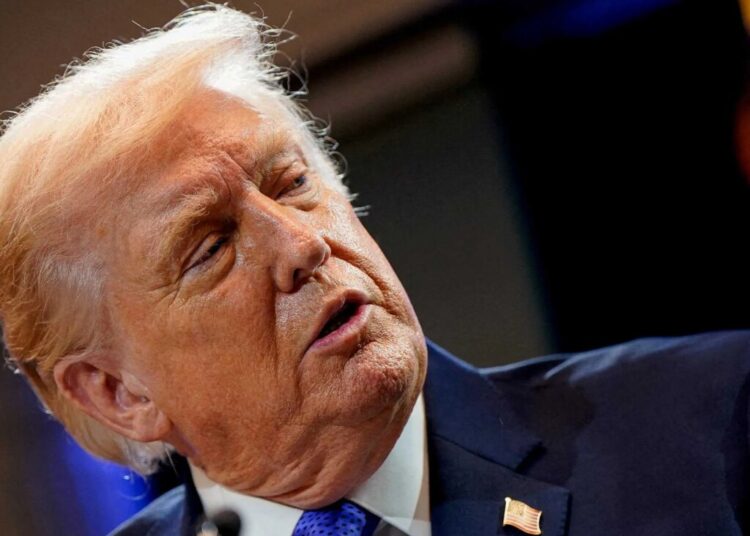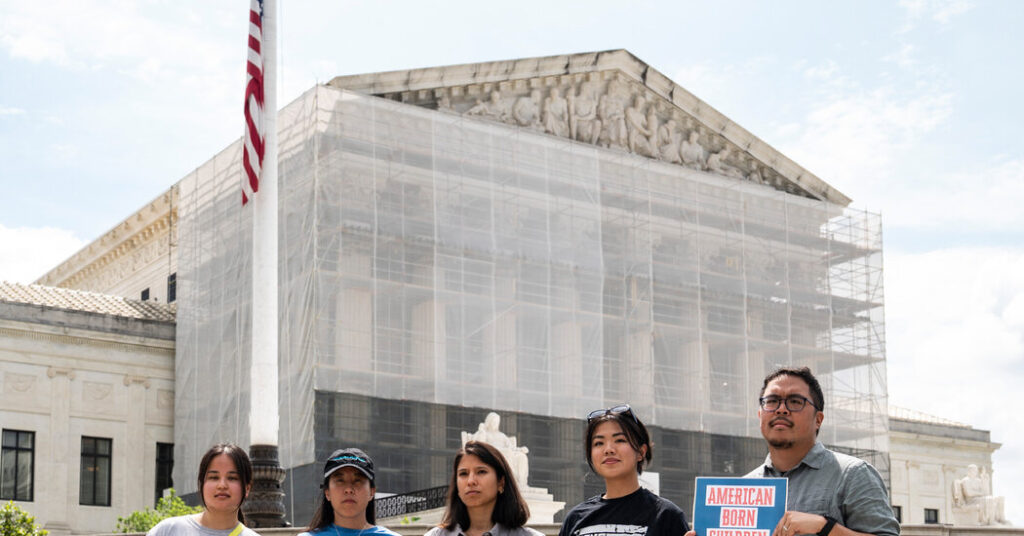
Hello! The Supreme Court will hear arguments next week over President Trump’s plan to limit birthright citizenship. The case involves a big constitutional question: What is the meaning of the 14th Amendment, which has long been understood to grant citizenship to just about every baby born in the United States?
But the case, Trump v. Barbara, also poses a bunch of additional questions, all of them land mines that the administration will have to avoid if it is to prevail.
Wait, There’s Also a Birthright Citizenship Statute?
In its Supreme Court briefs, the Trump administration focused almost all of its attention on convincing the justices that the 14th Amendment, which was adopted in 1868 after the Civil War, did not automatically confer citizenship on children born to parents who were in the United States unlawfully or temporarily.
The government’s briefs spend considerably less time on the Immigration and Nationality Act of 1952, which says that anyone “born in the United States, and subject to the jurisdiction thereof,” is a citizen.
The statute’s language mirrors that of the amendment, and your first impulse may be to think they mean the same thing. If Trump is right about the 14th Amendment, he must be right about the statute. And if he’s wrong about the Constitution, then he would be equally wrong about the statute.
That is essentially what D. John Sauer, the solicitor general, told the justices on behalf of the administration.
But, as Chief Justice John Roberts wrote in a landmark 2024 decision on the power of executive agencies, “every statute’s meaning is fixed at the time of enactment.”
Whatever might have been the original meaning of the 14th Amendment, there is substantial evidence — in judicial decisions, legislative reports and executive practice — that Congress understood the 1952 law to guarantee birthright citizenship.
There is no question that Congress has the power to grant citizenship, including birthright citizenship, whatever the correct interpretation of the constitutional amendment. Indeed, Sauer acknowledged that federal lawmakers can “confer citizenship at birth upon various categories of persons who are not guaranteed citizenship under the 14th Amendment” — and that they did so in several provisions of the 1952 law.
Will the Justices Take an Offramp?
The Supreme Court ordinarily does not reach a constitutional question if it can decide a case on statutory grounds.
Should the court rule against the administration based on the 1952 law and leave the meaning of the 14th Amendment unresolved, the administration could choose a new path, asking Congress to adopt legislation to curtail birthright citizenship. Such bills have been introduced, without success, in almost every Congress since 1995.
A few decades ago, the consensus view was that they were frivolous.
“My office grapples with many difficult and close issues of constitutional law,” Walter Dellinger, a Justice Department official, said in 1995 of a measure introduced that year. “The lawfulness of this bill is not among them. This legislation is unquestionably unconstitutional.”
Let’s imagine that Congress did enact a law along the lines of Trump’s executive order. It would surely be challenged as a violation of the 14th Amendment — and end up in front of the justices.
Will Millions Lose Citizenship?
The case concerns an executive order issued on the day Trump returned to office. It had an ad hoc, gerrymandered quality, drawing lines that did not seem especially obvious.
For instance, the order said that it was prospective only, applying to babies born 30 days after it became effective. Since it has been blocked by lower courts, no one has yet been subject to it. Should Trump win in the Supreme Court, the order will come to life 30 days after the ruling.
But a friend-of-the-court brief from more than 200 Democratic members of Congress said the president was powerless to declare that a constitutional provision or federal law only applied in the future. After all, if the Constitution and the federal law do not grant birthright citizenship, countless people never acquired it.
“Should the court endorse the administration’s interpretations,” the brief said, “millions of Americans will simply no longer meet the constitutional and statutory criteria for citizenship. Statutory law will therefore bar them from voting, securing passports, and more. The administration cannot change that by announcing that it will (for now) treat those erstwhile Americans as if they were citizens, giving them benefits the law forbids them to have.”
Foundlings and the Founders
Five years ago, when the Supreme Court heard arguments over whether it should overrule Roe v. Wade, Justice Amy Coney Barrett asked a series of questions about safe haven laws, which allow parents to anonymously surrender newborn babies at hospitals or firehouses, without fear of prosecution.
Her point was that the laws eased some of the burdens of what she called “forced motherhood,” even in absence of a right to abortion. But if Trump prevails in the birthright citizenship case, a mother contemplating taking such a step may want to consider another factor: Would her baby be a U.S. citizen?
Under the executive order, abandoned infants would not be entitled to citizenship under the 14th Amendment unless they were able to produce evidence that at least one parent had been a U.S. citizen or lawful permanent resident.
The 1952 law took a different approach. It conferred citizenship on anyone of “unknown parentage” who was found in the United States under age 5, unless it was proved, before they turned 21, that they had not been born in the United States.
Notably, the law did not exclude children later shown to have been born to people in the United States temporarily or unlawfully.
A Moving Target?
The improvised quality of the executive order raises questions about its durability should the Supreme Court uphold it, Akhil Reed Amar, a law professor at Yale, wrote in a brief supporting the challengers.
“If today’s president can make up rules one way, can tomorrow’s president reverse everything?” he asked. “Can tomorrow’s president go even further in the opposite direction?”
Other Legal News
-
Trump has granted clemency to more than 70 people convicted in fraud cases. Matt Purdy and Luke Broadwater show that the pace of such pardons and commutations has quickened in the president’s second term.
-
Judges are abandoning the calm, understated language usually associated with judicial prose for “an emotive, populist approach, giving full vent to the intensity of their concerns about cases flooding their dockets since President Trump returned to office,” Matt Schwartz writes in a fascinating exploration of a divisive trend.
-
“It has been a grim time for press freedom,” Charlie Savage wrote in his analysis of a federal judge’s decision striking down restrictions on reporters’ ability to cover the Defense Department. “Against that backdrop,” he wrote, “the judge’s repudiation of rules that led to the exodus of credentialed Pentagon reporters from virtually every mainstream news outlet stands, at least for now, as a vigorous affirmation of constitutional press freedom.”
Mailbag
Are There Any Limits on the President’s Pardons?
I would like to understand how pardons work. Is there a system of checks and balances or does the president have the authority to pardon anyone (and he has pardoned some bad actors) without anyone being able to say no? — Val Williams
The Constitution gives presidents very broad authority to grant pardons. The power is subject to only one check by the other branches: the theoretical possibility of impeachment and removal from office.
In 2024, the Supreme Court said the president was absolutely immune from prosecution for exercising his core constitutional powers, and it gave granting pardons as an example.
In dissent, Justice Sonia Sotomayor summarized the ruling this way: “Takes a bribe in exchange for a pardon? Immune.”
There are some practical limits on the power. It does not apply to state crimes, impeachments or acts that have not yet been committed. Opinions vary on whether presidents can pardon themselves.
I’d love to hear your questions on the law, the courts or whatever is on your mind. Send them my way at [email protected].
What I’m Reading
-
“Adding Family Complications to Birthright Citizenship,” in which Scott Titshaw explores what he calls the “complex mess” created by Trump’s birthright citizenship order. The article will be published in The Georgetown Immigration Law Journal.
-
Marty Lederman’s four-part series in Just Security evaluating the arguments in the birthright citizenship case.
-
“Justice Scalia’s Uncertain Legacy,” in which Richard Re, in his “Controlling Opinions” column on Scotusblog, explores how “the surface celebration masks a deeper ambivalence and even repudiation” of some of the justice’s positions.
Closing Argument
Arrested for Asking Questions
Last week, in ruling that parts of the Pentagon’s restrictions on press coverage violated the First Amendment, Judge Paul Friedman paused “to state the obvious.”
“Obtaining and attempting to obtain information is what journalists do,” he wrote. “A primary way in which journalists obtain information is by asking questions.”
Three days later, the Supreme Court turned down an appeal from a reporter who was arrested, as Justice Sonia Sotomayor wrote in dissent, “for doing something journalists do every day: posing questions to a public official.”
The reporter, Priscilla Villarreal, was the subject of a 2019 profile in The New York Times by Simon Romero called “La Gordiloca: The Swearing Muckraker Upending Border Journalism.” (La Gordiloca is Villarreal’s nickname and the title of her popular Facebook page. It roughly translates, she told Simon, to the Crazy Fat Lady.)
In 2017, Villarreal twice confirmed information she already possessed by sending text messages to a police department source. Six months later, she was arrested under an obscure Texas law, on the theory that she committed a criminal act by soliciting nonpublic material for her benefit.
A state judge ruled that the law was unconstitutionally vague. Villarreal sued the officials involved in her arrest for violating her First Amendment rights, but lost before divided panels of the Fifth Circuit.
The case has a convoluted history and the usual legal gymnastics (qualified immunity, probable cause, retaliation). My point in writing about it today is to note that only one member of the Supreme Court thought to stand up in public for what Justice Sotomayor called “one of the most basic journalistic practices of them all: asking sources within the government for information.”
The court does not disclose vote tallies when it acts on petitions seeking review, and it is possible that as many as two other justices voted to hear the case. It takes four votes to add a case to the docket.
Judge Friedman’s ruling, in favor of The Times, suggested support from the courts for journalism. But it is not the last word, and Monday’s order rejecting Villarreal’s case might have been a taste of things to come.
Adam Liptak is the chief legal affairs correspondent of The Times and the host of The Docket, a newsletter on legal developments. A graduate of Yale Law School, he practiced law for 14 years before joining The Times in 2002.
The post Four Problems for Trump in Birthright Citizenship Case appeared first on New York Times.