For wealthy donors interested in burnishing their legacies, having a university place their name on a campus building is a reliable way to leave a mark.
The fallout from Jeffrey Epstein’s crimes has revealed the pitfalls for schools eager to take the large checks often offered in exchange.
Many campus buildings are named after people associated with Mr. Epstein, including the billionaires Leslie Wexner, Howard Lutnick and Steve Tisch. And now students, faculty and alumni at several colleges, including Ohio State University and Harvard, are demanding the names be removed.
At Ohio State, students have been pushing to have the name of Mr. Wexner, the university’s largest donor, removed from three buildings.
“Names reflect the values of our institution,” said Kaleb Duarte, who, along with other Ohio State architecture students, recently unfurled a 40-foot banner from a campus building that read “Oust Wexner.”
Mr. Wexner, an Ohio State alumnus, is listed in government documents as a potential “co-conspirator” and major benefactor of Mr. Epstein. At a deposition last month before a House committee, Mr. Wexner said he had been “conned” by the financier but had done nothing wrong. A spokesman for Mr. Wexner declined to comment.
Mr. Wexner, who made his fortune in retail, is “connected to harm and violence,” Mr. Duarte said.
A similar argument has led many colleges to remove the names of racists and segregationists under pressure from students in recent years. Administrators across the country are currently considering renaming schools and buildings honoring the labor leader Cesar Chavez after a New York Times investigation detailed allegations of rape and sexual abuse against him.
The cases involving Epstein associates, who have not, for the most part, been accused of any crimes themselves, are more nuanced, at least according to some university leaders and experts. No campus buildings appear to be named for Mr. Epstein himself.
The wave of new name-change requests followed the Justice Department’s release of millions of documents in late January that painted a clearer picture of Mr. Epstein’s relationship with wealthy and influential men.
So far, in cases involving Mr. Epstein’s associates, universities have not budged. Colleges often have policies for name changes that involve many layers of review, and some have punted the matter to a campus committee. Trustees usually have the final say, and the removal of a name from a building in some cases could require returning money to a donor.
The money can be significant, and it can be unclear whether universities would be obligated to return funds to donors if their names are removed. It is possible some schools could face litigation, but the issue has rarely come up with a living donor.
At Haverford College, in Pennsylvania, students have pressured school leaders to change the name of a campus library that bears Mr. Lutnick’s name. Mr. Lutnick, who is the Trump administration’s commerce secretary and a 1983 Haverford graduate, gave the college a $25 million gift in 2014.
Last year, Mr. Lutnick said in a podcast that he had been so disgusted with Mr. Epstein during a 2005 visit to his townhouse that he never set foot in a room with him again. But after the release of the Justice Department documents, he acknowledged he had taken a trip with his family to Mr. Epstein’s island in 2012, years after Mr. Epstein’s 2008 conviction for soliciting prostitution from a minor.
Wendy Raymond, Haverford’s president, has said she is reviewing calls for a name change. “I am taking this complex issue under deep consideration,” she wrote in a message to the campus community last month.
The school has a building naming policy that lays out rules for giving names and for removing them. It argues for balance, avoiding “oversimplifying, revising, or erasing history” while also not keeping a name that is “inconsistent with the college’s mission, inhibits or prevents academic freedom, interferes with its independence, or is harmful to its teaching mission and inclusiveness.”
The Haverford policy also lists minimum prices for “naming opportunities” — $3 million for a named professorship, or $1 million for a year of a named domestic scholarship. It is also careful to say that individuals cannot buy naming opportunities. “Rather,” it states, “the college acknowledges gifts by recognizing donors or those whom donors wish to honor through these naming opportunities.”
At Tufts University, outside Boston, the student newspaper has called on the university to remove the name of Mr. Tisch, an alum and film producer, from campus buildings. Mr. Tisch discussed women with Mr. Epstein, sometimes in crude ways. Mr. Epstein also connected Mr. Tisch with women.
The newspaper’s editorial board called on the university to distance itself from Mr. Tisch to “preserve the university’s commitment to ethical, honest and principled civic engagement.” It also pointed to recent precedent: In 2019, the university removed the name of the Sackler family from its medical school for its role in the opioid epidemic.
The university did not respond to a message seeking comment. In a previous statement, Mr. Tisch denied any wrongdoing and described his relationship with Mr. Epstein as “a brief association where we exchanged emails about adult women, and in addition, we discussed movies, philanthropy, and investments.”
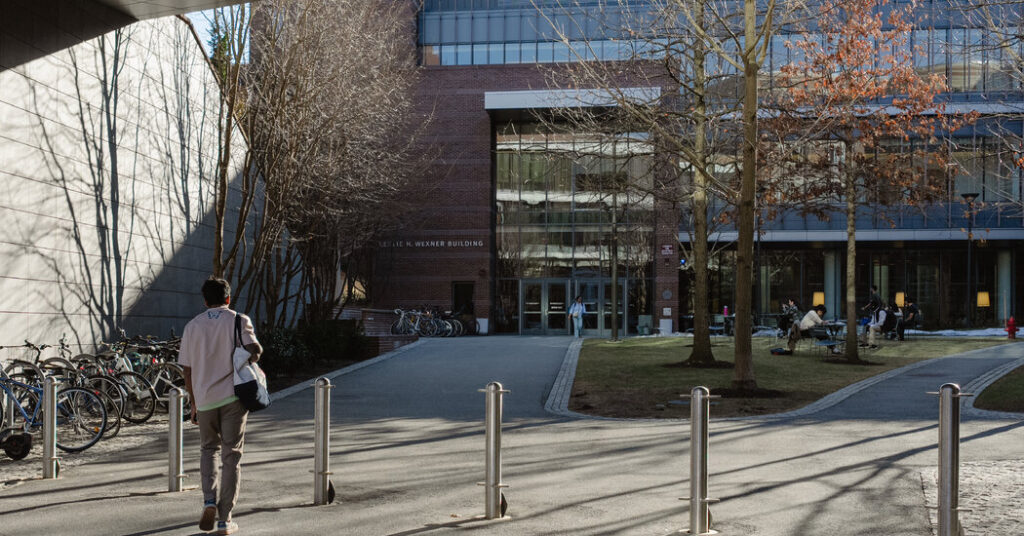
At Harvard, a building at the Kennedy School of Government’s bears the name of Mr. Wexner. Faculty members and students in the school submitted a request for the name to be removed from the building and an atrium, arguing that keeping it sends “an unintended signal of institutional tolerance of his conduct.”
“This inflicts psychological harm on visitors, students, staff, faculty, and, particularly, survivors of sexual assault,” the proposal continues.
A Harvard spokesman confirmed that the university had received the formal proposal, but declined to comment further.
The university dealt with similar controversy recently. In 2024, Harvard declined to remove the Sackler name from two buildings. A proposal to change the names argued that Arthur Sackler was “instrumental in creating the unethical marketing practices” that Purdue Pharma and other family members would eventually use to market OxyContin, the addictive opioid painkiller.
A committee packed with senior administrators, including Alan M. Garber, who is now Harvard’s president, said that Mr. Sackler had died several years before the opioid crisis and the marketing of OxyContin.
“Arthur Sackler’s legacy is complex, ambiguous and debatable,” the report stated in rejecting the proposal. The committee also noted that the presence of Mr. Sackler’s name on the buildings was governed by a gift agreement, complicating any effort to remove it.
At Ohio State, the university may have more leeway because there is no such contract tying a specific donation to the Wexner Medical Center and the Les Wexner Football Complex. However, the Wexner Center for the Arts is governed by such a contract.
Hundreds of students recently walked out of classes, demanding the removal of the Wexner name. The Ohio Nurses Association also called for an end to Mr. Wexner’s association with the school’s medical programs.
Benjamin Johnson, an Ohio State spokesman, said the matter was under review. As of this month, the university had received about 470 requests for a name change related to the Wexners.
Naming campus buildings — or even entire colleges — after wealthy donors has always been transactional, said John Thelin, who is a historian of higher education and a University of Kentucky professor emeritus. It is “something of an American tradition,” he said, and not one that is likely to change.
“What I can’t figure out is what are the limits?” he said. “Where does someone cross the lines in terms of what is acceptable?”
Vimal Patel writes about higher education for The Times with a focus on speech and campus culture.
The post College Buildings Named for Epstein’s Friends Lead to Removal Demands appeared first on New York Times.