Chinese carmaker BYD is on the brink of making the recharging of an electric vehicle akin to fueling up at the gas station. The best way for U.S. firms to respond to this EV Sputnik moment is by leaning into American strengths rather than imitating Chinese strategy.
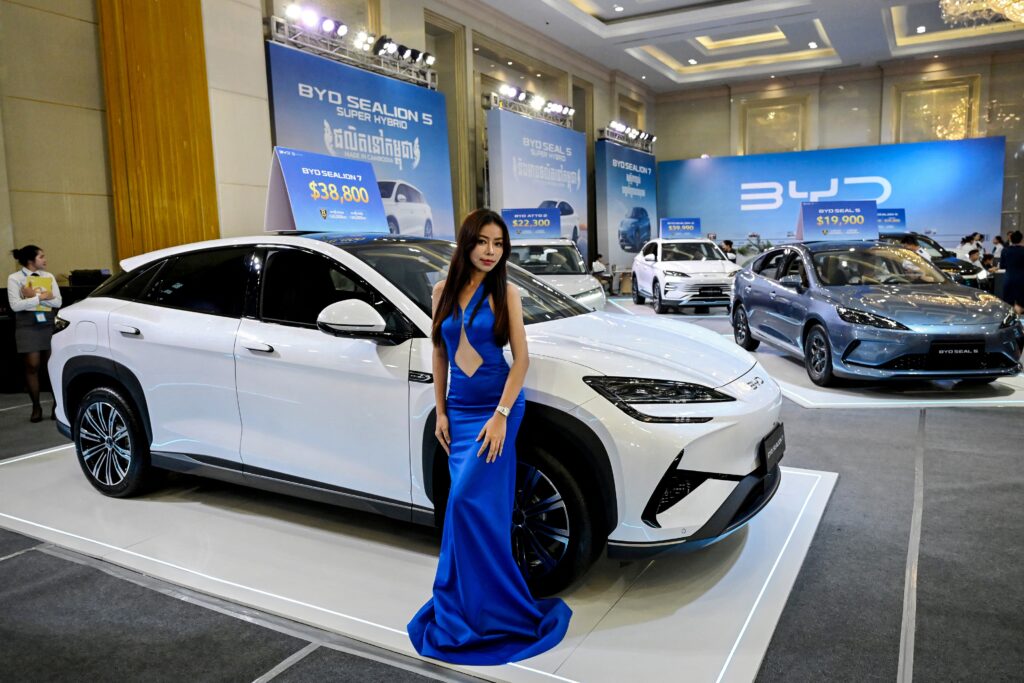
Earlier this month, BYD presented its second-generation Blade battery and its FLASH Charger. The company claims that it is now possible to take an electric vehicle from a 10 percent to a 97 percent charge in nine minutes. It can get to 70 percent in just five.
For a country once known for ripping off foreign tech, it’s a remarkable achievement. It shouldn’t be surprising. China already dominates the worldwide EV market.
More than 54 percent of all new passenger cars sold in China are electric or hybrid. BYD last year surpassed Tesla, once the industry’s leading innovator, in overall sales. And China’s EV push is buttressed by a massive nationwide charging infrastructure as it aims to wean itself off fossil fuels and become the first “electro-state.”
But there are serious issues with how China got here. They may be phasing out gasoline and internal combustion engines, but the Chinese electric grid is mostly powered by coal, the dirtiest of fossil fuels. The burning of coal in China accounts for roughly twice as many tons of annual CO2 emissions as all sources combined in the United States.
More than 15 years ago, China’s leaders designated the EV sector a “strategic emerging industry.” Under China’s statist model, the EV industry was lavished with at least $230 billion in government subsidies from 2009 until 2023. Government grants still account for an estimated 35 percent of BYD’s net profit. And most Chinese EV companies don’t look like BYD. China has around 200 EV companies, and that’s after hundreds went out of business. Very few of these make any meaningful contribution to advancing technology, eating up government subsidies until the trough runs dry.
Chinese carmakers also benefit from a massive domestic car market, and a 9-9-6 work culture; factory workers toil from 9 a.m. until 9 p.m., six days a week.
China’s state-led model is a challenge for the U.S., which has its own lighter version of the statist model. American politicians calibrate their industrial planning of the auto sector to maximize the number of jobs and the number of regulations, environmental and safety, it must comply with. But the U.S. market is at least responsive to consumer demand, unlike China, where cars nobody wants are rotting away. U.S. demand for EVs is weak, partly because of the end of federal subsidies last year.
Right now, U.S. policy is defensive, keeping Chinese EVs out of the U.S. market through tariffs that add up to over 100 percent. But while closing the market to Chinese cars helps protect jobs at Detroit’s Big Three automakers, it also stifles the innovation that comes from competition. The U.S. risks becoming a gas-powered island while the rest of the world goes electric.
A better strategy is to be proactive and compete where the U.S. has advantages. Instead of building a competing super-fast charging system, better to leapfrog to the next-generation technology. That might include developing a solid-state battery, or a sodium-ion one, which both look promising. China now controls the processing for the vast majority of the world’s battery materials: lithium, cobalt and graphite. The U.S. has some lithium deposits, but sodium is far more abundant.
The government has a small role to play by funding long-term research that isn’t necessarily cost-effective at the outset. But the bigger struggle will be to avoid the temptation to lavish subsidies on the industry.
Ultimately, Chinese taxpayers are subsidizing not only their own car industry, but the purchases made by consumers around the world. This may lead China to dominate an industry or two, but it won’t lead to broad, sustainable growth across the economy. It’s not even doing that in China, where the government is trying its hardest to encourage more consumption spending as projected growth falls. It also won’t be politically sustainable, as President Donald Trump showed when he slashed EV subsidies last year.
The U.S. can learn from China’s technological advances, but it would be wrong to assume their political economy is worth emulating.
The post China, the U.S. and the great electric vehicle race appeared first on Washington Post.