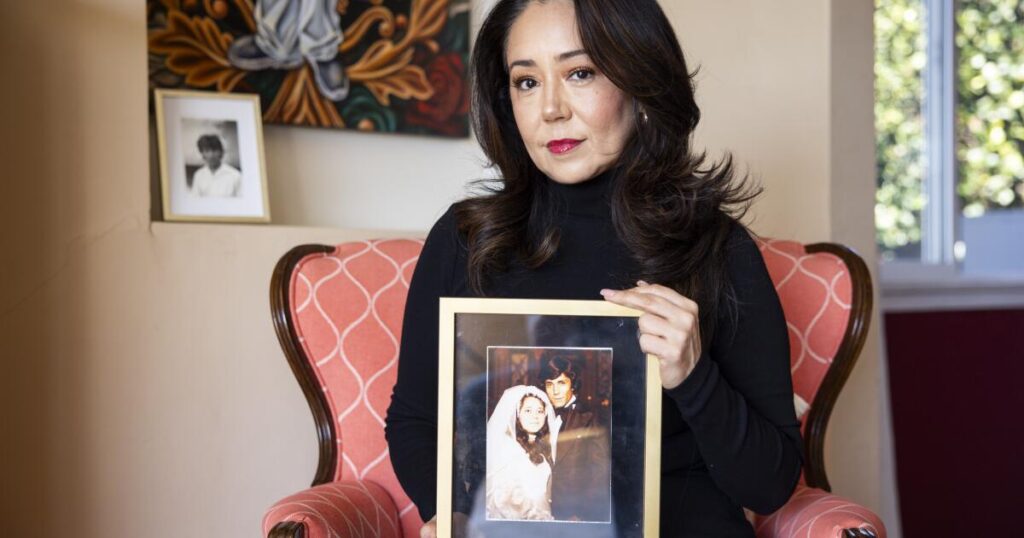
Two days after Mexican forces killed the leader of the Jalisco New Generation cartel last month, Gladdys Uribe was in her California home, anxiously tracking her parents’ movements in Mexico.
The capture and death of the world’s most wanted drug trafficker — Nemesio Rubén “El Mencho” Oseguera Cervantes — triggered a violent retaliation that spread from Jalisco to other states, leaving highways blocked, businesses and vehicles burned, and 25 members of the Mexican national guard dead.
The eruption of violence lasted little more than a day, but it rattled much of Los Angeles, where ties run deep to Jalisco, and many Jalisciences and their descendants are bracing for more chaos in their homeland as rivals in the fractured cartel vie for power.
Tens of thousands of Angelenos worry about family in Jalisco, while those in the U.S. without documentation fear getting swept up in Trump’s immigration crackdown and sent back to a place where deportees are often targets of the cartels.
Uribe frantically monitored the uprising on Feb. 22 through texts, video calls and social media.
Her parents, aunt and uncle, who were in Jalisco, have since returned to the U.S., but she and other families dread a bloody power struggle in the cartel like the one that claimed many civilian lives when the Sinaloa cartel fractured in 2024.
“In the short term, I do think that things will grow more violent,” Uribe said. “In the past, when one cartel seemed weak, other cartels tried to encroach upon their territory.”
Alex Martinez, who has family in Jalisco, said some of his aunts, uncles and cousins in Zapopan, next to Guadalajara, are afraid to go outside while the cartel is in a state of crisis.
“It’s like that saying — If you cut the head of a serpent, then more heads will grow,” he said. “The main hope is that there’s a smooth transition of power.”
The violence has put additional strain on mixed-status families in the U.S. with ties to Mexico, many of whom face the threat of deportation under the Trump administration.
“I have some family that wants to come over, but with the whole ICE situation over here, it complicates things,” Martinez said. “And this is a family that’s looking to do it the legal way.”
The administration has also put a restriction on the number of foreign nationals who can enter the country by revoking or denying tourist visas, as well as increasing immigration fees.
Ingrid Eagly, a law professor at UCLA, said the combination of cartel violence and stricter immigration policies creates uncertainty for immigrants.
“Many people who are being deported currently have lived in the United States for 10 to 20 years,” she said. “And so to return to a place they haven’t been to since they were a child, a place that has all of this violence, I think, would just cause further instability.”
She said general threats of cartel violence would be insufficient for people to file for asylum.
“That can complicate the ability for people to leave, even if it’s just for a short period of time.”
Migration from Jalisco to California and other states dates to the late 1800s with the construction and expansion of the railroad systems in Mexico and the U.S.
The number of people migrating north magnified as many fled violence from the Mexican Revolution and Cristero War, and continued with the Bracero Program, according to James Schmal of Indigenous Mexico, an online resource to Mexico’s Indigenous people, history and genealogy.
Jalisco, a western state in Mexico, is the birthplace of many Los Angeles staples: mariachi music, tequila, charreadas (rodeos), and Jalisco-style cuisine that includes birria(spiced goat or beef stew) and torta ahogada (a salsa-drenched Mexican sandwich).
Los Angeles serves as an extension of home for Jalisciences, who have had considerable influence on the makeup of the city’s culinary and cultural landscape. Countless restaurants carry the name of the state, places such as Birrieria Jalisco and Mariscos Jalisco. Mariachis are a staple of the city, playing at quinceañeras, weddings, birthday parties, gathering at places such as Olvera Street in downtown and Mariachi Plaza in Boyle Heights.
Although the numbers of people with roots in Jalisco is not known, the state is often cited as one of the top feeding Mexican immigration to California, where up to 13 million people identify as being of Mexican descent, according to estimates of the 2024 American Community Survey.
The connection goes both ways. Thousands of American expats live in Guadalajara, Puerto Vallarta and communities along the shore of Lake Chapala — and many more American tourists visit there.
This summer Guadalajara is set to host some of the World Cup games held in Mexico, the U.S. and Canada. The stadium, however, is in Zapopan.
Mexico President Claudia Sheinbaum has been trying to dispel security concerns over the tournament.
“There is no risk,” Sheinbaum said during a Feb. 24 news conference. “Our objective is security and peace, and that is what we’re working towards.”
In the last year and a half, she has reported significant progress curtailing the violence in Mexico, reporting a decrease in homicide rates by 42% from September 2024 to January 2026.
But many wonder how long the relative peace can hold.
Martinez pointed out the surge in violence after Mexican and U.S. authorities captured Ismael “El Mayo” Zambada and Joaquin “El Chapo” Guzman, former leaders of the Sinaloa cartel. He said the violence often stops when a new leader emerges.
“It’s a repeated thing with cartels,” he said.
For years, Jalisco experienced low levels of violence compared with other Mexican states. But that began to change with the formation of the Jalisco New Generation (CJNG) cartel sometime around 2009.
The cartel was one of two factions that splintered from the Milenio cartel, which had its roots in Michoacan and Jalisco in the late 1970s. A turf war ensued and CJNG came out the victor, taking control of the smuggling networks in the region.
The CJNG became known for its ruthlessness and violent military-style tactics, carrying out deadly attacks against security forces including shooting down an army helicopter using rocket-propelled grenades in 2015. Homicides and kidnappings spiked in Jalisco. A key supplier of fentanyl, the cartel has also profited in human trafficking, extortion and fuel thefts. The U.S. has designated it as a foreign terrorist organization.
The uprising over Oseguera’s death underscored the cartel’s reach across Mexico.
When the violence broke out last month, Martinez tried to locate his grandfather, who was eventually found safe in Michoacan.
Elizabeth Uribe, who is friends with Gladdys, checked in on her parents throughout the day as they sheltered inside a hotel in Rincón de Guayabitos, a beach town not far from Puerto Vallarta.
She stuck to traditional news outlets to avoid misinformation being shared by family and on social media.
She said her niece’s godmother was forced out of a bus by cartel gunmen before it was lit on fire. Although her parents returned to the U.S. safely, she’s still concerned about her father’s family in Guadalajara and Puerto Vallarta.
“They don’t have an option, they just kind of have to go back to work and hope things are gonna be OK,” she said.
Gladdys Uribe said her parents were heading to Etzatlán, where cartel gunmen and teens on motorbikes torched a gas station, a state-run bank and dozens of vehicles. She said police and firefighters were nowhere to be seen.
When her parents arrived in the town, she said, they saw people closing their businesses and fleeing. They checked into a hotel and waited for the violence to pass. Smoke was pouring into the room from the street, and they could hear gunfire in the distance and cars exploding.
Uribe enrolled her parents on the Smart Traveler Enrollment Program, or STEP. The federal program sends enrollees updates and alerts from U.S. embassies and consulates abroad.
Uribe and Elizabeth Uribe, who are not related, felt Sheinbaum and other government officials were too quick to declare that things were returning to normalcy and providing a false sense of security.
“My parents were angry,” she said. “Everybody was scared and still sheltering in place, and I felt anger too because I felt like we couldn’t trust what they were saying, like they’re trying to protect their tourism interests and they’re trying to protect the World Cup.”
By Thursday they boarded a plane in Guadalajara, and Uribe gave them a big hug when they walked through the front door of her home in Los Angeles.
“I told them I’m taking their passports for a while,” she said chuckling.
At home sitting in the living room near her daughters, Uribe said she’s still processing what’s happened and reexamining her relationship with Mexico.
“It’s always been like a place that holds a special place in my heart,” she said. ”I feel very rooted there and I’ve always wanted it to be a part of my kids’ lives.”
She said she’s canceled a family trip to celebrate her oldest daughter’s 15th birthday in southern Mexico.
The last year has been difficult for many Latinos, but especially for Mexicans and Mexican Americans.
“It’s like in Mexico, people are in fear of the narcos, and here, even for those of us who are born here, we are cautious when we leave our house,” she said. “We’ve started to carry our passports around.”
“We’re not safe there and we’re not safe here, obviously in a different way.”
The post Californians with deep ties to Jalisco rattled by cartel violence and fears of bloody power struggle appeared first on Los Angeles Times.