On Thursday, minutes after the stock market ended one of its worst days this year, President Trump announced that he had extended his deadline for Iran to open the Strait of Hormuz or face strikes on its power plants.
The change, according to Mr. Trump, reflected that recent talks with the Iranians had been “going very well.” But his timing could not be ignored, given the president’s penchant for turning to the bully pulpit whenever his policies cause markets to get, as he says, “a little bit yippy.”
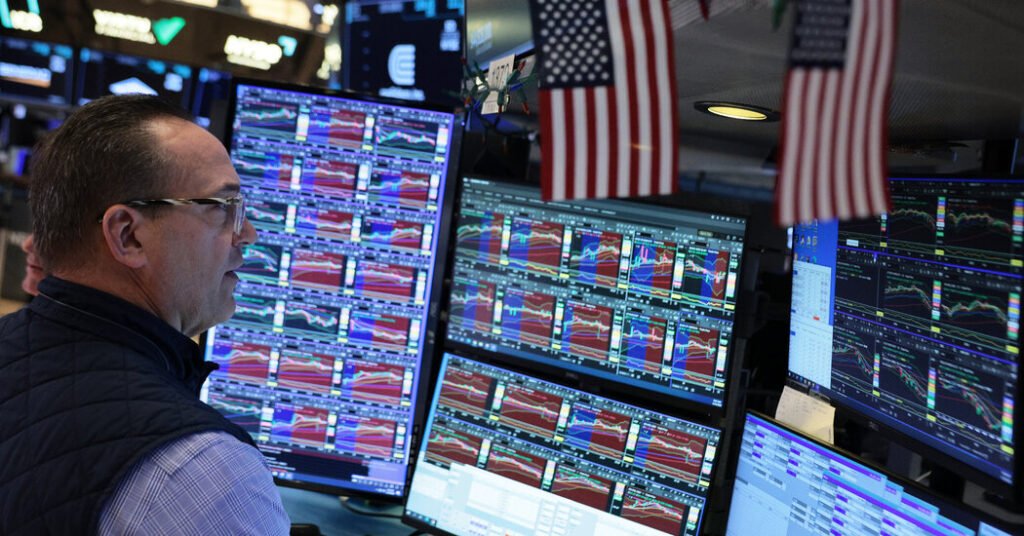
For investors, Thursday marked a brutal session of trading with stocks suffering their largest daily decline since the war with Iran began about four weeks ago. Bond prices slipped and the S&P 500 fell, while the price of Brent crude oil, the global benchmark, surged to just above $108 per barrel.
With risks to the U.S. economy mounting by the day, Mr. Trump has largely dismissed those disruptions as temporary and necessary in pursuit of security and stability in the Middle East. Earlier Thursday, the president even admitted at a cabinet meeting that the fallout “hasn’t been nearly as severe” as he first anticipated.
“Frankly, I thought the oil prices would go up more and I thought the stock market would go down more,” Mr. Trump said at one point.
But the president nonetheless has been sensitive to adverse movements in financial markets throughout his second term. Sometimes explicitly, he has responded with public comments and social media posts that appear designed to give stocks and bonds a jolt.
When his original slate of punishing tariffs triggered a global sell-off last year, for example, Mr. Trump tried to calm markets with an all-caps reassurance on Truth Social. “BE COOL,” he wrote at the time. “THIS IS A GREAT TIME TO BUY!!” Markers later soared.
The same dynamic has surfaced around the U.S. war with Iran, as financial markets and oil prices whipsaw in tandem with the president’s threats and his predictions as to when the conflict may end.
Last weekend, the president threatened to bomb Iranian energy facilities, in a move that could have further constrained the supply of oil, causing prices globally to swell. That led to a panic among investors, until Mr. Trump backed down on Monday, causing oil prices to fall and stocks to rise. He then set a new Friday deadline for Iran to reopen the Strait of Hormuz.
As the week progressed, Mr. Trump claimed that the Iranians were open to a deal — while officials in Tehran appeared to indicate that they were far from a resolution in hostilities. Consequently, trading remained volatile, and appeared to ebb and flow around the conflicting statements about the war.
By Thursday, with his original deadline approaching, Mr. Trump said on social media that he was “pausing the period of Energy Plant destruction by 10 Days to Monday, April 6, 2026, at 8 P.M., Eastern Time.”
Shortly after, by Thursday evening, stock futures were up slightly
Government bond yields, which underpin interest rates on consumer and corporate debt and trade later in the day than stocks, fell sharply after Trump’s announcement, only to keep rising afterward.
Joe Rennison contributed reporting.
Tony Romm is a reporter covering economic policy and the Trump administration for The Times, based in Washington.
The post As Markets Revolt in the Face of War, Trump Extends Iran Deadline appeared first on New York Times.