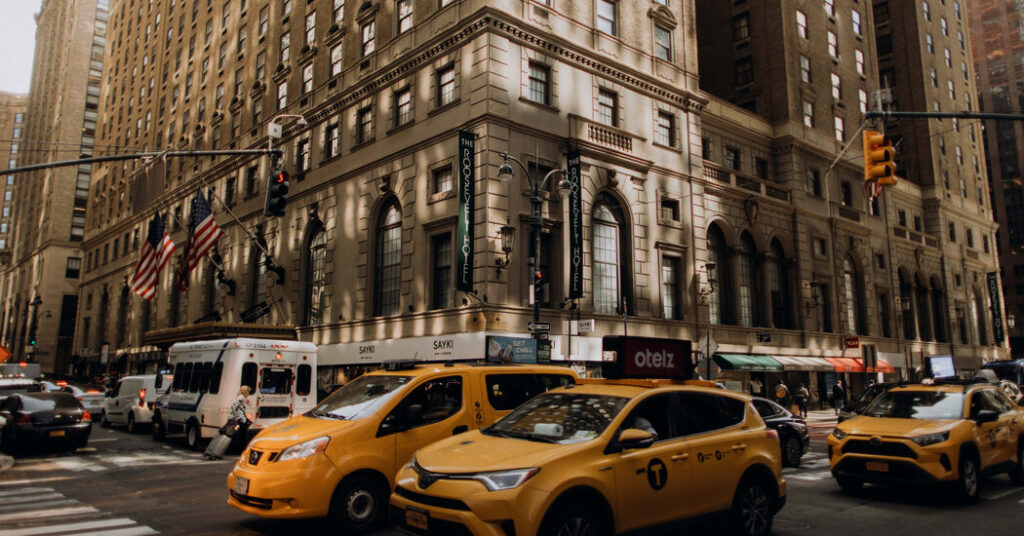
At President Trump’s inaugural Board of Peace meeting in Washington last month, his special envoy, Steve Witkoff, unveiled a promising new partnership with Pakistan.
It was not a governmental decree against terrorism or war. Rather, it was an unorthodox real estate deal involving a shuttered hotel in Midtown Manhattan.
A former real estate developer now assigned to negotiate peace around the world, Mr. Witkoff brokered the unusual arrangement between the United States and Pakistani governments to explore the redevelopment of the Roosevelt Hotel, a once glamorous building that Pakistan owns.
While the Trump administration has not made the terms of the deal public, a White House official briefed on the matter described it as a potentially lucrative partnership between the two governments to co-own the property.
It was the latest bond that Pakistan forged with the Trump administration, part of a broader strategy of wooing the president and his inner circle.
The charm campaign, while not initially tied to Mr. Trump’s war in Iran, elevated Pakistan’s standing in Washington in the lead-up to the conflict. And Pakistan, which shares a 565-mile border with Iran, is now playing a potentially central role in the halting effort to bring about a cease-fire and a peace deal.
Pakistan’s leaders recently relayed to Iran Mr. Trump’s 15-point plan to end the war, acting as a pivotal intermediary, and they have offered to host talks between the two sides.
It is a striking rise in station for Pakistan, which little more than a year ago was a diplomatic afterthought in Washington. But since Mr. Trump returned to office, the Pakistanis have lavished praise on the president, hired lobbyists tied to his family and even nominated him for the Nobel Peace Prize. They also struck a series of business deals that mimicked the administration’s own transactional approach to foreign policy.
Mr. Trump’s Board of Peace embodies that worldview. The board’s very name connotes the loftiest of intentions; it was originally pitched as a diplomatic body to help rebuild Gaza and even rival the United Nations. But it has also become a forum for commerce, requiring a $1 billion fee for countries to gain permanent membership, making it a natural venue to roll out the Roosevelt Hotel deal.
A month before the Pakistani finance minister sealed the hotel deal there, he signed an agreement to work with an affiliate of World Liberty Financial, the crypto start-up founded by the Trump and Witkoff families.
The White House, however, denied any link between Mr. Witkoff’s Roosevelt Hotel deal and either his family’s crypto firm or his talks with Iran.
“This is a deal that could only be negotiated by someone with the talent and expertise of Special Envoy Witkoff,” Anna Kelly, a White House spokeswoman, said of the hotel deal, adding that it came “at no cost to the American taxpayer.” She said that Pakistan “has been an important partner” on a range of issues, including counterterrorism.
David Warrington, the White House counsel, said Mr. Witkoff “has not and does not participate in any official matters that could impact his financial interests.”
And David Wachsman, a spokesman for World Liberty, said the crypto firm “has nothing to do with the actions of the U.S. government.” Mr. Witkoff’s stake in World Liberty was divested and sold to his sons in January, a White House official said.
A spokesman for Pakistan’s finance ministry did not respond to requests for comment.
Pakistan would gain from a quick resolution to the Iran war, officials and analysts say. Prolonged instability in Iran could unsettle Pakistan’s Shiite community, one of the world’s largest outside Iran. The strangling of the Strait of Hormuz has also stranded Pakistan’s economy.
Facilitating talks, on the other end, would help Pakistan strengthen its profile in the West and Asia as a diplomatic power, while sidelining its archrival India.
For more than two decades, the war in Afghanistan shaped the U.S.-Pakistani relationship. After the United States withdrew troops from Afghanistan in 2021, Pakistan became somewhat irrelevant in the eyes of the United States, analysts have said, to the point that Mr. Biden never called the two Pakistani prime ministers who served during his tenure.
The second Trump era offered Pakistan a reset — and a new cast of diplomats with whom to intersect, notably Mr. Witkoff, Mr. Trump’s longtime friend, and Jared Kushner, the president’s son-in-law.
Like the president, Mr. Kushner and Mr. Witkoff emerged from the back-scratching world of New York real estate, an experience that influenced their diplomatic undertakings.
Mr. Kushner holds no formal government role — Mr. Trump pronounced him an “envoy of peace” — while Mr. Witkoff is an administration official. In addition to their role in negotiations with Iran, they led the Trump administration’s successful efforts to extract hostages from Gaza and have waded into talks surrounding Russia’s war in Ukraine.
Ms. Kelly, the White House spokeswoman, said Mr. Witkoff and Mr. Kushner have “spent considerable time away from their families, while paying all of their own expenses,” to advance peace around the world.
In an interview last year after a breakthrough in the Gaza talks, Mr. Kushner said his and Mr. Witkoff’s approach to diplomacy relied on being “deal guys” who “understand people.”
Mr. Kushner added: “A lot of the people who do this are history professors, because they have a lot of experience, or diplomats. It’s just different being deal guys — just a different sport.”
Pakistan has appeared to emulate that approach.
Last spring, Pakistan hired lobbyists who once worked for Mr. Trump’s family business, including Keith Schiller, Mr. Trump’s ex-bodyguard. It also negotiated a deal with the Trump administration last year that benefited both countries, extracting a commitment from Washington to invest $1.3 billion in a gold-copper mine as part of an effort to erode China’s global dominance over critical minerals.
And after an armed conflict with India last year, Pakistan credited Mr. Trump with securing a cease-fire, even nominating him for the Peace Prize, “in recognition of his decisive diplomatic intervention and pivotal leadership.”
Pakistan also landed in Trump’s good graces last year when it arrested a top Islamic State leader.
And in June, Field Marshal Syed Asim Munir, Pakistan’s top military leader, had a private lunch in the Oval Office with Mr. Trump, developing a personal relationship that helped improve ties between the two administrations. They discussed economic development and crypto, among other subjects, according to the Pakistani government. (A White House official denied that crypto was discussed.)
“The natural way of how the Pakistani military establishment works is that it tries to align closely to the American interests,” said Hussain Nadim, a former Pakistani policy official who has served as a lecturer at George Washington University. In the Trump era, he added, the Pakistanis appear to have pursued a policy of “crypto diplomacy.”
Pakistan formed its alliance with World Liberty last spring when Mr. Witkoff’s son Zach traveled to Islamabad for meetings that had the hallmarks of a state visit. With an American flag pinned to his lapel, the younger Mr. Witkoff met with the prime minister; he also took in a fireworks display with the co-founders of his firm.
Zach Witkoff returned to Pakistan in January to announce a new memorandum of understanding, pledging to work with Pakistan to incorporate crypto into the country’s financial system.
Mr. Wachsman, the spokesman for World Liberty, said the firm was not paid for the agreement. While the exact contours of the collaboration are unclear, the company said Pakistan was examining ways to use stablecoins, a type of cryptocurrency that World Liberty issues, to process international money transfers.
Muhammad Aurangzeb, the Pakistani finance minister, was there for the deal announcement, shaking hands and posing for photographs with the younger Mr. Witkoff.
A month later, Mr. Aurangzeb met with the elder Mr. Witkoff at the Board of Peace meeting, where the Roosevelt Hotel deal took flight.
The property was shut down during the pandemic and briefly reopened as a migrant shelter. Now, the Pakistani government wants to demolish the hotel to develop a new high-rise tower — and it sought Mr. Witkoff’s help.
The deal is a nonbinding collaboration between Pakistan and the General Services Administration, the federal agency that typically buys, builds and manages office space for other agencies.
With little precedent for such a deal, congressional Democrats recently questioned why Pakistan might need the G.S.A.’s assistance in a private real estate endeavor.
The arrangement “doesn’t make any sense,” Representative Rick Larsen, a Democrat from Washington, told the head of the General Services Administration, Edward C. Forst, at a hearing this month. “It’s not G.S.A.’s job to do this.”
In a statement to The New York Times, Mr. Larsen said he had “not yet heard anything from G.S.A. that would explain what possible interest they could have in a property owned by the government of Pakistan.”
A G.S.A. spokeswoman, Marianne Copenhaver, said the agency “is pleased to support the bilateral and commercial relations” between the two countries by “exploring opportunities to help facilitate the redevelopment” of the property. At the congressional hearing, Mr. Forst, another former real estate executive, said the deal “obligates us to do nothing.”
“The government of Pakistan approached Special Envoy Witkoff with the opportunity to collaborate” on a property in a “very hotly interested location,” he said.
With Mr. Witkoff standing behind him, Mr. Forst signed the deal at the peace meeting, alongside Mr. Aurangzeb and Pakistan’s prime minister, Shehbaz Sharif.
The Trump administration chose to announce the deal at the peace meeting, a White House official said, because officials from both the United States and Pakistan would be present.
The next steps are unclear. Pakistan is looking to retain a stake in the property but wants to redevelop it with a partner, according to Muhammad Ali, the chairman of the Pakistani government’s privatization commission.
In an interview at a government office in Islamabad, Mr. Ali said he did not know whether the U.S. government might remain involved in the project, but said the partnership with the G.S.A. was “one big plus” that gave Pakistan “more credibility.”
He said Pakistan would also seek to partner with sovereign wealth funds from the Middle East and U.S. real estate developers over the next four to six months.
Mr. Trump’s family real estate business had discussions years ago about a potential deal for the hotel, but has not been involved in any recent talks with Pakistan or Mr. Witkoff about the property, according to people with knowledge of the matter. Mr. Witkoff’s family real estate business also said that it had no involvement and therefore had no comment.
Now, Pakistan has emerged as a messenger between the United States and Iran.
In a social media post on Tuesday, Prime Minister Sharif offered to host peace talks between the United States and Iran, “in the interest of peace and stability in region and beyond.”
David Yaffe-Bellany writes about the crypto industry for The Times from New York. He can be reached at [email protected].
The post After Wooing Trump With Deals, Pakistan Gets a Seat at the Table appeared first on New York Times.