Did we even hear the same thing?
That old line that tends to come up when people disagree about a concert or opera. In the case of the new hit production of Wagner’s “Tristan und Isolde” at the Metropolitan Opera, that question may actually be in order.
After my review of the show’s opening earlier this month, some readers sent me emails that expressed bafflement at my largely positive descriptions of the cast and orchestra’s sound. The singers were chronically quiet, they wrote, while the orchestra was far too loud.
I returned to “Tristan” with their observations in mind last Saturday, and sat in the same seats as before, about a third of the way up the Orchestra level, on the left aisle. The opera sounded even better, with the tenor Michael Spyres more secure and soaring as Tristan, and the soprano Lise Davidsen an Isolde of astounding radiance. The orchestra was occasionally more present than it should have been, but it was never unmanageable for the leading singers.
Then, curious to hear what the show might have been like for some of those disgruntled readers, I bought a ticket to Wednesday’s performance in the Balcony, which, with the Family Circle, forms the highest level of seating at the Met. This is where you find some of the least expensive seats in the theater, and some of the most devoted fans. It’s here that I fell in love with opera as a teenager, captivated by how the sound from the orchestra pit and the stage swirled upward and blended with satisfying balance.
On Wednesday, the performance was off from the start, with technical mishaps that presaged five hours of tentativeness and a seemingly contagious lack of energy. But in the Balcony, the biggest problem was the very thing I had been hearing about since opening night: erratic, suffocating acoustics that at their worst diminished Spyres and Davidsen. You would have thought their vocal power was slight. Nothing could be further from the truth.
There are two likely culprits.
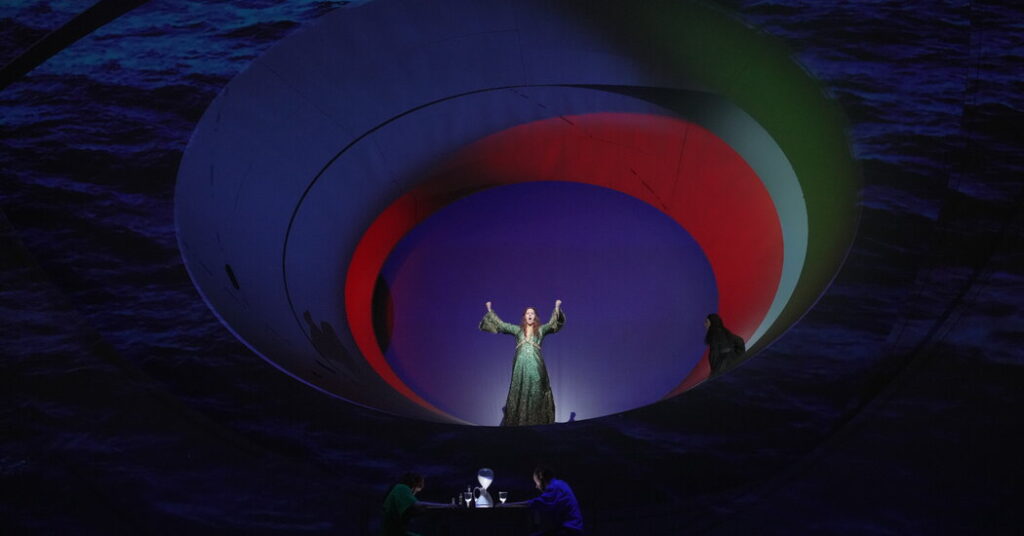
One is the production’s scenic design. Yuval Sharon’s staging features sets by Es Devlin, and at the heart of their visual conceit is a series of tunnels that change with each act, culminating in a cosmically immense, deep portal to the beyond. From the Orchestra level, the tunnels were only a problem when they erratically amplified the singers’ voices, similar to how the famous Whispering Gallery at Grand Central Terminal works. But from the Balcony the performers, enveloped and hooded by the tunnels, were dampened. The only artist who emerged unscathed was the English horn player Pedro R. Díaz, whose strange and lonely Act III solo, staged inside the structure, was as clear as can be, with no competing sounds.
The most apparent indication from the Balcony of how drastically the set affected volume was a bit of action that takes place downstage, outside the tunnels and closest to the orchestra and audience. There, the cast performs in a zone of more neutral acoustics in which Spyres and Davidsen regained their titanic force. (The mezzo-soprano Ekaterina Gubanova, as Brangäne, was underpowered regardless of where she stood.)
Even then there were difficulties with balance, which brings us to the second culprit: the orchestra. “Tristan” is an exceptionally symphonic score, but it’s still an opera, drama communicated through vocal music. Few lines of the libretto could be made out over the playing, which from the Balcony was often so loud it reduced the singers to textures, like instruments in the ensemble.
Yannick Nézet-Séguin, the Met’s music director, has been conducting this run, and Wednesday’s bombast was symptomatic of a worrying trend. He often conducts as if his duties didn’t extend beyond the pit to the stage, and in “Tristan” he isn’t sensitive to the set and its limitations. For the past several years, he has been incapable of balancing the orchestra and singers. The issue was especially pronounced in the Balcony; from there, he seemed uninterested in even trying.
The problem of this production’s sound can be corrected, though. “Tristan” is nearing the end of its run, on April 4, and it’s a miracle that a staging with so many moving parts was ready on opening night. Premieres in opera are like the first preview of a Broadway musical: the roughest form of the show the public will ever see. There are always kinks that need to be worked out.
Sharon needs an opportunity to work out even more. If the Met revives his “Tristan” (something never afforded Mariusz Trelinski, whose 2016 production had only one outing before Sharon’s was commissioned), he should be allowed the proper space to refine his ideas and ensure that it can be heard from anywhere in the auditorium. It doesn’t seem right for only the most expensive seats in the house to have acceptable acoustics.
The orchestra, for its part, could improve its sound as soon as tomorrow. At this point, its reckless sense of balance is willful. And only Nézet-Séguin can fix it.
Joshua Barone is an editor for The Times covering classical music and dance. He also writes criticism about classical music and opera.
The post A Troubling Problem at the Heart of the Met Opera’s Big Hit appeared first on New York Times.