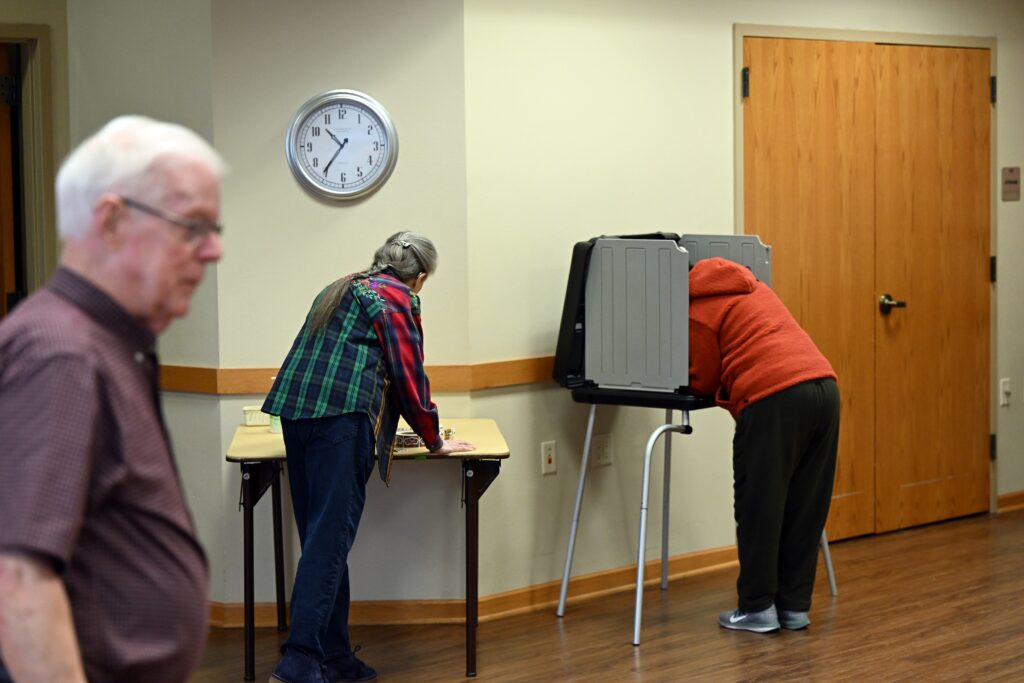
The chair of elections in Wisconsin had a helpful reminder for voters in the state Wednesday: Don’t place bets on a state election. It’s illegal.
“I know it’s all the rage to bet on everything, but you cannot bet on an election in Wisconsin,” Elections Commission Chair Ann Jacobs said on X. “If you do, your ballot can be challenged & thrown out. … So go vote and save your $ for playing Euchre with your uncle!”
Jacobs cited an obscure statute within Wisconsin law that dictates that no individual is allowed to vote in an election in which they have “become interested, directly or indirectly, in any bet or wager depending upon the result of the election.”
The state’s Elections Commission won’t proactively check whether voters are placing bets on elections but will investigate any complaints it receives, Jacobs said. Those who vote in elections where they make wagers could face voter-fraud charges, she said.
She posted a message about Wisconsin’s restrictions on voting on elections after hearing a news report on the rise of betting markets, she said. Jacobs, a Democrat who chairs a bipartisan commission, said Wisconsin’s ban makes sense.
“You want people to vote based on who they believe the best candidate is, not in order to tip the scales on a bet,” Jacobs said.
Koleman Strumpf, a political economy professor who specializes in prediction markets at Wake Forest University, told The Washington Post that it would be difficult for Wisconsin officials to identify and prosecute individuals who violate the statute.
“If you go and find John Q. Citizen betting $50 on an election, and you do something to this person, you’re going to look not so good,” Strumpf said. “It’s not worth the time.”
Wisconsin is one of the few states that have laws that specifically ban bets on elections.
A Texas statute bans betting “on the result of any political nomination, appointment, or election or on the degree of success of any nominee, appointee, or candidate.” And Arizona laws ban betting on elections, as well as the operation of unlicensed wagering businesses.
As of Wednesday, about $18,000 was at stake in elections for Wisconsin governor and its eight congressional races, a Post analysis of Polymarket data showed.
Far more — about $1.1 million — rests on elections in Texas. Most of that, more than $840,000, is at stake on the winner of the Republican primary runoff in May for Texas’s open Senate seat, a race that pits incumbent Sen. John Cornyn against the state’s attorney general, Ken Paxton.
Prediction markets are facing more scrutiny from lawmakers amid their rising popularity — and availability — in the United States. Last week in Arizona, state Attorney General Kris Mayes (D) filed charges against Kalshi, accusing the company of election wagering and of operating an illegal gambling business in the state without a license.
Arizona alleges that Kalshi, an exchange and prediction market, accepted bets from Arizona residents on a variety of events in violation of state law. Those include not only professional and college sports games but also on the likelihood that the SAVE America Act — a piece of legislation that President Donald Trump is urging Congress to pass — will become law.
The website is being accused of election wagering because it promoted bets on the 2028 presidential race, the 2026 Arizona gubernatorial race and the 2026 race for Arizona secretary of state.
Kalshi contends it is a financial marketplace rather than a gambling operation, subject to federal regulation by the Commodity Futures Trading Commission, and has vowed to fight the case.
“Kalshi may brand itself as a ‘prediction market,’ but what it’s actually doing is running an illegal gambling operation and taking bets on Arizona elections, both of which violate Arizona law,” Mayes said in a statement. “No company gets to decide for itself which laws to follow.”
At the federal level, Sens. Adam Schiff (D-California) and John Curtis (R-Utah) introduced a bipartisan measure this week that would specifically ban sports prediction markets. While the legislation does not mention betting on elections results, Curtis explained in a statement that the measure “is about respecting states’ authority, protecting families, and keeping speculative financial products out of spaces where they don’t belong.”
Jeremy Merrill and Patrick Marley contributed to this report.
The post Wisconsin elections chair reminds voters they can’t bet on state elections appeared first on Washington Post.