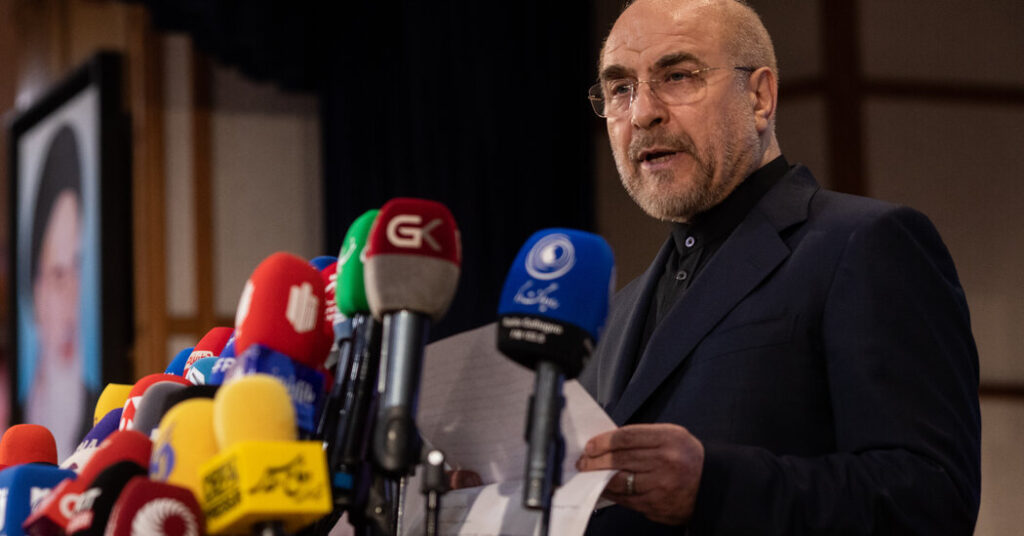
Mohammad Bagher Ghalibaf, a former Islamic Revolutionary Guards Corps commander who is one of the key figures overseeing Iran’s war with Israel and the United States, has been a defiant voice for the regime. On Wednesday, he said on social media that Iran was closely monitoring American troop deployments, warning, “Do not test our resolve to defend our land.”
Yet as the Trump administration pursues talks to end the fighting, Mr. Ghalibaf, a brigadier general who is also the speaker of Iran’s Parliament, has emerged as a potential contact point.
Pakistan’s army chief, Field Marshal Syed Asim Munir, recently reached out to him with a proposal that Pakistan serve as host for negotiations between the United States and Iran, according to an Iranian official and a Pakistani official, both of whom spoke on condition of anonymity to discuss the sensitive communications. Field Marshal Munir is believed to have close ties to the Revolutionary Guards.
Mr. Ghalibaf, 64, is one of the highest-ranking officials left in Iran, having survived the wave of killings of the country’s top leaders since the start of the war. Before Israel and the United States attacked the country on Feb. 28, Ayatollah Ali Khamenei, the supreme leader killed in the initial strikes, had designated Mr. Ghalibaf as his de facto deputy, tasked with leading the armed forces during war.
Mr. Ghalibaf is also close to the slain supreme leader’s son, Ayatollah Mojtaba Khamanei, who succeeded his father.
Mr. Ghalibaf, who became the speaker of Parliament in 2020, is one of Iran’s most prominent conservatives. A former pilot who served as mayor of Tehran, he ran for president several times, always unsuccessfully, though he was seen as a top contender for the job in both 2017 and 2024. His appeal was based more on his management skills than his ideology. He has long been seen as a leader of the conservative wing of Iran’s establishment, but he is not considered one of its most hard-line figures.
He faced accusations of financial corruption during his tenure as mayor, and of moral hypocrisy for his family’s lavish spending abroad. He has denied the allegations.
In 2015, as mayor, he made headlines for ordering that all of Tehran’s 1,500 billboards be fitted out with copies of famous works of art, including ones by Western artists. The initiative delighted and astonished residents, some of whom also saw it as a savvy move. At the time, it appeared that relations with the United States might be warming, and some wondered if Mr. Ghalibaf was trying to position himself as a cosmopolitan moderate, to show he was the right man for the times.
But Mr. Ghalibaf has taken a hard line against dissent. He was known for his role in Iran’s violent repression of protesting students in 1999 and then in 2003, when he served as the country’s chief of police and was reported to have told the authorities to use live ammunition against students.
He labeled the most recent wave of protests, which the government brutally repressed in January, as “sedition.”
Since the war began, Mr. Ghalibaf has joined other top officials in speaking out defiantly against the United States and Israel.
Earlier this month, he wrote on social media that Iran was not seeking a cease-fire, vowing to fight on. “We believe we must strike the aggressor in the mouth so that it learns a lesson and never again even thinks of aggressing against our dear Iran,” he said. And on Monday, he dismissed as “fake news” President Trump’s assertion that talks with the United States were underway.
Amelia Nierenberg is a Times reporter covering international news from London.
The post Who Is Mohammad Bagher Ghalibaf? appeared first on New York Times.