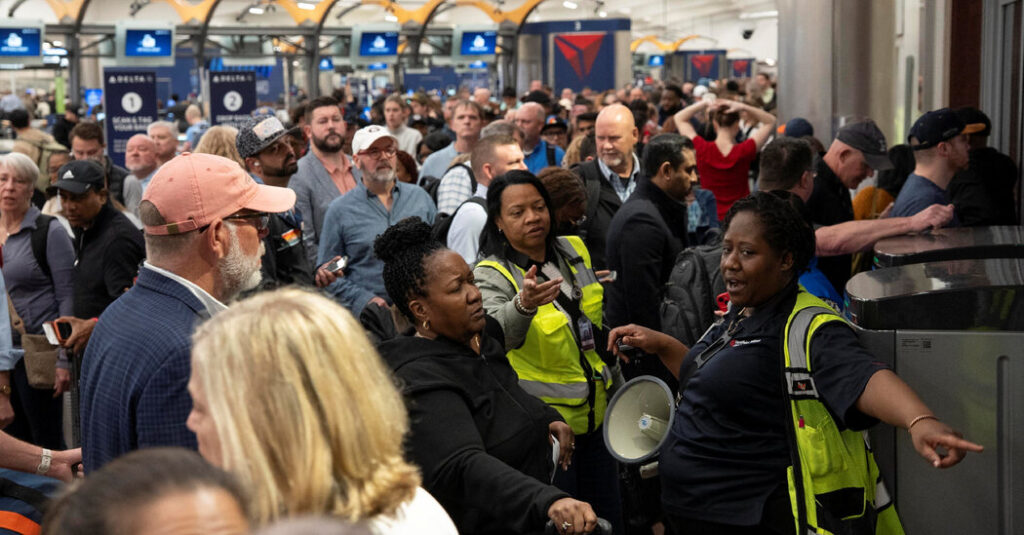
Inside the claustrophobic basement of Houston’s Bush Intercontinental Airport, Dyan Thompson, 42, and her co-workers were already making plans for the end of the line.
“We’ll be laughing about this when it’s through,” Ms. Thompson assured Angela Macfarlane, 50, and Shelley Blair, 49, who all work for a veterinary practice in the Houston area.
“We’ll be laughing once we get a cocktail,” Ms. Blair corrected her.
Even on a good day, any time spent in a security line at the airport is something to be endured, not savored. Tuesday was a day for endurance.
At a seemingly random collection of airports all over the country, people waited in security lines that stretched for hours, the result of a government shutdown that has forced Transportation Security Administration workers to show up for work without pay. The Trump administration this week deployed Immigration and Customs Enforcement to help, with unclear results.
The New York Times dispatched reporters to several of the airports. Some were there to report on the delays; others just to get where they were going. What they found were thousands of would-be air travelers who were frustrated, beleaguered, but mostly making the best of it.
Houston
The line had started two escalators down from check-in, beside where the airport subway runs. A Kacey Musgraves song played over the airport speakers: “Slow Burn.”
Of all the airport chaos this week, the larger of Houston’s two major airports seemed to have gotten the worst of it. In the morning, the Houston Airport System’s wait time tracker was clocking a wait time of four and a half hours.
Those of us in the basement were left to look around, listen to music or talk to the people in line beside us. Nearby, a group of four ICE agents leaned against a wall.
Glen Pennetta, 64, a territory sales manager, was traveling for work. He joined the veterinary workers’ conversation. A frequent flier, he had some wisdom to share: “It’s always something,” he said. He offered me some of a breakfast bar he’d brought with him.
Although this group in line had started the morning as strangers, a half-hour spent standing together, facing the prospect of hours more, created a sort of lightly deranged bond.
“If you want to hear a real bad story, ask that guy,” said Ms. Thompson, pointing to a man standing ahead of them. That guy was Janovemr Vaagane, 66, a Norwegian retired offshore technician. He too had experience with this sort of thing, though it was somewhat more recent: He’d been here yesterday, trying and failing to get back to Europe.
“I was waiting in line for three hours here when my plane to Frankfurt took off,” he said. He gave up and decided to try again on Tuesday.
“Except this time I got here a lot earlier,” he said. Later, he texted me a picture of a basket of chips and salsa and said he’d made it to his gate — after a three and a half hour wait, with 30 minutes to spare. “Relaxing with a beer and some nacho chips,” he wrote. “Life is good.”
— SHANNON SIMS
Atlanta
I had never packed a snack for the airport security line.
But in my kitchen around 5 a.m. on Tuesday, I grabbed a banana and raided my family’s Goldfish supply.
I had heard about hours of waiting, flaring tempers, growling stomachs and aching feet at Hartsfield-Jackson Atlanta International Airport, among the world’s busiest.
But I had meetings in Washington, so I joined the PreCheck line curbside at 6:03 a.m. At first, people stood silently. Some snapped pictures. Then people started to talk: When is your flight? How early did you wake up? Someone yesterday said it took how long? Oh, dear, there’s a television camera. Where’s ICE?
After 16 minutes, the single-file line inched inside, past the check-in counters and snaked among the baggage carousels.
For the most part, people were cheerful. But in a long and sluggish line, with neither its beginning nor end in sight, drama was inevitable. At one point, a man about 40 feet away shouted “white privilege!” Where was white privilege occurring? Who was experiencing it? Were they somehow getting out of this line? We would never know.
So airport workers offered pep talks. “Last of the sprint,” one said at 6:45 a.m., as if we were marathoners. A handful of ICE agents moved past, some clutching coffee cups.
“They had time to get Starbucks,” one passenger observed. A few moments later, another passenger opined on line logistics: “Two lines and then one — this is how a zipper works.”
The area where the lines often begin came into view after 63 minutes in line. There were more ICE agents, including one with zip ties.
T.S.A. officers awaited. They smiled wanly. They nodded when someone thanked them. They appeared exhausted.
The clump of newfound friends — or whatever they were, since names were never exchanged — marched forward, shedding bags and coats, emptying pockets, eyeing clocks, silently pleading with the gods that today not be the day the random screening beep sounded.
Exactly 90 minutes after we met alongside a curb in Atlanta, we were through. I found pancakes so I wouldn’t break out the Goldfish.
I didn’t know if I might need them in line on the way home.
— ALAN BLINDER
Newark
The scene at Newark Liberty International Airport on Tuesday was disorienting: It resembled … a functional airport?
What had a day earlier been a river of people, flowing frustratingly past patrolling ICE agents and into struggling TSA personnel, was now a trickling stream. For the passengers and the agents within sight, bedlam had passed. Boredom had taken over.
The check-in time at Terminal C was about seven minutes, Terminal A about five minutes. At Terminal B, what was a 30-minute wait to go through security for a flight to India was quickly cut to five minutes according to an airport security guard.
It had been slow and jammed earlier, the guard said. No longer. Passengers rolled their suitcases at a fast clip toward the checkpoints.
Nearby, a photographer from a Turkish news agency took pictures as a group of three ICE agents strolled along. They spoke to no one. No one spoke to them. Once their patrol was over, the agents joined another group of agents.
They stood around, their thumbs in their vests, talking among themselves.
“Man, I’m really, really bored,” one ICE agent said to the group. “Anybody want coffee?”
— MARK BONAMO
Alan Blinder is a national correspondent for The Times, covering education.
The post What It’s Like to Stand in an Airport Security Line for Hours appeared first on New York Times.