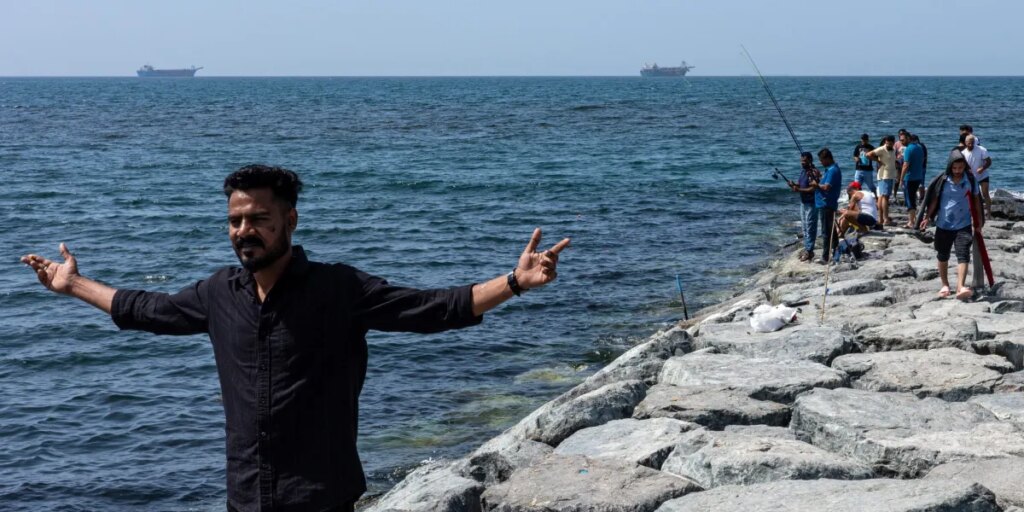
Iran’s supreme leader is dead. Much of its military infrastructure is destroyed. Its allies are alienated. But the war against Israel and the U.S. has given Tehran something it might not have otherwise appreciated: the unprecedented leverage it holds over the Strait of Hormuz. Now, Iran is trying to milk it.
The Islamic Revolutionary Guard Corps (IRGC), the hardline military force that has consolidated power within what remains of the Iranian regime following Khamenei’s death, has communicated a list of cease-fire conditions to the Trump administration, according to the Wall Street Journal. The two sides aren’t in direct contact, and the Journal reported that these conditions were sent through Middle Eastern intermediaries, though the U.S.’s recent fifteen-point-plan was sent through Pakistan. President Donald Trump, the “master of the deal” who has championed his ability to jawbone other nations through tariffs, has now insisted that his administration has been in fruitful negotiations with Iran, a claim Tehran has mocked by asking if the President was talking to himself.
The demands are sweeping: closure of all American military bases in the Persian Gulf; full reparations for U.S. strikes on Iranian territory; and the complete lifting of sanctions. Iran also seeks full preservation of its missile programs and guarantees that the war won’t restart, for itself and for Iran’s proxy Hezbollah in Lebanon.
But one demand stands apart from the rest.
Tehran wants a new order for the Strait of Hormuz—one that would let Iran collect fees from every ship that transits the waterway, modeled on the toll Egypt collects from vessels passing through the Suez Canal. The Suez uses a somewhat complex formulabased on the tonnage of each ship, but on average, cargo ships pay $250,000 to cross. Since the Suez is a manmade canal, Egypt collects the toll to pay for the costs of constructing and maintaining it.
The Strait of Hormuz, on the other hand, is a natural waterway, and Tehran essentially wants to charge ships for the privilege of crossing it without being bombed. It’s hard to overstate the importance of the Strait: roughly 20% of the world’s oil supply passes through it each day. It is the single most important chokepoint in global energy markets,and though oil future markets have taken to bullishness with all the talks about peace talks (as of writing, Texas crude is at $89,), oil analysts are losing their voices from warning about the physical reality of the Straits’ closure catching up. Only two vessels crossed the Strait on March 24, according to figures from the S&P Global Market Intelligence team, much less than the usual 150-160 vessels that cross. And if those vessels would be required to pay a permanent Iranian toll, it would reshape the economics of global energyand hand Tehran a lever it could pull any time it wanted concessions from the West.
Iran has already started charging ships approximately $2 million to cross the Strait, which Iran’s foreign ministry confirmed. Analysts say that the premium is a “bargain” compared to the price of traditional shipping insurance premiums, which have skyrocketed since the war began. ut it effectively means that Tehran is leveraging the threat of its own missiles and mines to capture the profits of the insurers. Plus, an unconfirmed Iranian plan to require the ships to pay their toll in yuan, instead of dollars, would pose a great threat to the dominance of the American petrodollar, long considered the keyto the U.S holding its reserve currency status.
A U.S. official called the demands ridiculous and unrealistic, and told the Journal the posturing will make reaching a deal harder than before Trump authorized the strikes that started the war.
That may be true. But the demands, of course, aren’t designed to be accepted at face value—rather, they’re designed to set a negotiating floor amidst whipsawing energy markets.
The IRGC is also flexing its influence, anchoring the negotiation on its terms and signaling to domestic audiences that Iran emerged from the war unbowed. The regime’s information council called the U.S. peace plan a wishlist of objectives that hadn’t been achieved on the battlefield. The semi-official news outlet Press TV said Iran doesn’t accept a ceasefire at all—only an end to the war “when it decides to do so” and when its strategic objectives are met. Trump’s 15-point-counterplan is equally maximalist, demanding a rollback of Iran’s nuclear program and the end of their funding proxies, according to Israel Channel 12.
The post Trump wrote the tariff playbook. Now Iran is using it on the world’s most important oil route. appeared first on Fortune.