The Trump administration’s decision to ease oil sanctions on Russia and Iran in a bid to contain soaring energy prices prompted by the war with Iran has drawn bipartisan backlash on Capitol Hill, where lawmakers warn that it risks funneling billions of dollars to U.S. adversaries.
Lawmakers in both parties said the policy undercut years of economic pressure designed to weaken Moscow’s war effort in Ukraine and constrain Tehran’s regional ambitions.
“Easing sanctions on Russia at this critical juncture, instead of increasing pressure, risks fueling Russia’s aggression and undermining progress we have made to reduce Russia’s global energy leverage,” Representatives Don Bacon, Republican of Nebraska, and Gregory W. Meeks of New York, the top Democrat on the House Foreign Affairs Committee, said in a letter to Treasury Secretary Scott Bessent and Secretary of State Marco Rubio demanding answers on the administration’s decision to ease sanctions on Russian oil.
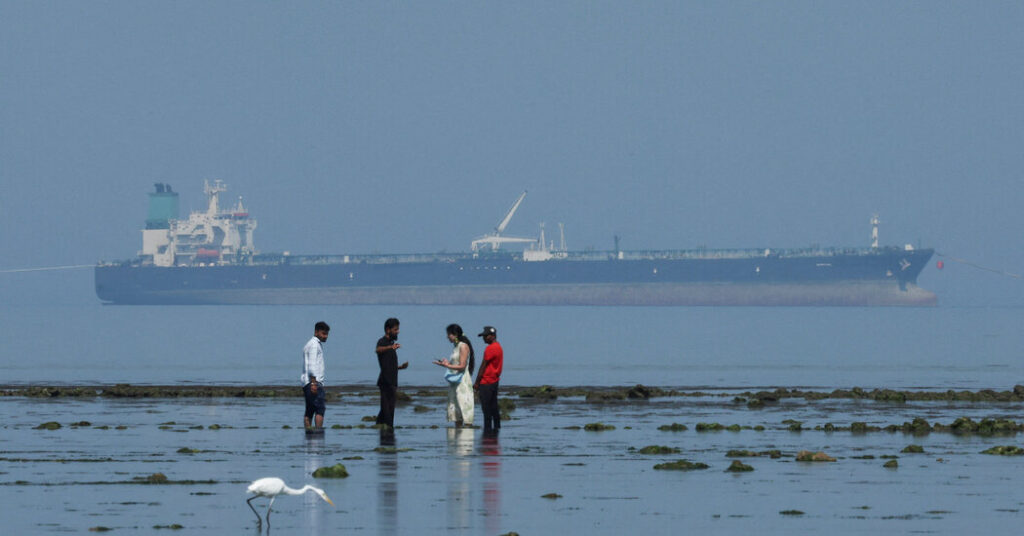
Earlier this month, President Trump lifted restrictions on Russian oil exports, allowing shipments to resume to buyers around the world as officials scrambled to stabilize global supply following disruptions tied to the war in Iran. Days later, the administration temporarily waived sanctions on roughly 140 million barrels of Iranian oil sitting at sea, opening those cargoes to the global market for 30 days.
With crude hovering near $100 a barrel, the twin moves were intended to ease pressure on gasoline prices at home. But they could also deliver a financial windfall to two countries at the center of U.S. national security concerns.
Criticism has come from across the political spectrum.
Senator Chuck Grassley, Republican of Iowa, called lifting restrictions on Russian oil the “wrong move,” adding that every dollar generated from sales “fuels Putin’s war” and prolongs suffering in Ukraine.
Senator Roger Wicker of Mississippi, the Republican chairman of the Armed Services Committee, signaled unease with the administration’s broader strategy, criticizing the combined decision to ease sanctions on both Russian and Iranian oil.
The moves, he said on Tuesday, were “not my favorite thing that I’ve ever heard.”
In a floor speech on Tuesday, Senator Jerry Moran, Republican of Kansas, warned that the temporary waivers would “enrich the very countries that we wish to harm,” contending that they reversed the impact of earlier sanctions that had begun to squeeze Russia’s finances.
“The effect of President Trump’s sanctions policy is now at risk of being reversed,” Mr. Moran said, noting estimates that both Russia and Iran could reap billions of dollars in additional revenue during the waiver period. “It makes no sense to provide financial relief to a country that we are currently fighting.”
Democrats have gone further, casting the moves as evidence of a reactive and poorly coordinated strategy as the administration grapples with the economic fallout of a widening conflict in the Middle East.
Senator Jack Reed of Rhode Island, the top Democrat on the Armed Services Committee, said the decision to lift sanctions on Iranian oil could hand Tehran as much as $14 billion at a moment when the United States is actively engaged in military operations against its leadership.
“President Trump’s reckless decisions are literally fueling the Islamic Revolutionary Guards Corps’ ability to launch attacks, crack down on Iranians and export terrorism,” Mr. Reed said in a statement, referring to Iran’s powerful and ideologically driven military force and network of proxy groups in the region.
He added that the administration appeared to be reversing its own “maximum pressure” campaign on Iran just weeks after imposing new restrictions, calling the shift “shortsighted” and unlikely to produce meaningful relief for consumers.
“We’re literally putting money into the pockets of the very nations that we are fighting right now,” Senator Christopher S. Murphy, Democrat of Connecticut, said on NBC’s “Meet the Press.”
The administration has defended the moves as necessary to prevent further spikes in energy prices that could ripple through the global economy and hit American consumers. Officials maintain that the waivers are temporary and narrowly tailored, designed to increase supply at a moment when disruptions have tightened markets.
But they have at times struggled to offer a coherent justification. Treasury Secretary Scott Bessent, who has led the process of exempting Iranian and Russian oil, did not deny that the moves would provide a windfall to the two nations but said the size of those profits had been “grossly overstated.”
Speaking on “Meet the Press,”, he asserted that moving the oil from an illicit market to an open market would allow the Treasury Department a “better line of sight” over the transactions so that it could engage in what he described as financial martial arts.
“In essence, we are jiu-jitsuing the Iranians,” he said. “We are using their own oil against them.”
Some Republicans in Congress, too, have been at pains to defend the policy.
“I understand why the president did it,” Senator John Kennedy, Republican of Louisiana, said of the moves. He added that “I wish he hadn’t had to do it.”
Mr. Kennedy and other Republicans indicated that details of the strategy had not been shared with lawmakers but deferred to the White House on it.
“The president’s got data that we don’t have, and so I don’t think it’s fair to second-guess him on that,” Mr. Kennedy said, adding that he did not think that Mr. Trump “particularly enjoyed removing those sanctions.”
For years, restrictions on Russian and Iranian oil have been a central tool of U.S. strategy, aimed at limiting the revenue that both governments can devote to military operations. Lawmakers in both parties have backed additional measures to tighten those restrictions, with more than 80 senators supporting legislation to further penalize Russian energy exports.
The new waivers, critics say, cut against that effort at a pivotal moment.
Mr. Moran warned that growing cooperation between Moscow and Tehran highlighted how easing pressure on either country benefited both.
“The influx of cash is a gift to one of our nation’s greatest adversaries intent on continuing its war in Ukraine, dividing NATO and cooperating with China, Iran, and North Korea to undermine American interests,” he said, adding that “the waivers signal desperation to the Iranian regime and reinforces that their strategy of taking the Straits of Hormuz hostage is working.”
Robert Jimison covers Congress for The Times, with a focus on defense issues and foreign policy.
The post Trump Draws Bipartisan Backlash for Easing Oil Sanctions on Russia and Iran appeared first on New York Times.