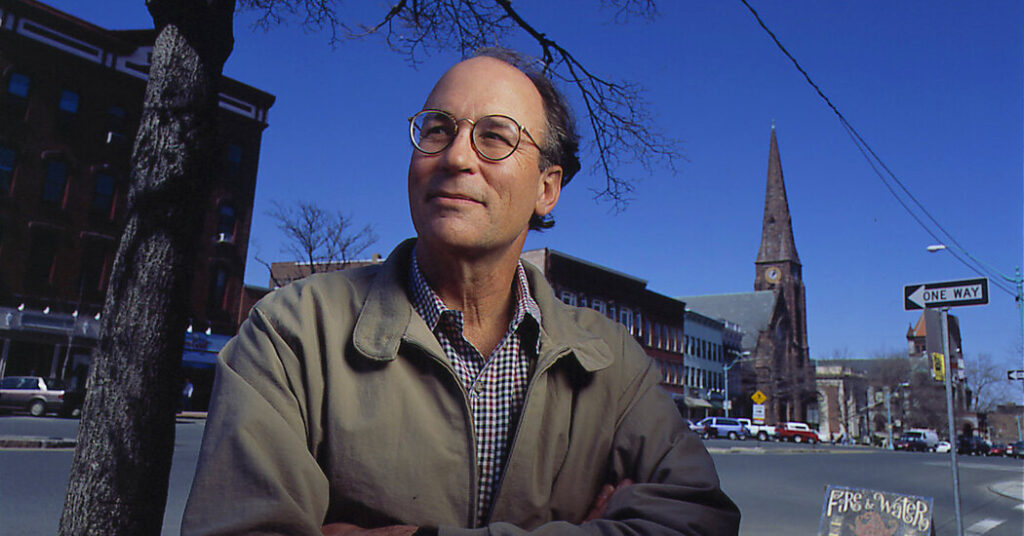
Tracy Kidder, a wide-ranging journalist and author whose deep reporting and novelistic prose illuminated worlds as diverse as home construction, disease prevention and — as portrayed in his prizewinning 1981 breakthrough book, “The Soul of a New Machine” — the computer industry, died on Tuesday in Boston. He was 80.
His daughter, Alice Kidder Bukhman, and his son, Nat Kidder, said he died of lung cancer at Dr. Kidder Bukhman’s home.
In a market increasingly dominated by quick hits and hot takes, Mr. Kidder’s immersive narratives stood apart. He highlighted people who had mastered their realms, placing them as characters in accounts that rang true because they were based on staggering amounts of research.
For “Among Schoolchildren” (1989), he spent an entire school year in a Massachusetts classroom. For “Mountains Beyond Mountains: The Quest of Dr. Paul Farmer, a Man Who Would Cure the World” (2003), Mr. Kidder followed Dr. Farmer — the founder of Partners in Health, an organization that provides care to some of the world’s poorest people — to his hospital in Haiti as well as to Peru, Cuba, Russia and elsewhere.
His most lauded book, “The Soul of a New Machine,” introduced readers to the physical parts and electronic bits that go into creating a business computer. The book arrived just as the PC revolution was gearing up.
When he took on the project, he told a reporter for The New York Times, he was not familiar with the field and relied on his subjects at Data General Corporation to teach him.
“Some of them despaired over my lack of technological background,” Mr. Kidder said, “but most of them were pleased that an outsider was interested in what they were doing.”
While he had to get the technology right, it was not what he most cared about. “It was the people themselves,” he said, “their incredible passion for this thing.”
The book won a Pulitzer Prize and the National Book Award, launching his career.
His 1985 book, “House,” depicted the process of planning and building a home and the collaboration and tensions between owners, architects and builders. In The Times, the architecture critic Paul Goldberger called it “one of the few books about building that is actually the story of people.”
John Tracy Kidder was born on Nov. 12, 1945, in Manhattan. His father, Henry Maynard Kidder Jr., was a lawyer. His mother, Reine Marie Melanie Tracy Kidder, was a high school teacher and the granddaughter of the painter John Martin Tracy. He had two brothers, Henry Maynard Kidder III and Timothy Joseph Kidder.
His father’s work took him on a deadening three-hour daily commute from their home in Oyster Bay, N.Y., on Long Island, to New York City and back. “I did not want to do what he’d done,” Mr. Kidder said.
His parents took him out of public school at 13 and sent him to Phillips Academy in Massachusetts. He went on to Harvard, entering it as a political science. But he soon found the subject dull.
“During a lecture by Henry Kissinger, I got up and left the room,” he recalled. “I was just bored to death.”
He switched to English and took a creative writing course from the poet and translator Robert Fitzgerald, producing stories that impressed the teacher and fellow students alike. Fitzgerald, he said, “made me feel that writing could be a high calling, possibly available to me.” He graduated in 1967.
Military service followed. He had joined the R.O.T.C. during the Vietnam War to avoid being drafted, going through officer training and expecting to be sent to Washington to do the communications intelligence he’d been trained for.
Instead, he got shipped off to Vietnam. He spent a year there and saw no combat, instead monitoring radio transmissions in the rear echelon. He reached the rank of first lieutenant and received a Bronze Star.
His service, he recalled in an interview for this obituary last year, did not make the impression on him that it had made on writers like Tim O’Brien, who created masterpieces from their war experiences.
Still, on his return, Mr. Kidder wrote a war novel, “Ivory Fields,” only to see it rejected by 33 publishers. He burned his remaining copies of the manuscript, he said. Years later, a friend sent him an unearthed copy, and Mr. Kidder decided that he would try again to write about his Vietnam experience, this time in a memoir. The result was “My Detachment” (2005).
Two Times reviews had different opinions: Verlyn Klinkenborg called the book an “acerbic, honest, moving memoir,” while Michiko Kakutani took Mr. Kidder to task for writing a “self-absorbed book about the author’s younger, self-absorbed self.”
In 1970, at a party in Boston, Mr. Kidder met Frances Gray Toland, a teacher who would become an artist. He told her that he planned to devote himself to writing and that he hoped to write about an “intensely good person,” she later recalled.
They married the next year and moved to the Midwest so that he could enter the prestigious creative writing master’s program at the University of Iowa, known as the Iowa Writers’ Workshop.
The program was an awakening for Mr. Kidder, who was intimidated by his fellow novelists in the program, including Denis Johnson and T.C. Boyle. He found himself struggling to write fiction.
One of the professors, Seymour Krim, was teaching a course in the New Journalism, which combined factual reporting with the narrative tools of fiction, as practiced by writers like Tom Wolfe and Truman Capote. Mr. Kidder tried his hand at reporting and, he said, “I liked it — it was like a relief from the sound of my own mind.”
Narrative journalism freed him, said Stuart Dybek, a friend from those days. “Every day we go by people building a house,” Mr. Dybek said. “Tracy goes by people building a house and he sees stories there. He sees characters there. It sounds simple — but try to do it.”
After Iowa, the Kidders moved to Williamsburg, a rural farming town in western Massachusetts, eight miles from academic, artsy Northampton. An Iowa professor, Dan Wakefield, had recommended Mr. Kidder to Robert Manning, the eminent editor of The Atlantic Monthly, and told Mr. Kidder that he should work with a young editor at the magazine, Richard Todd.
That began a working relationship and friendship that shaped Mr. Kidder’s career over the next half-century. When Mr. Todd became a book editor in the 1980s, Mr. Kidder stuck with him. In 2013, the two men published a book about writing, “Good Prose: The Art of Nonfiction.” Mr. Todd died in 2019.
Mr. Kidder recalled the editing process as both critical and supportive. Mr. Todd “could tell you that a piece of writing wasn’t any good,” he said, but “he never made you feel that you were not a good writer. He was honest, but he was never destructive.”
When The Detroit Free Press offered Mr. Kidder a reporting job, he told Mr. Todd, “Maybe I can get a Pulitzer if I work really hard.” Mr. Todd responded, “You can get a Pulitzer staying here in Western Massachusetts and writing books.”
But not right away. Mr. Kidder’s first published book, “The Road to Yuba City” (1974), about a serial killer, was a critical failure. He bought the rights from the publisher and never allowed it to be republished.
“I thought I was Truman Capote and I was going to do ‘In Cold Blood,’” he said in the interview last year. “I don’t know what I was thinking.”
One problem, he realized, was his use of a “swashbuckling first person” narrating style, which he called a misguided attempt at the New Journalism. He went back to writing articles for The Atlantic, and over time, he said, “I found a writing voice, the voice of a person who was informed, fair-minded, and always temperate — the voice, not of the person I was, but of the person I wanted to be.”
Mr. Kidder wrote in endless drafts. “Tracy throws up on the page and cleans up afterward,” said Jonathan Harr, author of the best-selling book “A Civil Action.” “He was absolutely indefatigable in the writing.”
In addition to his son and daughter, a physician, Mr. Kidder is survived by his wife, his brothers and four grandchildren.
His later books focused on heroic virtuousness, including “Mountains Beyond Mountains” and “Rough Sleepers: Dr. Jim O’Connell’s Urgent Mission to Bring Healing to Homeless People” (2023). In “Strength In What Remains” (2010), he told the story of Deogratias Niyizonkiza, an immigrant from Burundi who arrived in the United States with nothing and who made his way through medical school, ultimately building a nonprofit public health clinic back in Burundi.
Mr. Kidder was, in effect, doing what he had told his wife while courting her: writing about deep, even intimidating, goodness.
“I’m drawn to that,” he said. “I don’t know why the world is such a miserable place.”
Ash Wu contributed reporting.
The post Tracy Kidder, Author of ‘The Soul of a New Machine,’ Dies at 80 appeared first on New York Times.