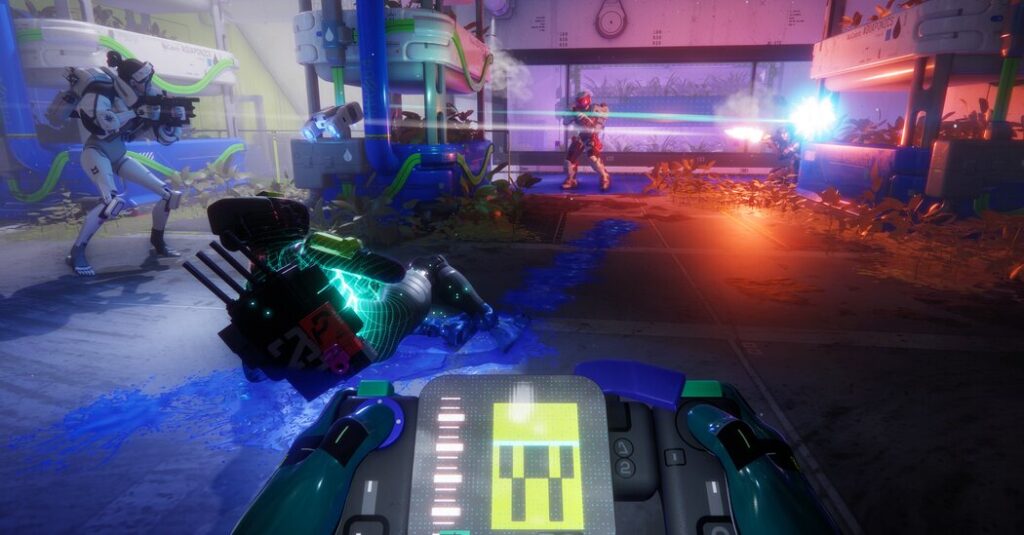
Players take up the role of runners, free-floating consciousness beamed across space into the hollow shells of mindless synthetic bodies, in Marathon, the newest game by the studio behind the sci-fi behemoths Halo and Destiny. These temporary forms have been built as part of a reckless hunt for treasure and answers in a distant colony project that collapsed a hundred years before.
A hundred years is just what it feels like since the game’s precursor series, also called Marathon, was released for the Macintosh Operating System in the mid-1990s.
At that time, artificial intelligence floated safely in the realm of science fiction: the onboard computer HAL 9000, from “2001: A Space Odyssey,” or the philosophical dilemmas presented by Asimov, Herbert and Clarke. The internet was clunky and difficult to access, and video games were played in the darkness of a den with the blinds drawn, or in a home office on a big beige box. Waiting for our modems to crawlingly bring us online to read our five emails, A.I. seemed like an idea for a distant and unimaginable future.
The contemporary Marathon, a challenging extraction shooter, was released this month into a vastly different context. Video games have burst into the mainstream, with stars like Megan Thee Stallion cosplaying Tekken characters in music videos, and grannies grinding out levels in Bejeweled. Far from being a distant, unlikely concept or a conventional sci-fi villain, A.I. now seems inevitable. Large language models sit just a prompt away, having infiltrated everything from Word documents to kitchen appliances.
Unlike the colorful game Doom, from which it liberally borrows its mechanics and first-person, quasi-3-D approach, the original Marathon was dark and monotonously gray. It was forged from the era’s cold, hard sci-fi aesthetic. Gunmetal walls and brown bulwarks stretch through the cavernous interiors of the moon-size spaceship U.E.S.C. Marathon. Players control a nameless security officer, sent in vain to rid the colony ship of an alien invasion. Much of the game involves tense shootouts against waves of grunting alien soldiers in narrow, mazelike corridors.
Interspersed are terminals through which players can experience one-sided text conversations with the ship’s intelligences. The mischievous Durandal, an A.I. that went rogue after the aliens invaded, spends the game taunting and belittling the player, teleporting them wherever it likes, on a Machiavellian quest to gain independence from its human creators.
Durandal is a fascinating character who sets the game apart from its more straightforward contemporaries. The player may represent an all-powerful killing machine but still exists within the limits of this world, in which an even more powerful and more willful being gets the final word. The game’s two sequels continued to expand this relationship.
In 2026, Marathon has changed with the times. Its setting is the same Tau Ceti solar system, but that is about all that feels familiar.
Day-Glo corporate logos and stylish iconography plaster every surface of the failed colony setting. Aliens have mostly disappeared, replaced by a boxy robotic security force and player-controlled runners who are plumbing the place for loot: fancy new guns, upgrade materials, dazzling colorways for their outfits. Aside from the hulking Destroyer, a throwback nod, these synthetic shells are slick, sexy and sartorially stunning, the bright overabundant future injected into a crumbling past.
Occupying these runner shells feels uncanny. These are bodies which our intervention brings to life, but which cannot actually die. It’s a different take on the necessary immortality of video game heroes. If the security officer of the 1990s games tripped into lava or was crushed by a piston, the camera would fall from its perch on his shoulders followed by the sound of blood hitting the floor, sometimes with a gurgle or a scream. The next instant would find you back at the last terminal where you saved, evidently unkillable.
It’s more difficult to classify just what a runner is. Can a person truly be a conscious subject without a permanent form? Runners must give up their original body to join this mission. All that’s left are the memories and behaviors that float from ready-made shell to ready-made shell. Whatever you are is held in thrall to powerful corporate interests, fronted by friendly A.I. voices. They implore you to go out and finish their contracts, to die again and again in service of their bottom line. It is capitalist dehumanization manifesting literally in the game’s text.
The A.I. that we feared — big narcissistic personalities driving human actors in one direction or another — and that dominated the imaginations of the 20th-century science fiction writers is far more incomprehensible and ever-present here, less agentic adversary than systemic reality.
In the decades between the first trilogy and the current game, the studio Bungie created Halo, Destiny and several sequels, mainstream departures from its humble roots. Halo represents a future very different from the one in the original Marathon games: much brighter and cleaner, an Earth in ascendancy, conquering the galaxy with its space marines, just as Microsoft was conquering living rooms and college dormitories with Xboxes.
The sensory maximalism and rainbow brightness of the new Marathon’s aesthetic seems, at first, like a similar departure from the quiet moodiness of the first games. Echoing footsteps through underlit tunnels, the electric whoosh of a Pfhor trooper’s energy staff in the distance, are supplanted and drowned out here by an endless cacophony of creature noises, robotic chirps and the stomping footsteps of nearby adversaries. But the longer one plays, the more the similarities between the games are clarified.
In the original Marathon, humanity was more of an anomaly than an inevitability. The only other beings you saw that weren’t aggressive aliens were weaponless men in jumpsuits running back and forth and yelling for help. A number of them were secretly bomb-implanted booby traps laid by the enemy. It was difficult not to shoot each one on sight, feeling only a little bad to see red blood rather than alien yellow fluid seep from their bodies.
The new Marathon feels truer to this mercurial and aggressively individualistic tone than Bungie’s other games. The reality of playing the game, rife with distrust and secrecy, undermines its bright colors and utopian corporate-speak. This manifests principally in the relationship with other players. Are they friend or foe? Is that speck running across the horizon a security robot I can safely ignore, or a player drawing a bead on me with murderous intent? Do we have individual agency, outside of the tasks assigned to us by our faceless A.I. overlords, or are we here to murder and be murdered?
Marathon successfully bridges its 30-year gap, though its new iteration could only have come out today. It is a game that reflects on our modern flavor of A.I.: friendly and accessible digital assistants who have replaced murderous and rampant sci-fi villains but are potentially just as insidious. It raises the question of humanity’s place in the universe as we work inexorably against our own interests, replacing ourselves piece by piece with something synthetic, projecting ourselves piece by piece into the invisible beyond.
The post The Anomaly of Humanity as A.I. Grows Inevitable appeared first on New York Times.