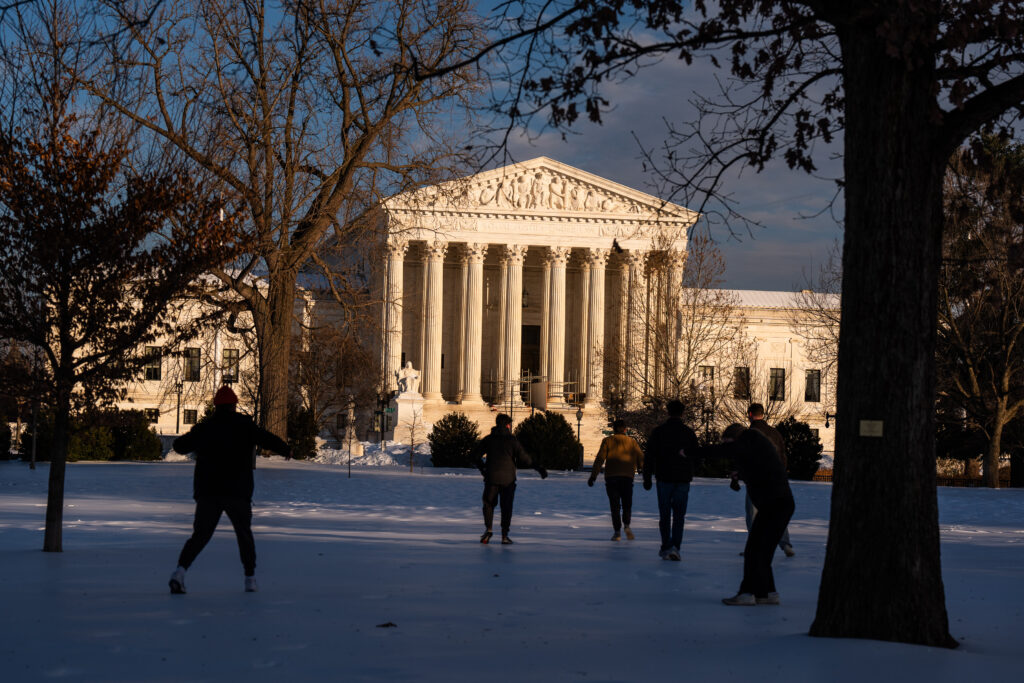
The Supreme Court ruled Wednesday that internet service providers are generally not responsible for the illegal distribution and downloading of music on their services, a blow to the music recording industry’s efforts to curb online piracy.
The unanimous decision means that Cox Communications will probably not have to pay a huge judgment in a case brought by dozens of music companies, including Sony Music Entertainment. They had alleged that Cox did little to stop users from exchanging copyrighted music by scores of famous artists, including Beyoncé, Justin Timberlake and Britney Spears.
The court carved out an exception if a provider “induced the infringement” or created a service specifically to pirate music.
Justice Clarence Thomas wrote the majority opinion and read from the bench on Wednesday. “Under our precedents, a company is not liable as a copyright infringer for merely providing a service to the general public with knowledge that it will be used by some to infringe copyrights,” Thomas wrote.
“Cox neither induced its users’ infringement nor provided a service tailored to infringement,” he added. “Cox simply provided Internet access, which is used for many purposes other than copyright infringement.”
Justice Sonia Sotomayor wrote a concurring opinion, joined by Justice Ketanji Brown Jackson, saying the majority opinion “unnecessarily limits” the behavior for which a company could be held liable. She nonetheless agreed that Cox cannot be held liable in this case.
Internet and tech companies have long been caught up in a debate over whether they are responsible for web content — and the Supreme Court’s decisions have been mixed.
In 2005, a unanimous court held that file-sharing companies Grokster and StreamCast could be sued because their products encouraged users to swap illegal files. In 2023, on the other hand, a unanimous court ruled that Google, Twitter and Facebook were not responsible for assisting in terrorist attacks even though their algorithms led users to content produced by the Islamic State militant group.
In the current case, a jury in Virginia in 2019 awarded Sony and other record companies $1 billion after finding Cox liable for its customers’ violations of more than 10,000 copyrights. The U.S. Court of Appeals for the 4th Circuit later threw out the verdict but decided Cox knew about the illegal activity and contributed to it by not cutting off customers who allegedly used the service to violate copyrights. The appeals court sent the case back to a trial court to reconsider the damages.
Cox, which serves more than 6 million customers in the country, argued that holding internet providers liable for pirated songs would expose them to a barrage of lawsuits. To avoid liability, they would be forced to deactivate swaths of internet users based only on accusations about people swapping pirated material, attorneys for Cox said.
During oral arguments in December, some justices seemed receptive to that argument.
Cox called the Wednesday ruling a “decisive victory for the broadband industry.”
“This opinion affirms that Internet service providers are not copyright police and should not be held liable for the actions of their customers,” Todd C. Smith, a company spokesman, said in a statement.
The post Supreme Court finds internet service providers not liable for users’ pirated music appeared first on Washington Post.