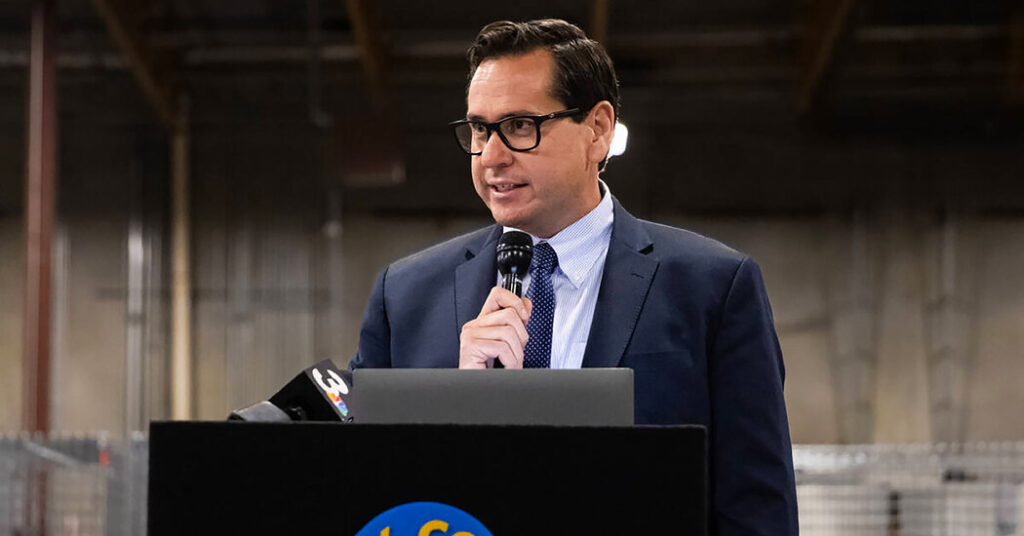
Francisco Aguilar, the secretary of state in Nevada, stepped out of the Supreme Court in Washington on Monday, where justices had just heard arguments about the legality of counting mail votes that arrive after Election Day. He immediately called his top deputy.
The court’s conservative majority had appeared deeply skeptical of the arguments for continuing the practice. So Mr. Aguilar’s message was urgent, he later said in an interview. He began listing things “we need to start working on and answering.” And in the middle of the midterm election season, they couldn’t wait for a decision to land — perhaps as late as June. “We have to provide a road map for the county clerks,” he said into the phone.
Mr. Aguilar, a Democrat, is one of 18 top election officials in states and territories across the country bracing for the possibility that the Supreme Court will require major changes to election law just months before the midterm election in November. Part of the urgency: getting the message out to voters that late-arriving ballots may no longer be counted. Such a decision could affect hundreds of thousands of voters.
The case centers on a Mississippi law that allows the state to accept ballots mailed and postmarked by Election Day that arrive up to five days later. Similar laws are on the books in 17 other states and territories, though the length of the grace period varies. In the 2024 election, at least 725,000 ballots arrived in the legally permitted post-Election Day time period across 14 states that provided data to The New York Times.
The court has not issued a ruling yet. The justices could reverse course from their apparent tone on Monday and allow the Mississippi law to stand. They could also rule against it but include an exception for the coming elections.
But, as Justice Brett Kavanaugh indicated during the arguments, a decision could come as late as June, putting election officials on a tight timeline.
Given the complexity of election laws and the difficult task of educating voters in an election year, some election administrators are not waiting for the court to rule to begin planning for a world where all ballots must arrive by Election Day.
William Francis Galvin, the top election official in Massachusetts, was so alarmed by the arguments that he has already taken steps to prepare for November. He is planning to ask the state legislature to give him the authority to extend polling hours, and, if the court also requires military and overseas ballots to be received by Election Day, to expand electronic voting for those groups.
He has also reached out to his state’s congressional delegation, asking it to conduct a hearing on the ability of the U.S. Postal Service to handle tighter deadlines.
“The concern I have is great,” Mr. Galvin, a Democrat, said in an interview, noting that 34 percent of his state voted by mail in 2024. “The obvious strategic, partisan nature of this case is made clear by the fact that no one’s suggesting that these people aren’t citizens” or ineligible to vote.
“They just have a problem because they’re voting by mail,” he said.
Since the 2020 election, Democrats have voted by mail in far greater numbers than Republicans. But assessing the overall partisan impact of a court decision blocking late-arriving ballots is an imperfect science. In Virginia, 73 percent of late-arriving ballots cast in 2024 were for former Vice President Kamala Harris. At the same time, voters most likely to be affected by postal delays live in rural areas, which are typically more Republican.
Democrats, who have accused Republicans of bringing the case for partisan advantage, have already been working through potential outcomes. Among their concerns is whether an ambiguous ruling could offer a political weapon for President Trump to challenge election results.
“House Democrats are working with our state and local partners to defend the unfettered right to vote,” Representative Hakeem Jeffries, the Democratic minority leader, said in a statement. He framed the case as part of a larger effort by Mr. Trump to shape the midterms to his favor that also includes a redistricting effort and federal voting legislation that would impose strict identification requirements.
Despite his claims that mail voting invites fraud, Mr. Trump cast a mail ballot in this week’s special election in Florida.
“We will continue to push back forcefully against any and all diabolical Republican schemes,” Mr. Jeffries said.
In Oregon, the secretary of state’s office had already started reaching out to voters after Postal Service changes that could slow the arrival of mail ballots in the November election. Among other steps, it is encouraging voters to put their ballots in the mail at least seven days before Election Day. Now, in the wake of the Supreme Court’s arguments, the office will amplify that advice.
Postal changes in Oregon have resulted in a single, central sorting center in Portland serving most of the state. Officials say the curtailed service has contributed to both mail delays and postmarking delays for far-flung areas.
“It’s a message we are distributing on every channel we have, and we’re working with community partners to get the word out,” Tess Seger, a top aide in the office, said in an email. The office is also adding more communications staff, she said.
In most states, more expansive measures would require state lawmakers to intervene — and are unlikely given the cascading impact such changes could have on the election calendar.
“If, for example, local elections officials wanted to mail out ballots sooner, it would likely require legislative action and updating other deadlines, like the candidate filing deadline,” Ms. Seger said.
In Maryland, the state board of elections added an item to its agenda for a meeting this Thursday to discuss mail-voting challenges. Among the possible topics: whether officials could still count late-arriving ballots in state and local elections if justices were to ban the practice in federal races — and how complex a task that might be.
“Is this just going to affect the general election?” asked Jared DeMarinis, an administrator for the Maryland Board of Elections. “Is this affecting state and county offices? Is it the entire ballot?”
Political parties and campaigns are also planning ahead. Even the Republican National Committee, which brought the case in Mississippi and is arguing for the change in mail-ballot laws, will make voter education core to its midterm plans — an acknowledgment of the potential impact of its suit.
“The R.N.C.’s argument in this case is simple: Ballots must be received by Election Day to prevent delays, reduce confusion and ensure confidence in election outcomes,” Ally Triolo, a spokeswoman for the R.N.C., said.
No state faces as many challenges to voting as Alaska. More than 80 percent of Alaskan communities live off the road system, meaning they rely on boats or planes to deliver their mail, including election mail, according to a brief the state filed in the case.
The state, which is heavily Republican, has not begun planning, said Kelly Howell, the chief of staff to Lt. Gov. Nancy Dahlstrom, whose duties include election oversight.
“We have had some initial internal discussions, but those conversations are preliminary and exploratory,” Ms. Howell said. “Nothing has moved into a formal planning or implementation phase at this time.”
Other states, including Illinois, West Virginia and Washington, have indicated that a broad information campaign would be central to their efforts to help voters avoid ballot rejection.
But education campaigns are a difficult endeavor, especially if rules change when an election is imminent. The court’s decision is expected to apply only to the federal general election, not primaries.
“Voters are humans, and we know that one tap, one message doesn’t get through,” said Kathy Boockvar, the former top election official in Pennsylvania. “And it might take seven or 10 or 15 times with a voter hearing something to fully understand the changes.”
Nick Corasaniti is a Times reporter covering national politics, with a focus on voting and elections.
The post Some States Already Preparing for Potential Supreme Court Ban on Late Ballots appeared first on New York Times.