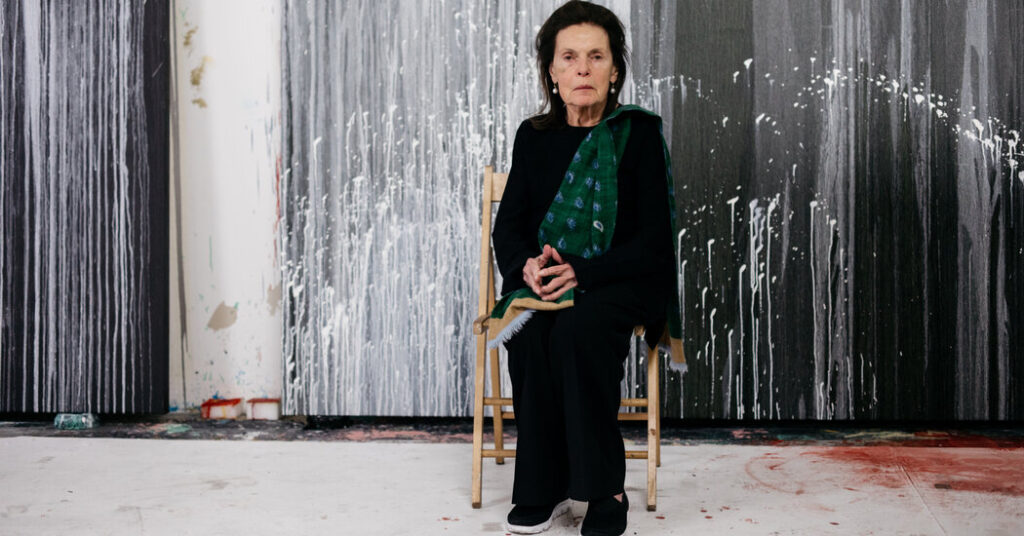
Pat Steir, a trailblazing artist whose shimmering paintings, born of ingenuity and accident, evoke the energy of natural forces, most vividly in her celebrated “Waterfall” series, died on Wednesday in Manhattan. She was 87.
Her death was confirmed by Marc Payot, a president of Hauser & Wirth, her primary gallery. He did not provide a cause of death or say where in Manhattan she died.
Ms. Steir often said that her “Waterfall” paintings painted themselves. Perched atop a tall ladder — or, in later years, a mechanical lift — she would spill paint onto canvas from a can or apply it in thick strokes, letting it streak down as it pleased.
“Gravity becomes my collaborator,” she told ARTnews in 2012. “The way the thing works is always in part a surprise.”
That humble description belied Ms. Steir’s preternatural sense for color and the verve with which she pursued her work, whose chance-based component was informed by Eastern art and philosophy and the aleatoric compositions of her friend the composer John Cage.
Ms. Steir (pronounced “steer”) frequently worked on a grand scale, and would add splashes of paint from a brush or spray water from a bottle to manipulate her pours. The results were immersive and vital.
“I’m not trying to do something to you,” she told T: The New York Times Style Magazine in 2020. “I’m not trying to make you see yourself, or make you see even a waterfall. I’m giving you the opportunity to stand there and become part of the painting.”
Acquired by numerous major museums, the “Waterfalls” secured Ms. Steir’s status as one of the key artists of her generation. She began the series in the late 1980s, when she was about 50; by that point, she had already forged a successful career, exhibiting regularly, becoming a masterly printmaker and helping develop essential arts organizations. It was a level of visibility and variety of accomplishment that in those days was rare for women artists.
When she was growing up, Ms. Steir said in a 2019 interview with The Times, “it was unimaginable to everyone around me that a small girl — not even a big strapping girl — could live a life as an artist and stay alive and committed.”
Iris Patricia Sukoneck was born in Newark on April 10, 1938, though she listed 1940 in professional contexts — so that, she said, “I wouldn’t be expected to be a Minimalist or a Conceptualist.” (Exponents of those art movements were generally born in the 1930s or earlier.)
She was the first of four children of Larry Sukoneck — who ran businesses in, at various points, window design, silk-screen printing and neon sign production — and Judith Lila (Kahl) Sukoneck. Both her parents attended art school but had not stayed in the field, a course that their daughter was determined not to follow.
Even in her early years, Ms. Steir later said, she knew she would pursue poetry or painting. Living in suburban New Jersey, she sometimes skipped school to visit the nearby Philadelphia Museum of Art. Her father encouraged her to become a poet, with the peculiar reasoning that she would make more money in that career than through art. She ultimately spurned the advice.
She enrolled at the Pratt Institute in Brooklyn in 1956 and studied with artists like Richard Lindner and Adolph Gottlieb. Marrying a childhood friend, Merle Steir, midway through school, she decamped to Boston, where Mr. Steir was attending business school, and she entered Boston University. A self-portrait from that period shows her naked, arms raised and eyes closed, fighting her way through fields of paint.
The military draft sent Mr. Steir to Atlanta, and Ms. Steir found her way back to Pratt. The marriage did not last, but she kept the surname, telling the Smithsonian’s Archives of American Art in a 2008 oral history: “I loved it. Pat Steir. It sounds like Roy Rogers’s best friend, doesn’t it?”
After graduating, she worked as an illustrator, but told the Brooklyn Rail in 2011 that “I wasn’t good at illustrations, because I couldn’t follow instructions.”
She became an art director at the publishing house Harper & Row (now HarperCollins) in New York. To make time for her art, she negotiated a deal to work just three long days a week.
But she quit at the end of the 1960s, and in the ’70s took teaching jobs at the Parsons School of Design, the California Institute of the Arts and elsewhere. She also traveled and began living part-time in Amsterdam. (She always considered New York home.)
The prevailing view in the male-dominated art industry at the time was that “a woman couldn’t be a good painter: She didn’t have the balls,” Ms. Steir told T.
But she was relentless, and managed to get her work shown. A 1964 review of her first solo gallery outing by Peter Preston of The Times described “grotesque figure paintings that deal uneasily with erotic fantasies.”
“They succeed in puzzling without making one care much about solving the puzzles,” Mr. Preston added.
Ms. Steir’s introduction to the feminist movement, in 1969, through the pioneering curator Marcia Tucker, was pivotal for her. “I was amazed, shocked and thrilled to find hundreds of women” who felt “trapped as I did by the very real limitations of society and government on women,” she told the Brooklyn Rail.
She added that she was “compelled to participate to save myself.”
“I was a young artist,” she said. “I hoped to escape the isolation I felt. I wanted to be seen simply as an artist, I wanted to be a contender, an equal.”
Ms. Steir was an indefatigable organizer. In 1976, with her then-partner, the artist Sol LeWitt, and others, she founded Printed Matter, a New York nonprofit devoted to artists’ books. The next year, she became a founding board member of Heresies: A Feminist Publication on Art and Politics. She also joined the editorial board of the venturesome publisher Semiotext(e).
Her work from the 1970s and ’80s eludes easy classification: It includes lively arrays of abstract forms and depictions of vibrant flowers, sometimes crossed out, sometimes containing handwritten text.
In an epic feat of research and sheer labor, Ms. Steir made two copies of a 17th-century floral painting by Jan Bruegel the Elder across dozens of panels, painting each section in the manner of other artists or styles, like Chardin, Rembrandt and Cubism. Shown at the Brooklyn Museum in 1984 and since then exhibited widely, the piece embodies her skill at wedding conceptual ambition and technical prowess.
Continuing in that appropriative vein, Ms. Steir made explosive paintings of waves by channeling canonical figures like Gustave Courbet and J.M.W. Turner. They are about “the terror of letting go, really being moved or being really carried away with emotion,” she told The Times in 1986.
At the time, she was examining Chinese literati paintings and southern Song dynasty pottery, she said in the Rail interview, which led her to realize that she could work without a paintbrush.
“I could use nature to paint a picture of itself by pouring the paint,” she said.
The ensuing “Waterfalls” — and other free-flowing series — seem to freeze in time rushes of glowing liquid. Taut displays of chaos, they have an organic, just-let-it-happen quality that sets them apart from much of Abstract Expressionism, exemplified by the obsessive tossing and dripping of Jackson Pollock.
But when asked if there was a feminist element to her subversion of such machismo, she told The New Yorker in 2019: “I didn’t think of it as a feminist gesture. I think of myself staying alive as a feminist gesture.”
While the “Waterfalls” were greeted with acclaim, Ms. Steir’s path did not proceed in a straight upward trajectory. She was “forgotten and rediscovered many times,” she told The Times in 2019, when her stature was rising to a new high, which she attributed to her advancing age.
The art world “is easier on older women because they feel like you have artwork they’ve never seen — because they’ve ignored it — so it’s like finding hidden treasure,” Ms. Steir said in a 2020 documentary, “Pat Steir: Artist.”
Directed by Veronica Gonzalez Peña, the film delves into her friends and mentors, like the painter Agnes Martin and Cage, who accompanied Ms. Steir and her husband, the graphic designer Joost Elffers, on their 1984 honeymoon.
She is survived by her husband and her niece, Lily Sukoneck-Cohen.
The year before the film’s release, Ms. Steir presented a commission installed around an entire floor of the cylindrical Hirshhorn Museum and Sculpture Garden in Washington, D.C.
Titled “Color Wheel,” it contains 30 panels, each nine feet tall and painted a different color; together they form a spectrum. Near the center of each panel is a wide brushstroke of another color, from which a torrent of paint has flowed in thin veins. Once more, a crystalline idea had generated unexpected, and unrepentant, beauty — a phenomenon that can transmit more than just visual pleasure.
“The spiritual in my art is giving up control,” Ms. Steir told Interview magazine in 2016. “My paintings are based on what I can do, and what I can do is not controlled.”
Ash Wu contributed reporting.
The post Pat Steir, Painter of Luminous ‘Waterfalls,’ Dies at 87 appeared first on New York Times.