RICHMOND — Abigail Spanberger was elected governor of Virginia as a potential role model for Democrats nationally, who were eager to see whether a moderate focused on affordability would help the battered party reclaim its mojo.
Two months in, Spanberger insists she is sticking to the script, working with a Democratic-controlled legislature to address issues such as housing costs and access to health care.
But the unexpected fight to redraw the nation’s congressional maps has overshadowed much of that, forcing her to enter the kind of partisan brawlshe hoped to avoid. Other actionsto undo the aggressive immigration crackdown of her Republican predecessor, former governor Glenn Youngkin, have enhanced a GOP narrative that she is a closet lefty who posed as a moderate.
“I was elected running on issues of affordability,” Spanberger said in a recent interview with The Washington Post, “with not just ideas but actual bills that I wanted to continue to push through the legislature.”
“But,” she added, “that certainly hasn’t been the most interesting thing that’s made the news, right?”
Instead, the April 21 referendum on allowing state lawmakers to redraw political boundaries and potentially create four new Democratic congressional districts has dominated Virginia politics. While Spanberger had no procedural role in passing the proposed constitutional amendment, she signed a bill setting out maps that give a 10-1 edge to Democrats in the state’s congressional delegation, which now features six Democrats and five Republicans.
After a landslide victory last fall in which she carried two of the state’s red congressional districts in addition to all of the blue ones, Spanberger had insisted that Democrats could pick up seats in Virginia in this year’s midterm elections without redrawing the map. She has gradually embraced the idea that radical redistricting is needed to respond to President Donald Trump’s unprecedented demand that Republican-controlled states create red-leaning seats to help the GOP maintain its thin House majority.
“She has changed her position 180 degrees from what she said earlier,” said Rep. Rob Wittman (R-Virginia), who had a heated exchange with Spanberger about redistricting when the state’s bipartisan congressional delegation met with her in December.
Spanberger, who uses saltier language in private meetings than during her carefully controlled public appearances, said in the interview that she told Wittman and the other Republicans they should have spoken up when Trump urged Texas, North Carolina and other red states to rig their districts for the GOP. “You didn’t give a s— about fairness,” she said she told the GOP delegation, “… until your singular seat was potentially the one” affected.
In the interview, Spanberger conceded that her support for redistricting could be called tepid.
“Do I wish that we didn’t have to even consider this? Sure. But in the world that we are living in … I do think that Virginia, because we have the ability to be responsive, I think that it’s important that we give that option to voters,” she said.
She cast her early vote in favor of redistricting last week, but her previous statements condemning partisan gerrymandering have enabled Republicans to charge Spanberger with hypocrisy and use her own words in “vote no” campaign mailers.
The contentious campaign has threatened to overwhelm her legislative agenda and recast her image with her term just barely underway.
“This should be a flashing red light for Democrats everywhere,” said Michael LaRosa, a former spokesman for former first lady Jill Biden who has prominently warned the party about the need to find an authentic identity ahead of this year’s elections.
“Abby Spanberger spent eight years building a brand as a ‘normal,’ mainstream Democrat — and it’s been set on fire in less than three months,” LaRosa said. “Not just because of a relentless offense from the right but because there’s been little to no defense shaping what voters actually see.”
LaRosa faults Spanberger not for supporting redistricting but for failing to define herself strongly enough — and explain her positions clearly enough — to counter the criticism that she has altered her agenda. He said her actions to dissolve cooperative pacts between state law enforcement and federal immigration officials known as “287g agreements” have given Republicans fuel for attacks on that issue.
The Department of Homeland Security has issued at least half a dozen press releases condemning Spanberger, one of which prompted conservative news media to raise alarms last month that Virginia might set free an allegedly undocumented immigrant from Sierra Leone after he was arrested on charges that he stabbed a woman to death at a bus stop in Fairfax County. He had been arrested and released previously on multiple charges but in this case was being held without bond.
“It’s sad because they’re, you know, a federal law enforcement agency trying to make me responsible for their failures,” Spanberger, a former CIA agent, said in the interview.
She pointed out that her position on immigration is not new — she campaigned on ending Youngkin’s crackdown, which she called “performative.” Though Spanberger issued an executive order barring state agencies from entering into 287g agreements on her first day in office, she said she waited two weeks to dissolve any existing agreements to make sure ongoing cases were not affected and found only minimal examples.
Youngkin had created what he called the “Virginia Homeland Security Task Force,” in which state and local officials worked at the direction of federal agencies to round up thousands of people accused of being undocumented immigrants. Now the state returns to its long-standing practice of notifying immigration authorities anytime a foreign national is in custody on criminal charges — whether undocumented or not — and sending word 60 to 90 days before release so federal officials can detain them if there is a judicial warrant.
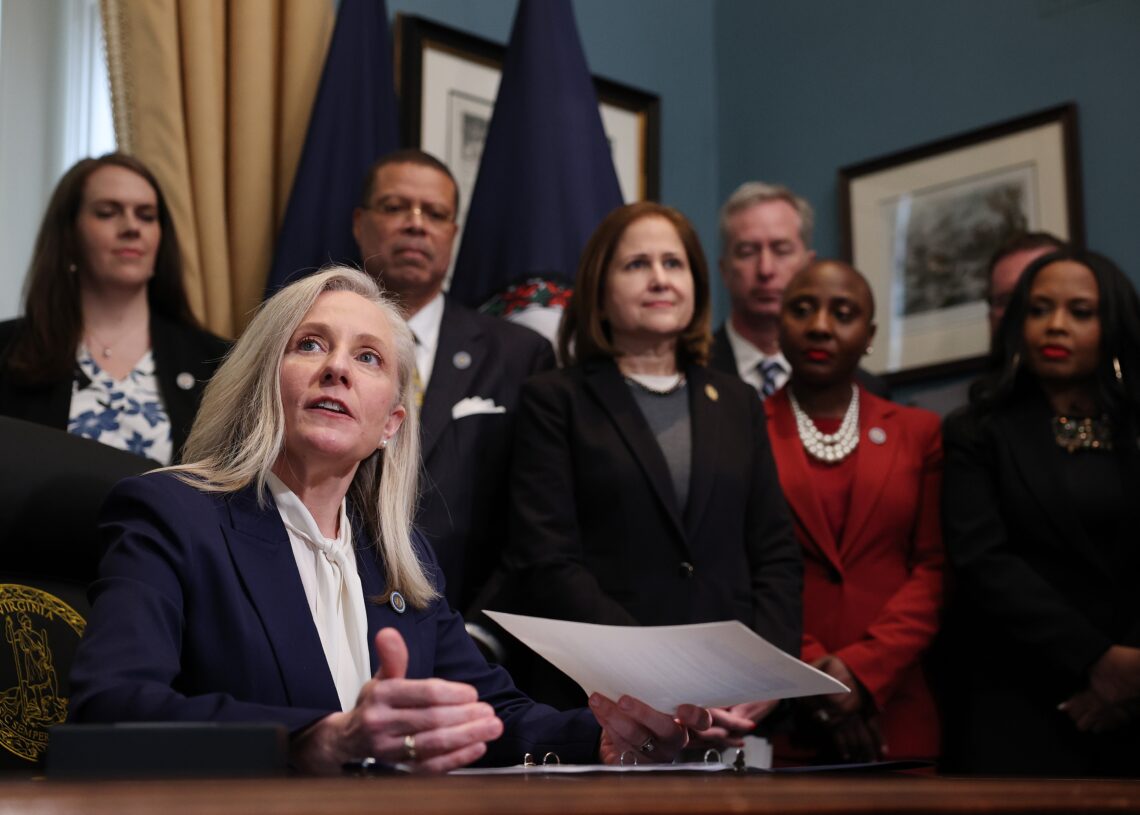
Spanberger has tried to smooth over friction with Republican lawmakers, meeting with them in the state Senate and House of Delegates and inviting them to events in the Executive Mansion. They are unmoved, at least publicly.
“She campaigned saying she’s about law and order and following the rule of law, and this [immigration policy] is not following the rule of law,” said state Sen. Bryce E. Reeves (R-Orange), whom Spanberger singled out as someone who is friendly behind the scenes yet harsh in public statements. “I just call balls and strikes,” Reeves responded when told of that. “So far she hasn’t shown any moderation and hasn’t shown leadership.”
Republicans have hammered Spanberger over her “affordability” agenda, which helped power her big win last year and is seen as a key theme for Democrats in this fall’s midterms. The state’s General Assembly recently wrapped up its regular legislative session and sent the governor packages of bills aimed at increasing funding for affordable housing, raising the minimum wage to $15 an hour, creating a paid family and medical leave program, limiting out-of-pocket health insurance costs and establishing a Prescription Drug Affordability Board, among other priorities.
Much of that legislation passed on party-line votes, though scores of other bills drew bipartisan support. The challenge for Spanberger is that lawmaking on affordability can be incremental — with success hard to gauge.
House Minority Leader Terry G. Kilgore (R-Scott) told reporters that when Spanberger spoke to his caucus, she pledged “that she will not sign bills that do not have bipartisan votes.” Spanberger denied saying that. “I said, ‘I look forward to signing … many, many bills that had bipartisan support,’” she said, adding that Kilgore’s statement might be “gamesmanship” but also apologizing if there was any misunderstanding.
Spanberger said the best evidence of her moderation might be what she is not signing: dozens of Democratic tax increases that died early in the process after she signaled she was not in favor, along with a repeal of the state’s “right to work” law that has long been a priority of organized labor. Her opposition to repeal put her on the side of businesses, which have been loath to cede more power to union organizers.
“It was very disappointing,” said state Sen. Jennifer Carroll Foy (D-Prince William), who filed a repeal proposal that never made it out of committee after Spanberger said she would not sign it. Repealing right to work “is about restoring workers’ rights in Virginia — one of the predominant promises that we made to Virginians,” Carroll Foy said.
Spanberger also took a business-first approach in dealing with legislation related to data centers. One of the state’s most powerful Democrats — Senate President Pro Tempore L. Louise Lucas (Portsmouth) — advocated ending a nearly $2 billion sales tax exemption that has drawn more data centers to Virginia than any other state. Lucas proposed taxing them and spending the money on teacher salaries, health insurance stipends and other priorities of both parties.
Democrats in control of the House of Delegates disagreed, creating a stalemate that delayed passage of the two-year state budget. Spanberger came down on the side of the data centers, arguing that Virginia should not renege on its 18-year-old exemption. She suggested a possible consumption tax for large electricity users, and lawmakers are working with data center lobbyists to craft an acceptable plan and complete work on the budget.
With opinion polls showing voters increasingly unhappy with the impact of data centers on the environment and energy usage, Spanberger’s position is unlikely to help her popular image. She said she doesn’t view it through a political lens.
“I don’t dispute that it is sort of a pro-business stance,” she said. “But it’s actually deeply consistent with who I am as a person and what I have prioritized, which is steadiness.”
The post Partisan brawl in Virginia taints Spanberger’s moderate image appeared first on Washington Post.