“Salzburg is no place for my talent,” Wolfgang Amadeus Mozart once wrote of his Austrian hometown. In fact, his family spent much of its time there making plans to get out.
His father, a court musician, repeatedly left to take his children on tour, showing them off in concerts across Europe. But while the Mozarts didn’t love Salzburg, the city has never lost its affection for Wolfgang. His likeness is inescapable, in window displays and on the wrappers of marzipan chocolates; tourists visit the house where he was born and the more spacious home the family moved into as it became famous.
Those sites are overseen by the Mozarteum Foundation of Salzburg, which maintains a vast collection of memorabilia and instruments. A number of its holdings, like the ink-stained portable clavichord on which Mozart wrote “The Magic Flute,” are on view in “Treasures From the Mozarteum Foundation of Salzburg,” at the Morgan Library and Museum through May 31.
The exhibition and its accompanying catalog cover the composer’s entire life and legacy, but much of it is devoted to his foundational years in Salzburg, with objects that collectively illustrate how a boy of seemingly miraculous talent became the Mozart we know today. Here are three of those artifacts.
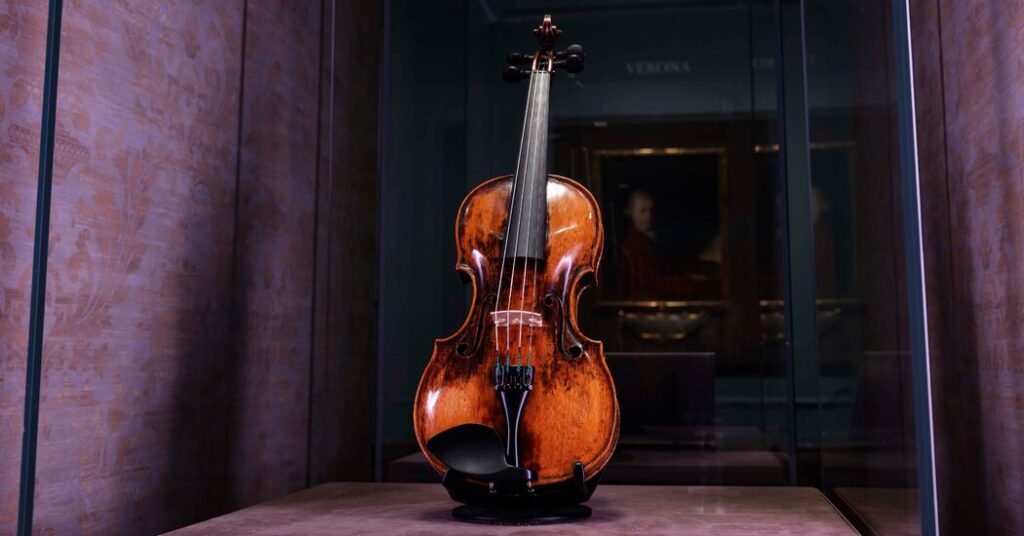
His Childhood Violin
Wolfgang’s father, Leopold, gave him this violin when he was 6 or 7. Much smaller than the standard size, it was made from spruce and maple by Andreas Ferdinand Mayr, one of Leopold’s fellow court musicians.
In the mid-1750s, Leopold published a treatise on how to play the instrument. Well received, it probably also helped him as he began to give lessons to his two children that had survived infancy: Wolfgang and Maria Anna, known as Nannerl.
By the time Wolfgang received the violin, he was already improvising and writing for keyboard instruments, which he picked up with phenomenal ease. But he took a liking to his violin, and began to compose sonatas for it; these are some of his earliest pieces with multiple movements and a broader, more mature sense of form. Quartets followed, along with a series of concertos that have become staples of the repertoire.
The violin is more notable for its provenance than its sound, which is modest and a little nasal. But it is also remarkable for how well it was been preserved. Children’s instruments are often battered, but this one survived Wolfgang’s peripatetic early years and custodianship in Nannerl’s home, and later private ownership, before landing with the Mozarteum in 1896.
Nannerl’s Music
This fragment is the only surviving bit of music written by Nannerl. Several years older than Wolfgang, she was the Mozart family’s first prodigy.
Nannerl learned from a notebook that Leopold gave her when she was 7. It’s also on display, and it contains pieces written by a variety of composers, copied by hand and arranged in order of difficulty. Eventually, Wolfgang learned from the same collection, then began to attempt music of his own.
The siblings toured together, but at some point Wolfgang began to overshadow Nannerl. She was a brilliant harpsichordist, and her brother wrote four-hand pieces for them that exploited her talent; Leopold, though, was more interested in selling his wunderkind son.
After Wolfgang’s death, in 1791, Nannerl became his first biographer. She must have composed, too. Letters from her brother express amazement at her skill, but for a long time scholars had to take him at his word.
Two fragments of a score by her are in Paris and Augsburg, Germany. Recently, though, their conclusion was found in a collection given to the Morgan in 2019. (That batch also included a sensational Chopin discovery.) The museum’s scrap had been miscredited to Wolfgang, but it was found to align with the two others. Now all three have been reunited, assembled as facsimiles and a manuscript in the exhibition and offering the clearest possible impression of her music: a steadily walking bass line under two-note phrases that rise and fall, ending with a natural and satisfying resolution.
The ‘Rondo alla Turca’
Wolfgang’s childhood spent on the road saved him from the provincialism he would have been confined to in Salzburg. And as he matured into a constantly evolving master, he wove his cosmopolitan experiences into his music, to the delight of audiences then and now.
For example, the finale of his Piano Sonata in A (K. 331), better for known as the “Rondo alla Turca,” whose copyist manuscript is on view at the Morgan, opens with one of the most famous melodies in music. Reminiscent of Turkish military bands that were popular in Vienna at the time, it was practically made to be a hit, with bouncing rhythms, puckish ornamentation and a winning exotic theme that returns again and again.
Like much of Mozart’s music, the “Rondo” is also within reach for amateur musicians, which allowed it to be heard in homes throughout Austria when it was published in 1784. It’s still irresistible for young pianists who want to show off, not unlike little Wolfgang in his youth.
Joshua Barone is an editor for The Times covering classical music and dance. He also writes criticism about classical music and opera.
The post Mozart Wouldn’t Be Mozart Without These Three Objects appeared first on New York Times.