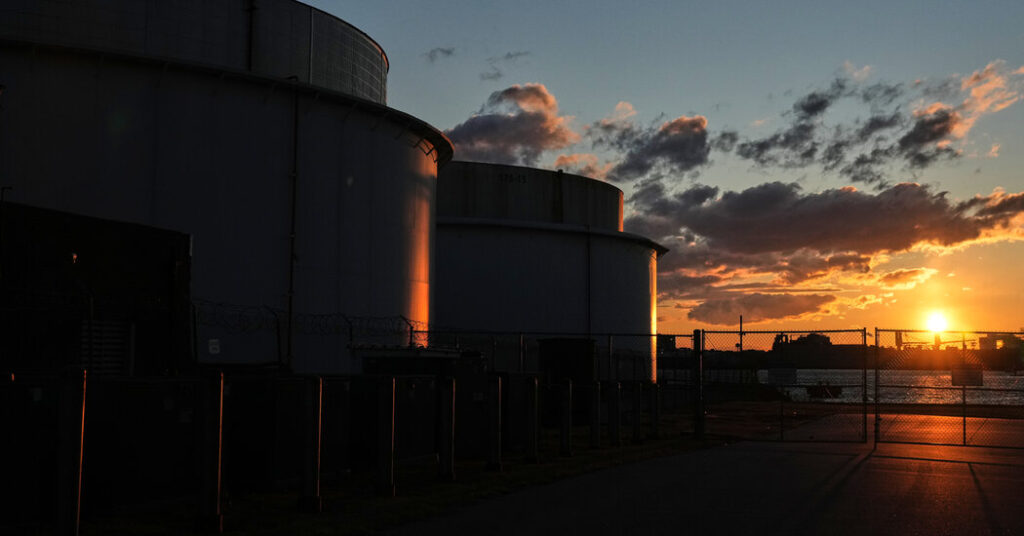
The Maryland Supreme Court on Tuesday dealt a major blow to cities and other local governments looking to sue oil companies over climate change.
The court ruled against reviving climate lawsuits brought by Baltimore, Annapolis and Anne Arundel County that were struck down by lower courts.
Those governments had sued 26 multinational oil and gas companies to recover damages caused by the effects of greenhouse gas emissions, accusing them of deceiving the public about the dangers of using their products. Some three dozen similar lawsuits have been filed nationwide in the past decade.
The Maryland court ruled that federal law overrides state law on air pollution that crossed state lines. The court blocked such lawsuits from proceeding and accused the plaintiffs of trying to use litigation to regulate greenhouse gas emissions. There is broad scientific consensus that greenhouse gases from the burning of fossil fuels are dangerously warming the world.
“No amount of creative pleading can masquerade the fact that the local governments are attempting to utilize state law to regulate global conduct that is purportedly causing global harm,” Justice Brynja M. Booth wrote in the decision.
In another strongly worded passage, Justice Booth wrote that the premise of the litigation was “so far afield from any area of traditional state or local responsibility that it cannot be seriously contemplated.” The court’s decision found that even if the claims were not pre-empted by federal laws, they would still be invalid under state laws.
The justices found fault with many aspects of the litigation, including the claims that the companies had failed to warn people about the dangers associated with the use of fossil fuels. Greenhouse gases, like carbon dioxide, act as a blanket when released into the atmosphere, trapping the sun’s heat and warming the world.
“We determine that the duty the local governments seek to impose is, indeed, a duty to warn the entire human race of the effects of climate change,” the decision said. “We have resisted efforts to find such a duty under our common law and continue to do so here. Finding such a duty would stretch tort law beyond any manageable bounds.”
Two lower courts had dismissed the cases, which were filed in 2018 and 2021. Once the plaintiffs appealed, the Supreme Court stepped in and held hearings on the cases in October.
A coalition of Republican-led states and the Justice Department had submitted amicus briefs in favor of the defendants in Maryland. The Trump administration has made stopping climate lawsuits a priority. It took the unusual step of suing Hawaii and Michigan in an effort to prevent those states from filing climate-related lawsuits. (Both went ahead and filed them.)
The decision comes as the U.S. Supreme Court is set to hear arguments, likely in the fall, in a climate lawsuit brought by the city and county of Boulder, Colo. The question before the justices in that case mirrors the central one in Maryland, namely whether federal law “precludes state law claims seeking relief for injuries allegedly caused” by greenhouse gas emissions.
The majority opinion in the Baltimore case was joined by four other justices. However, two of them dissented in part, one rather forcefully in a separate opinion totaling 75 pages, the same length as the majority’s.
Justice Peter K. Killough wrote in the opinion that the majority had been misled by the defendants’ misrepresentation of the case as being about emissions rather than fraud.
“But not a single emissions regulation is implicated in this case,” he wrote. Referring to Baltimore, he wrote that the city was seeking compensation for damage from floods, storms and heat waves “that its local taxpayers are bearing.”
“Those are local injuries caused by local impacts of a global phenomenon,” Justice Killough said, “and they are alleged to have resulted from a fraud, not from an emissions policy.”
Sara Gross, chief of the Baltimore City Law Department’s Affirmative Litigation Division, also referred to Justice Killough’s dissent. She quoted the justice’s assertion that the majority’s view on the emissions question was less a finding than a prediction “dressed up as a legal conclusion and deployed to close the courthouse door.”
The other parties in the lawsuit did not immediately respond to requests for comment.
Karen Zraick covers legal affairs for the Climate desk and the courtroom clashes playing out over climate and environmental policy.
The post Maryland’s Supreme Court Strikes Down Baltimore’s Climate Lawsuit appeared first on New York Times.