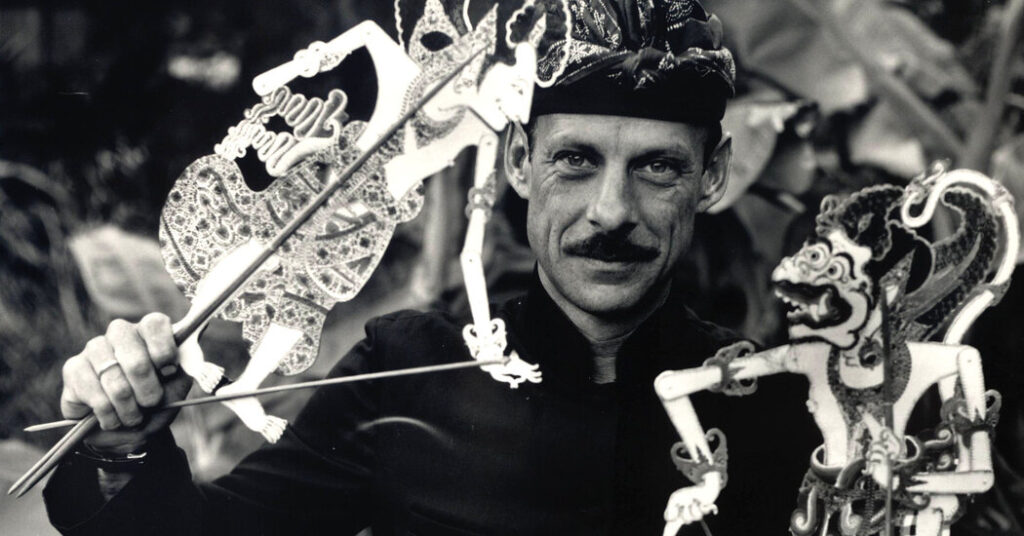
In 1970, a young filmmaker named Larry Reed traveled to Pengosekan, a Balinese village, searching for a new theatrical experience, something different from the standard Broadway fare.
He wasn’t certain what he was looking for. But one night he found it.
“We came upon a clearing filled with people crowded around a small screen, with a flame behind it making flickering shadows,” he recalled decades later. “A single performer was manipulating scores of puppets, creating incredible sounds with his voice, leading the orchestra with a mallet in his foot and making the audience laugh and cry.”
What he had seen was the ancient art of wayang kulit, or Balinese shadow puppetry, whose stories are derived from the Mahabharata myth cycle. UNESCO designated the form a Masterpiece of the Oral and Intangible Heritage of Humanity in 2003.
Mr. Reed, who died at 81 of a heart attack on Jan. 30, at his home in San Francisco, didn’t understand the language being spoken.
But the show “excited me because it was so worked out, yet so wild,” he told The San Francisco Chronicle in 1984. “It involved the same old stories that we’re used to here, but a different mix — like ballet and a clown show all mixed together. It was like watching primordial cartoons.”
This would not be just a thrilling one-off. Over the coming years, as he trained to become a dalang, or shadow master, Mr. Reed returned regularly to Indonesia to study in the village of Tunjuk with the dalang I Nyoman Rajeg. Mr. Reed lived in Tunjuk for a year with his future wife, Jane Levy, before they married in 1976.
Back in the United States, Mr. Reed had formed the nonprofit ShadowLight Productions in San Francisco in 1972 to stage traditional shadow puppetry shows. But by the early 1990s, he began to realize that “not everybody in the world is as interested in Indonesian stuff as I am,” he told Mission Local, a San Francisco news website, in 2023.
So he created a modern version, or what came to be called cinematic shadow theater, “that emerged over many years through experimentation,” Caryl Kientz, ShadowLight’s managing director, said in an interview.
Mr. Reed turned the intimacy of traditional Balinese shadow puppetry into a large-scale show, using the age-old techniques to tell stories from around the world. Instead of a single dalang, there was a cast of performers — including puppeteers, masked actors and dancers — behind a 15-by-30-foot screen, and multiple electric light sources instead of a flame.
Drew Dir, a shadow puppeteer and a founder of Manual Cinema, a performance company in Chicago, called Mr. Reed a creative inspiration.
“When we were coming up, people would pass us DVDs of his performances,” Mr. Dir wrote in an email. “His tools were so simple — light, shadow, foamcore, the human silhouette — and yet the possibilities were endless. To the best of my knowledge, he was the creator of modern shadow play and performance.”
Mr. Reed’s productions, which he often directed and in which he gave voice to some of the characters, were multicultural in their subject matter.
“Monkey King at Spider Cave” (2006) was based on a 16th-century story about a Buddhist high priest in China. “Ghosts of the River” (2009), a series of vignettes written by the playwright Octavio Solis, explored stories about crossing the Rio Grande. “A (Balinese) Tempest” (2005), an adaptation of Shakespeare’s play, debuted in San Francisco and was also performed at the Public Theater in Manhattan.
“In Xanadu” (1993) followed the Mongol emperor Kublai Khan’s quest to bring his late wife, Chabi, back from the underworld. It won puppetry’s highest honor, the Citation of Excellence from UNIMA-USA, the North American chapter of an international puppetry organization.
Steven Winn, a critic for The Chronicle, praised that show’s “ingenious use of perspective,” which made shadow images of 13th-century warriors look three-dimensional on the screen. The battlefield scenes, he added, had “a wonderful, illusionistic depth.”
Charles Lawson Reed III was born on June 21, 1944, in Los Angeles, and moved with his family to Cincinnati after World War II. His father, Charles Reed Jr., was an engineer who owned a valve-manufacturing company. His mother, Dorothy (Whittaker) Reed, was a homemaker and an active supporter of arts organizations.
Mr. Reed recalled noticing the effect of shadows from an early age.
“Once I woke up from a nap and found myself watching the shadow of a bug on a leaf, inches from my nose,” he wrote in Puppetry International magazine in 2009. “My first photographs were of shadows in the snow.”
In elementary and boarding school, he acted. At Yale, he studied French and theater, but left after two years to join a Peace Corps theater program, through which he worked at the National Theater of Costa Rica from 1966 to 1968. In 1970, he earned a combined bachelor’s and master’s degree in film from the San Francisco Art Institute.
Following his first trip to Bali, Mr. Reed returned to the United States, where he studied Balinese instruments and the Indonesian language at the Center for World Music in the Bay Area. One of the teachers suggested that Mr. Reed study shadow puppetry with his father, Mr. Rajeg, in Indonesia.
Returning to Bali for extended trips in 1973 and 1974, Mr. Reed recalled sitting behind the screen with Mr. Rajeg — watching him perform, learning how he gave voice to multiple characters and how he animated his flat, carved-rawhide puppets.
“I learned the entire repertoire, just note by note, the way the Balinese do it, except much slower,” Mr. Reed said in a video on the ShadowLight website.
His time in Mr. Rajeg’s village led him and the filmmaker John Knoop to make “Shadow Master” (1979), a docudrama about the dalang’s family — including his grandchildren, caught between tradition and modernity.
Mr. Reed’s troupe has collaborated with organizations like the American Conservatory Theater in San Francisco, the Santa Fe and Los Angeles operas, Gamelan Sekar Jaya, a Balinese music and dance company, the singer Coco Zhao, the choreographer Wan-Chao Chang and the actress Karen Kandel.
Mr. Reed is survived by his wife; his son Nik, who confirmed the death; another son, James; three grandchildren; two sisters, Janet and Dede Reed; and a brother, Foster.
His final show, which he performed last November on a houseboat in Sausalito, Calif., was a wayang kulit story, “Arjuna Tapa,” in which the title character travels to secure a powerful weapon from Lord Shiva for an upcoming war. Mr. Reed, who had chronic obstructive pulmonary disease, was the sole puppeteer and used a portable oxygen concentrator to breathe during the performance.
Rachel Cooper, the director of performing arts, culture and diplomacy at the Asia Society, recalled watching him perform in Indonesia in 1996.
“People were so delighted,” she said in an interview. “I think they felt here was someone who really respected and knew the form. If you can make jokes in another language, and they laugh, it tells you something. He made that connection.”
Richard Sandomir, an obituaries reporter, has been writing for The Times for more than three decades.
The post Larry Reed, Master of Shadow Puppetry, Dies at 81 appeared first on New York Times.