Israel continued to attack Hezbollah across Lebanon on Wednesday, even as fledgling diplomatic efforts to end the U.S.-Israeli war with Iran, the militant group’s main patron, seemed to be underway.
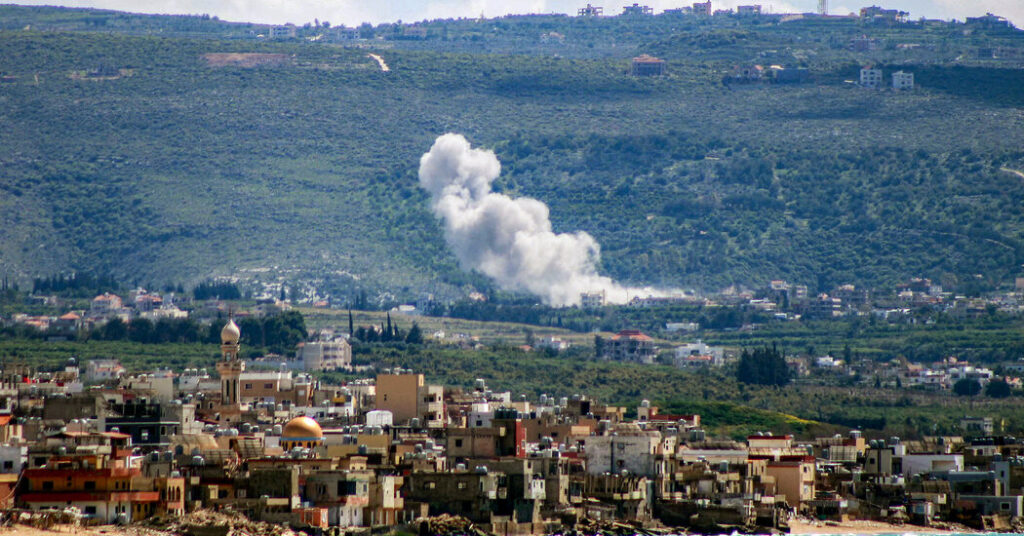
The Israeli military said it had carried out overnight strikes just south of Beirut, in a cluster of neighborhoods known as the Dahiya where Hezbollah is the dominant political and military force. It also issued new evacuation warnings for a number of towns and villages in southern Lebanon, putting more strain on a war-weary population facing a worsening humanitarian crisis.
Nearly 1,100 people have been killed in Lebanon since Hezbollah fired rockets into Israel early this month, shortly after the United States and Israel attacked Iran. Israel has responded with widespread bombardment of Lebanon and an expanding ground invasion of the country’s south. More than a million Lebanese — most of them Shiite Muslims, the core of Hezbollah’s support base — have been displaced, many into communities where fragile sectarian balances are being tested.
There were few signs on Wednesday that either side was prepared to step back from the fighting. Hezbollah’s leader, Naim Qassem, said the group faced a choice between “surrender” or “inevitable confrontation and resistance,” a signal that it was preparing for a protracted conflict.
Mr. Qassem said that Hezbollah “fundamentally rejected” any negotiations while Israel’s strikes and ground invasion continued. That mirrored Israel’s own stance that talks could not come at the expense of its military campaign.
On Tuesday, President Trump appeared to support a Pakistani offer to broker talks between the United States and Iran. It is not clear whether Israel supports a U.S. peace proposal that Pakistan is said to have delivered to Iran, or whether Iran would accept it. Iranian officials have publicly denied Mr. Trump’s claims that the two countries are already in talks.
But whatever room for diplomacy may be opening over Iran, it has not translated into any letup in Israeli attacks for Lebanon.
Hezbollah said on Wednesday that it was continuing to engage Israeli ground forces with rockets and drones as they pushed a few miles farther north into Lebanon. A day earlier, Israel’s defense minister, Israel Katz, had said that Israel intended to “control” territory up to the Litani River, which at its furthest point lies about 20 miles north of the countries’ border. His comment was one of the clearest signals yet from Israel that it was preparing for a large-scale ground invasion and, potentially, a prolonged occupation.
Israel’s targets on Wednesday included the Al-Amana fuel company, a network of gas stations across Lebanon that have been placed under U.S. sanctions for alleged links to Hezbollah’s financial apparatus. Those Israeli strikes seemed to be part of what analysts describe as a broader effort to degrade Hezbollah’s sprawling economic network.
While Israeli officials say the gas stations help fund Hezbollah, they have also benefited many Lebanese. At times, they have sold fuel at subsidized prices, making them a lifeline for poorer people as the war in Iran drives up fuel costs.
Isabel Kershner and Abdi Latif Dahir contributed reporting.
Euan Ward is a Times reporter covering Lebanon and Syria. He is based in Beirut.
The post Israel Keeps Up Strikes in Lebanon as Hezbollah Signals Defiance appeared first on New York Times.