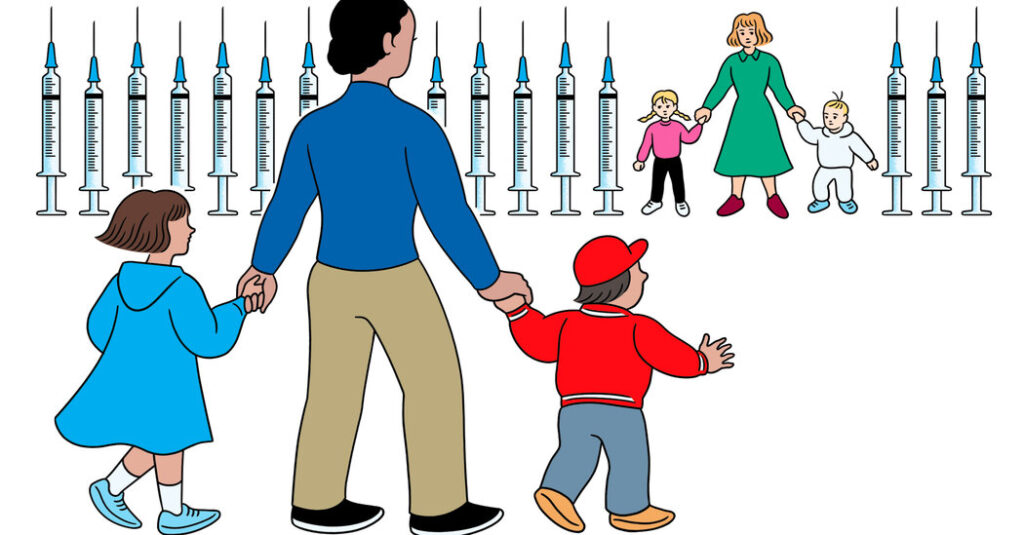
I have a close friend who recently made a statement about vaccines that is a fringe opinion and, quite frankly, a conspiracy theory. I didn’t say anything at the time, but I later texted her to say that her statement was false and I sent a screenshot of the facts. Given her beliefs, I don’t really want to devote more energy to this friendship. Among our history of disagreements, this one may be the straw that broke the camel’s back. I had never before brought up my objections to her ideas, because until now I considered her beliefs inconsequential. But it seems actively dangerous for her to espouse this belief about vaccines. I have trouble treating her patently false belief as a matter of opinion and doing what she calls “respecting her decision.” I told her I wasn’t comfortable hanging out knowing that she’s not vaccinating her children on schedule, given that our kids play together every week.
She’s upset because she says I’m holding her to a higher standard than I would a stranger. But I think I am well within reason to do so — she’s not a stranger. In fact, we would be more likely to catch something from her family precisely because of how often we get together. She also said my comments about not socializing with her were hurtful, but I don’t understand how. If this is her position, she has to understand that friends and family might feel the way I do and it’s nothing personal. It’s a health and safety issue for me and our community. Moreover, it really bothers me that she is selfishly choosing to put her children and others at risk when there is no need to do so.
As it stands, we aren’t really talking. Our kids see each other much less frequently than before, and I am fine with this. What do you think?
— Name Withheld
From the Ethicist:
Your friend is among the many people who have been drawn into vaccine conspiracy theories, often through social media, and mistrust of vaccines has become increasingly correlated with political partisanship. Gallup polling shows Republican support for the importance of childhood vaccinations has dropped significantly over the past decade, while Democratic support has held roughly steady or even increased. (Previously there was little partisan split.) So part of your discomfort may be less about measles and more about what her views signal politically.
What’s true is that unvaccinated people are more likely to contract the infectious diseases they haven’t been protected against and to spread them, including to those who have been vaccinated, because no vaccine offers 100 percent protection. When you get vaccinated, you do two things at once: You lower your own risk, and you contribute to herd immunity, the collective protection that kicks in once enough of the population is covered. That’s why anti-vaxxers have, for such a long time, been able to free-ride on that majority. It’s a real problem for public health, as regional immunization rates have dropped below a safe level, and the incidence of measles, in particular, has risen because vaccine opposition has risen.
But the arithmetic cuts the other way for your immediate situation: If you and your children are vaccinated, your personal exposure to an unvaccinated family is raising your extremely low risk to one that, in absolute terms, is still extremely low. The diseases that once struck hundreds of thousands of Americans annually — measles, mumps, rubella — are still rare enough that the actual danger to your kids from this friendship is remote. (Should your friend’s family be connected to a measles outbreak, obviously, it’s a different story.) If this friendship were otherwise worth keeping, I’d worry less about your family’s health than about hers.
Your friend objects that you’re penalizing her for something a stranger could get away with — that your knowing her situation is being held against her. This is just how social life works, though. We hold people we’re acquainted with to standards we can’t apply to a stranger because we actually know what they’re doing. And you could make a public-minded argument in favor of the penalty, which is that ostracism can be a genuine deterrent. Arguing someone out of a conspiracy theory is hard; you might think that a social cost attached to the belief could do more work than logic would.
On the other hand, there’s also a democratic case for staying in conversation with people whose views you find wrong or even dangerous. It’s unhealthy for democratic self-governance when we disconnect over disagreement. Vaccine hesitancy among Republicans grew sharply during a period when Americans sorted themselves into increasingly insular partisan networks. Sealed social networks, a process of mutual ostracism, allow misinformation to go unchallenged: You lose the kind of friction that comes from having to defend your views to someone who doesn’t share them.
Remaining friends with your anti-vaxxer gives you a chance to change her mind — at the cost, admittedly, of having to hear her try to change yours. But the facts really are on your side. And the work of persuasion matters in the aggregate. Measles had zero reported cases in the United States in 2000, a triumph of herd immunity we’re now slowly squandering. Getting back there requires vaccination rates above 95 percent, which requires winning over people like your friend. It’s hard to do that once you’ve walked away. Even when the argument fails, having it is part of what it means to govern together. Democratic governance thrives when we treat others as people still worth persuading.
I’ve been making the point that you don’t have to break up with this woman simply for public-minded reasons. I should also acknowledge that a friendship you stick with simply for public-minded reasons isn’t much of a friendship at all. If you don’t much value this relationship — and your letter suggests that you don’t — you’re free to let it go.
Readers Respond
The previous question was from a reader who wondered whether it was OK to tell his wife that the money for her cigarettes couldn’t come out of the family budget. He wrote:
My wife doesn’t work, and she depends on me financially. This is an agreement we’ve had for years, and it works well for both of us. We live comfortably but on a tight monthly budget. When I met her 10 years ago, she didn’t smoke. I knew she had smoked before, but she assured me that she had stopped entirely. Some months ago, though, she started smoking again. We talked about it, and I told her my position was that, obviously, she was free to smoke, as long as she did so outside the house, and that the money for her cigarettes would not be included in our budget planning. She would somehow have to find the money somewhere else. … I have never said no to something she has asked for, and this is creating a division between us. Should I pay for my wife’s cigarettes? — Name Withheld
In his response, the Ethicist noted:
Your position is easy to grasp: Why should you subsidize this deplorable habit? Step back, though, and consider the basic situation here. Because you earn all the family income, you’ve taken it on yourself to exercise complete control over it, giving yourself unilateral veto power over your wife’s expenditures. That’s a problem, and she has cause to resent your position. You’re not treating your wife as a partner, and you’re not genuinely treating the household earnings as a shared resource. … Given that presumably she contributes to the household in other ways, including through her labor, it makes sense to treat your earnings as your family’s and to give her discretionary income. If she chooses to spend her share on cigarettes, that’s her choice. At the same time, you should feel free, as a loving spouse deeply concerned for your wife’s welfare, to tell her regularly that you think she should quit. It’s just that the subject of the conversation should be her health, not your money.
(Reread the full question and answer here.)
⬥
If spouses see money as a joint resource, that means both of them have the right to veto expenses. As a stay-at-home mom, I have vetoed some of my husband’s personal expenses, and he’s vetoed mine. Addictive substances that are unhealthy for everyone in the household would be at the top of the list for veto. On the other hand, if the letter writer’s wife can’t also veto his purchases? That’s a different kettle of fish entirely. — Narcissa
⬥
I agree entirely with the Ethicist that this should not be a financial conversation and that couching it in those terms diminishes the wife’s place in the family. I would also add that in a loving relationship, I would want to know why she took up smoking again after 10 years. Is there some stressor in her life that the husband could help alleviate or support her through? Could a therapist help? Maybe finding the root cause could help her find healthier means of coping. Seeking to control her, whether through financial restrictions or other means, would probably only exacerbate the stress that’s causing the behavior to re-emerge. Trying to understand where the other person is coming from should always be the first step in addressing a problem in a healthy marriage. — Cheryl
⬥
I disagree that the husband should tell his wife regularly that she should quit. Constantly reminding a smoker that smoking is bad and they should quit (which, in my opinion, amounts to badgering) probably will not convince them to stop doing something they enjoy doing. Efforts to quit in order to satisfy someone else are rarely successful. A person has to have a strong desire to stop — and be willing to feel miserable while doing so. — Marla
⬥
I think the letter writer needs to re-evaluate how he views “work.” When my wife and I married, she earned substantially more than I did. When we had kids, she quit her job and I started a new career with more earning power. But I would never say my wife didn’t work. She worked very hard but just didn’t get direct payment for it. Because she ran the household, watched the kids and did pretty much everything else, I was able to work longer and make more money. If I paid someone to do what she did, it would have cost well over half of what I was being paid. So when a paycheck came to me, it wasn’t my money — it was our money. Which isn’t to say that the letter writer’s issue here isn’t a major one. I am pretty sure that as much my wife loves me, if I started smoking and refused to quit, she would divorce me. — Mark
⬥
I don’t agree with the Ethicist’s response here. The reality is that regardless of who earns the money, smoking is quite expensive, and the letter writer says they are on a tight budget. For the wife to now stress the budget with an expensive and unhealthy habit isn’t right. I absolutely think the letter writer is within his rights to tell her she needs to fund her own habit. — Lisa
The post Is It OK to Cut Ties With a Friend Because of Her Views on Vaccines? appeared first on New York Times.