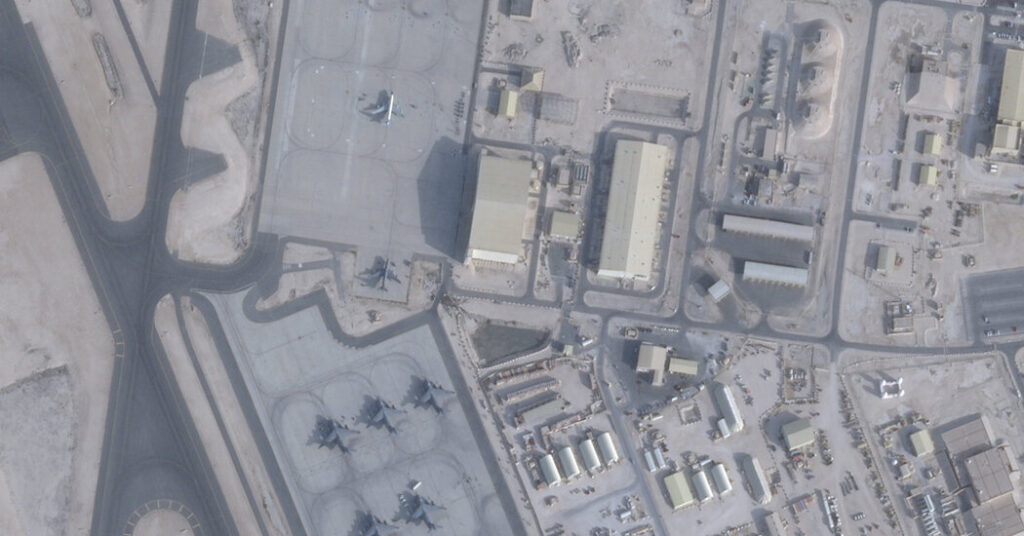
Iran has bombed U.S. bases across the Middle East in retaliation for the U.S.-Israeli war, forcing many American troops to relocate to hotels and office spaces throughout the region, according to military personnel and American officials.
So now much of the land-based military is, in essence, fighting the war while working remotely, with the exception of fighter pilots and crews operating and maintaining warplanes and conducting strikes.
Iran’s Islamic Revolutionary Guards Corps has urged people to report these new locations as it hunts for the dispersed troops. U.S. military officials say that threat is not stopping the Pentagon from carrying out the war against Iran, which is in its fourth week.
“To date, we’ve struck over 7,000 targets across Iran and its military infrastructure,” Defense Secretary Pete Hegseth declared last week. He then repeated what has become a common refrain at his news briefings: “Today will be the largest strike package yet, just like yesterday was.”
But the relocation of troops to makeshift — one official called them “alternative” — sites raises questions about the Trump administration’s preparations for the war.
There were close to 40,000 U.S. troops in the region when the war started, and Central Command has dispersed thousands of them, some to as far away as Europe, American military officials said. But many have remained in the Middle East, although not on their original bases, military officials said.
The result, according to current and former military officials, is a war that is much harder to prosecute.
“Yes, we have the ability to set up expedient operation centers, but you’re absolutely going to lose capability,” said Master Sgt. Wes J. Bryant, a retired Special Operations targeting specialist in the U.S. Air Force. “You can’t just put all that equipment on the top of a hotel, for example. Some of it is unwieldy.” A U.S. military official said that troops are not working from the roofs of civilian hotels.
Iran responded forcefully to the joint American and Israeli strikes, targeting not only U.S. bases but also embassies and oil and gas infrastructure throughout the region. With its supreme leader and dozens of other leaders killed, the Iranian regime has retaliated by launching hundreds of drones and missiles into neighboring countries and largely shuttered the Strait of Hormuz, a vital shipping route, making sure the war would be felt by people across the globe.
Many of the 13 military bases in the region used by American troops are all but uninhabitable, with the ones in Kuwait, which is next door to Iran, suffering perhaps the most damage. Six U.S. service members were killed in a strike on Port Shuaiba that destroyed an Army tactical operations center. Iranian drones and missiles also targeted Ali Al Salem Air Base, damaging aircraft structures and injuring personnel, and Camp Buehring, damaging maintenance and fuel facilities.
In Qatar, Iran struck Al Udeid Air Base, the regional air headquarters of U.S. Central Command, damaging an early-warning radar system. In Bahrain, a one-way Iranian attack drone struck communications equipment at the headquarters of the U.S. Fifth Fleet. At Prince Sultan Air Base in Saudi Arabia, Iranian missiles and drones damaged communications equipment and several refueling tankers.
An Iranian-backed militia in Iraq launched a drone swarm attack on an upscale hotel in Erbil early in the war.
Iranian officials have even accused the U.S. military of using civilians as human shields by putting American troops in hotels.
“We are forced to identify and target the Americans,” the intelligence arm of the Islamic Revolutionary Guards Corps said in a message to people in the region, according to Tasnim News Agency. “Therefore, it is better not to shelter them in hotels and to stay away from their locations.”
The message added that “it is your Islamic duty to accurately report the hiding places of American terrorists and send the information to us on Telegram,” a social media app.
Despite a punishing air campaign, the Iranians “still retain some capability,” Gen. Dan Caine, the chairman of the Joint Chiefs of Staff, acknowledged in the Pentagon news conference last week.
General Caine said that “layered defenses throughout the region” were allowing the United States to protect troops and interests but that the Pentagon was trying to bolster defenses in the region.
Part of the problem for the Pentagon is that two decades of war in Iraq and Afghanistan — war zones where the United States quickly established air superiority — left the military with facilities and headquarters close to the current front lines.
While Bagram Air Base in Afghanistan and the U.S. Embassy in Baghdad, for example, were often targeted in suicide bombings and other attacks, neither the Taliban or Iraqi militias possessed the kind of ballistic missile capability that Iran has.
During the war in Iraq in particular, the United States built up its bases there and in Kuwait, Bahrain, Saudi Arabia and Qatar. Now, the war in Iran has made all of those bases vulnerable — to the point where service members can’t really live or work there for extended periods, military officials said.
The lack of better planning, some military officials said, also reflects a miscalculation on the part of the administration about how Iran would respond. The Trump administration did not reduce staffing at American embassies and other facilities in the region before the war started, or order departures for nonessential government employees and family members. Nor did the State Department warn Americans to steer clear of the region until after the war began.
Two former U.S. officials briefed on military operations said there were no reinforced roofs on command centers at Prince Sultan Air Base in Saudi Arabia, where one service member was killed and several others were wounded in an attack.
Military officials say that American refueling tankers were rushed to the war with little time to orient or practice in the region before getting thrown into the round-the-clock operations. Two American KC-135 tankers collided this month, leading to deaths of six service members. A Central Command spokesman said that incident is under investigation.
Sergeant Bryant, the former Air Force special operator, pointed out that one area that the U.S. military excels at is what he called “decentralized execution,” or the ability to continue to do its job even from far afield.
“You could cut off the head of the snake and down to the last individual soldier, we’re still going to be operating,” he said.
But, he added, “you still lose something.”
Helene Cooper is a Pentagon correspondent for The Times. She was previously an editor, diplomatic correspondent and White House correspondent.
The post Iran’s Attacks Force U.S. Troops to Work Remotely appeared first on New York Times.