Karen Kramer is deputy director of the Center for Human Rights in Iran. Esfandiar Aban is the center’s director of research.
The bombs are still falling, and the Islamic Republic’s future is uncertain, but one thing is already clear: The Iranian regime is preparing for its next war — against its own citizens.
In the past few days, three young men arrested for participating in the January protests have already been executed — a chilling signal of what may lie ahead.
The danger to the Iranian people cannot be overstated. Confronted not only with external conflict but also with a population that has repeatedly taken to the streets in defiance, the regime is determined to settle scores with its domestic critics and extinguish any internal challenge to its rule.
Its willingness to inflict violence upon its own people has been demonstrated time and again over the past 47 years. But never has it been more intense than during the nationwide protests in January, when security forces gunned down thousands in the streets over a matter of days. Now facing an existential threat, the regime is angry and armed and sees enemies all around.
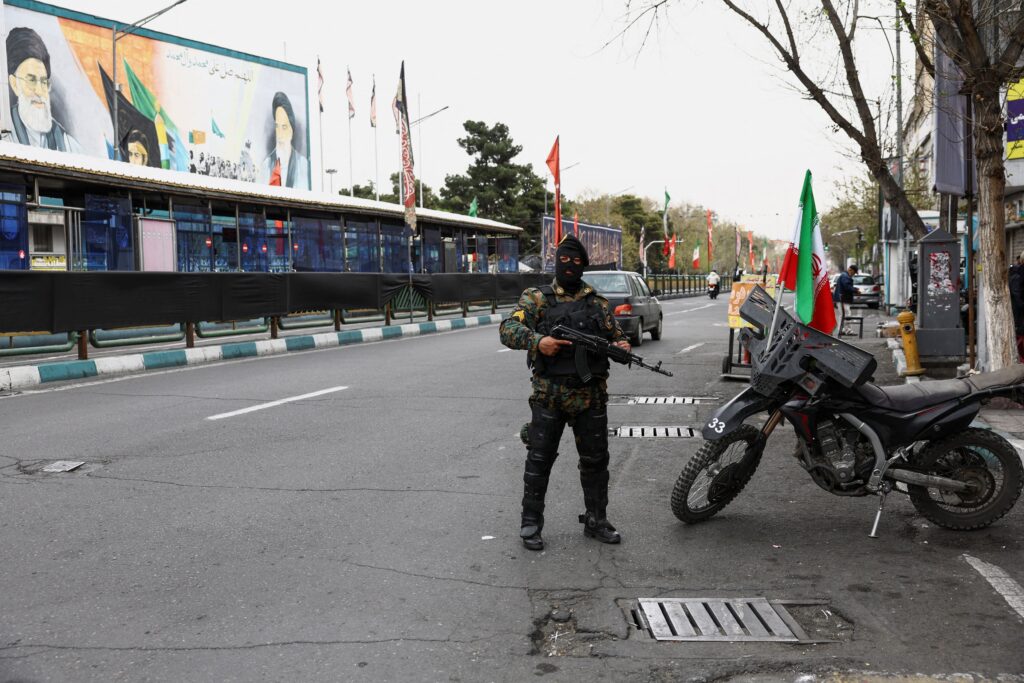
The warning signs are unmistakable. Armed Basij patrol neighborhoods. The Islamic Revolutionary Guard Corps has sent text messages to citizens warning that “a blow even stronger than that of January 8” awaits those who protest. Hundreds of arrests have taken place across the country since the current conflict began, according to research by the Center for Human Rights in Iran (CHRI). The detained include not only January protesters tracked down by the authorities but also activists, students, members of religious and ethnic minorities, and ordinary citizens. Sources inside Iran report checkpoints in Tehran, Mashhad and other cities, where security forces stop individuals, confiscate their phones and search for “suspicious” content.
Iranian judiciary chief Gholamhossein Mohseni Ejehi has made the regime’s position explicit: “Individuals who collaborate with the enemy in any manner are considered part of the enemy’s forces and will be dealt with accordingly.” In practice, the regime defines “collaboration” so broadly as to encompass any form of dissent — activists, lawyers defending political prisoners, doctors who treated wounded protesters, members of religious or ethnic minorities, or simply individuals whose private messages or social media posts run afoul of the state.
For many, the outcome is grimly predictable: They will be arrested, most likely tortured and quickly tried without independent lawyers or due process in special revolutionary courts by handpicked hard-line judges. Many will face espionage or national security charges, which can carry the death penalty.
In this environment, the risk of mass arbitrary detention is acute. Even more alarming is the prospect of mass executions, especially as those arrested face a high likelihood of forced “confessions” extracted under torture. Hundreds of such confessions were broadcast over state TV after the January protests.
Those detained during that unrest are especially vulnerable, as demonstrated by the March 19 public hanging of Saleh Mohammadi, 19, Saeed Davoudi, 21, and Mehdi Ghasemi (age unknown), who faced torture and trials without due process. Of the more than 53,000 individuals arrested, CHRI believes tens of thousands may still be in custody. They are at grave risk of fast-tracked prosecutions that result in death sentences. A significant number were forcibly disappeared and continue to be held incommunicado with no information provided to their families, greatly increasing their risk of torture and extrajudicial killing.
The threat of retaliatory violence extends to the hundreds of political prisoners already behind bars. Their families have been left in the dark about their condition, and the Islamic Republic has a history of deadly retribution against political prisoners during periods of crisis. There is well-founded concern that those already on death row could be executed in secret.
Such fears are not without precedent. In the years following the 1979 revolution, the new clerical regime was only able to consolidate its power through violent purges of perceived rivals — monarchists, Kurdish groups, leftists and even former Islamist allies. Amnesty International has estimated that at least 5,447 people were executed; some prominent historians believe the number was far higher.
One Iranian woman whose husband was imprisoned and executed in 1982 recently told CHRI: “During 1982 and 1983, political prisoners were executed secretly, particularly in smaller cities. The families had no information about their loved ones. This is something we are seeing again today, families are kept in complete ignorance about the fate of prisoners, while government officials threaten to execute opponents.”
A second wave of mass killings followed in 1988. As Ayatollah Ruhollah Khomeini agreed to a ceasefire after the devastating Iran-Iraq war, the regime unleashed a wave of retaliatory killings against political prisoners, executing an estimated 4,500 to 5,000, many of whom had already been tried and were serving sentences. Because the executions were carried out secretly and the bodies buried in unmarked graves, the true scale may never be known.
The parallels to today are alarming. With armed agents roaming the streets, arrests mounting, tens of thousands behind bars, an internet shutdown to obscure the regime’s actions, and executions already underway, the Islamic Republic appears poised to pick up where the security forces left off in January.
The international community should not allow this to happen. It should demand that detainees and political prisoners be released and make clear that any further violence against civilians will carry severe consequences that cannot be offset by concessions elsewhere.
The Iranian people — who had no say in the actions of this regime, who have repeatedly risked their lives to demand change and who are still grieving their January dead — should not be made to pay this price.
The post Iran is already ramping up its next war. Guess who the ‘enemy’ is. appeared first on Washington Post.