The first black-and-white surveillance image shows a simple factory complex on a tree-lined road west of the Iranian city of Isfahan. In a second image, the factory, which United States Central Command said was manufacturing drones, had been blown to pieces, leaving shards of debris and blackened skeletal frames where buildings once stood.
Central Command released the before-and-after images on last week, showing what it purported to be “another major blow” to “Iran’s defense industrial base,” while serving as a kind of promise to allies in the Persian Gulf that the barrage of Shahed attack drones targeting their population centers and energy infrastructure would eventually be stopped.
It is a promise the United States might not be able to keep.
The Shahed drones are cheap weapons made with off-the-shelf parts that can be assembled in a smaller workshop than the site near Isfahan University of Technology targeted by the United States.
“The problem with a technology like that is it’s become democratized,” said Maximilian Bremer, a nonresident fellow at the Stimson Center, an organization that analyzes global security, who was previously chief of the Advanced Programs Division at the U.S. Air Force’s Air Mobility Command.
“If it’s relatively easy to do, to bend aluminum, to 3-D print, a basic motorcycle engine, then it’s harder to track where it’s coming from,” Mr. Bremer said.
Yasir Atalan, a deputy director and data fellow in the Futures Lab at the Center for Strategic and International Studies, put it more bluntly. “Iran,” he said, “will be able to produce more if this war continues.”
The ease and relative cost of production have helped give Iran the ability to keep fighting and create havoc across the region, even in the face of widespread U.S.-Israel bombardment. Iran is regularly firing missiles and drones across the Gulf, albeit at a lower rate than at the start of the conflict. Mr. Atalan said Iran was still able to launch 70 to 90 drones per day. That was down from more than 400 drones launched on March 1. (Exact totals are hard to track. Some ministries of defense in the region are releasing statistics, while others are not.)
Iran is focusing large numbers of drones on the Gulf States. The distance from Iran to those nations is much closer than to Israel, giving them less time to react and shoot the drones down.
Many are intercepted. The Saudi Defense Ministry said on Saturday that it had shot down dozens of drones overnight, while sirens warned of another incoming attack in Bahrain. The United Arab Emirates’ Defense Ministry said it intercepted three more ballistic missiles and eight drones on Saturday.
Some have gotten through, often with deadly results. Six U.S. Army reservists were killed in an Iranian drone strike at Shuaiba port in Kuwait.
The Shahed drones are simpler to launch than ballistic missiles. They can be moved in the bed of a large pickup, making it possible for crews to evade detection with little more than a tarp to throw over the back. As long as the drones are in the air, Iran has a greater ability to pick and choose which countries’ ships can navigate the Strait of Hormuz, while the United States rushes more troops and matériel to the region to try to fully reopen the waterway.
The question facing war planners in Washington and Israel is just how many drones the Iranians still have hidden or can build, and whether they will have enough interceptors to shoot them down before the weapons can wreak further havoc for regional allies and global energy markets. Estimates of how many Shaheds Iran had at the start of the war vary widely — from thousands to tens of thousands.
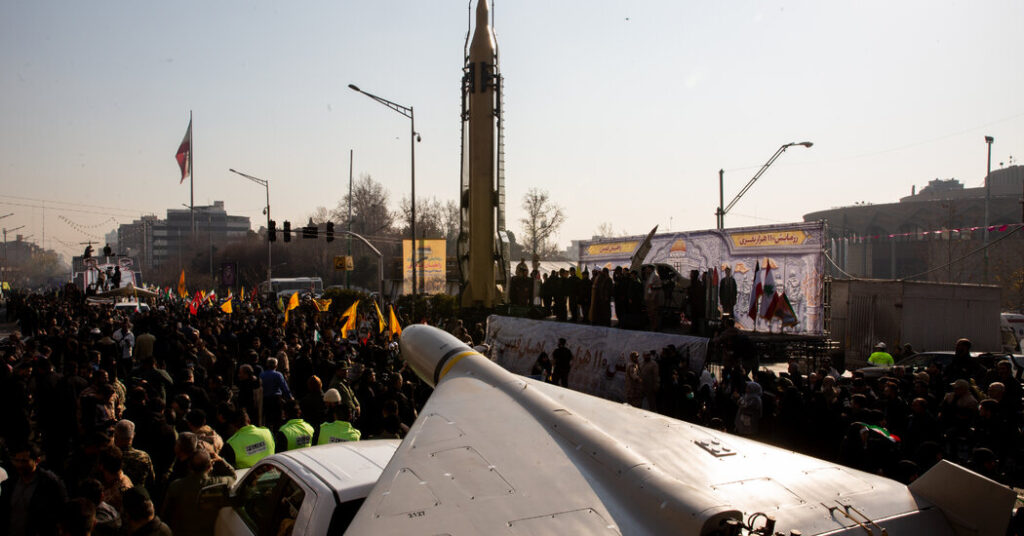
There are many different models of the drone known as the Shahed, but the most commonly used is the delta wing Shahed-136, which is in many ways a slow, rudimentary cruise missile. Just over 8 feet wide and around 12 feet long, with a top speed of 115 miles per hour, it launches from a rail-based rack off the back of a military or commercial-grade truck. Once in the air, the Shahed has a range of up to 1,500 miles and uses GPS to find the target for its 90-pound warhead. All at an estimated cost of $35,000 per drone.
To combat the threat posed by the Shaheds, Gulf States are firing interceptors that cost millions apiece and scrambling fighter jets that must slow down almost to stall speed to deal with the puttering low-tech machines. They also have Apache attack helicopters machine-gunning them out of the sky.
Even if Iran’s ability to manufacture drones were to be severely degraded, it may be able to count on assistance from Russia. Gordon B. Davis, a senior fellow at the Center for European Policy Analysis who served as a deputy assistant secretary general for NATO’s Defense Investment Division after retiring from the U.S. Army as a major general, said in a briefing on Thursday that Russia was working to produce as many as 1,000 drones a day.
Iran is not trying to defeat the United States in any traditional sense, Mr. Davis said, adding, “Iran has adapted quickly, targeting air defenses, radars and command-and-control nodes rather than simply trying to compete symmetrically.”
Russia, whose own economy and war machine feed on oil and gas revenues, has every incentive to help Iran keep the Strait of Hormuz closed. And every expensive interceptor fired at an Iranian drone is another that cannot be shipped to Russia’s adversaries in Ukraine.
President Volodymyr Zelensky of Ukraine, noting that 11 countries had asked for assistance combating Shahed drones, said that over 200 Ukrainian drone experts had rushed to the Middle East to aid in the fight. Ukraine has learned how to use cheap interceptor drones instead of expensive Patriot missiles to bring down the battle drones Russia launches in waves at its territory, often by the hundreds every night.
Iranian drones are the product of four decades of development, born out of military and financial necessity.
Iran first began using crewless aerial vehicles little more sophisticated than hobbyist, remote-controlled airplanes with cameras attached during the Iran-Iraq War in the 1980s. It continued developing newer and better models, sometimes with imported parts, but often with domestic production because of economic sanctions.
In a report on Iran’s military power, the Defense Intelligence Agency said that Tehran first used drones for “long-range, cross-border strike operations” in 2018, for an attack against the Islamic State group in eastern Syria. They were subsequently used in an attack on Saudi Arabian oil facilities in 2019, for which the Houthis claimed credit.
Iran first provided drones to the Kremlin in 2022, shipping them across the Caspian Sea on ships with their maritime-tracking beacons turned off or removed, Ukrainian intelligence officials have said.
In 2022, the European Union imposed sanctions on Shahed Aviation Industries, a company linked to the Islamic Revolutionary Guards Corps and accused of being “responsible for the design and development of the Shahed series of Iranian Unmanned Aerial Vehicles.” The United States followed suit.
Damien Spleeters, director of field operations at Conflict Armament Research, described the approach to manufacturing drones taken by Iran and Russia so far as “simplicity, reliance on commercial components, quantity over quality.”
The goal for U.S. and Israeli airstrikes is to destroy as many production facilities and weapon stores as possible to stop the threat from Iranian drones.
“Obviously, the U.S. is trying to hit the production sites, but you have different ways to produce these frames.,” said Mr. Atalan, of the Center for Strategic and International Studies. “ It’s not necessarily very easily tracked. Decentralized production is possible. You don’t need huge facilities for these.”
John Ismay contributed reporting.
Nicholas Kulish is a Times reporter who covers the changing nature of warfare in conflict areas around the world.
The post In Iran War, Cheap Drones Remain Wild Card appeared first on New York Times.