John Spencer is the chair of war studies at the Madison Policy Forum.
For decades, the world has accepted a dangerous reality: One of its most important energy arteries runs through the Strait of Hormuz, a narrow chokepoint repeatedly threatened by Iran.
During peacetime, the Strait of Hormuz carries roughly 20 million barrels of oil per day, about one-fifth of global petroleum consumption, along with a fifth of global liquefied natural gas trade. No other chokepoint, save the Strait of Malacca in Southeast Asia, carries a larger share of global supply. Nearly every barrel exported from Saudi Arabia, Kuwait, Iraq, Qatar and the United Arab Emirates passes through this narrow waterway before reaching global markets.
This arrangement has always been a strategic vulnerability. Iran has repeatedly threatened to close the strait, attacked commercial shipping, deployed naval mines and used proxy forces to target energy infrastructure.
For decades, the United States and its allies have responded the same way: deploying naval forces to keep shipping lanes open. During the Iran-Iraq “Tanker War” of the 1980s, more than 400 ships were attacked. The U.S. responded with Operation Earnest Will, escorting tankers through the Persian Gulf. Insurance premiums surged, raising costs and driving volatility in global oil markets.
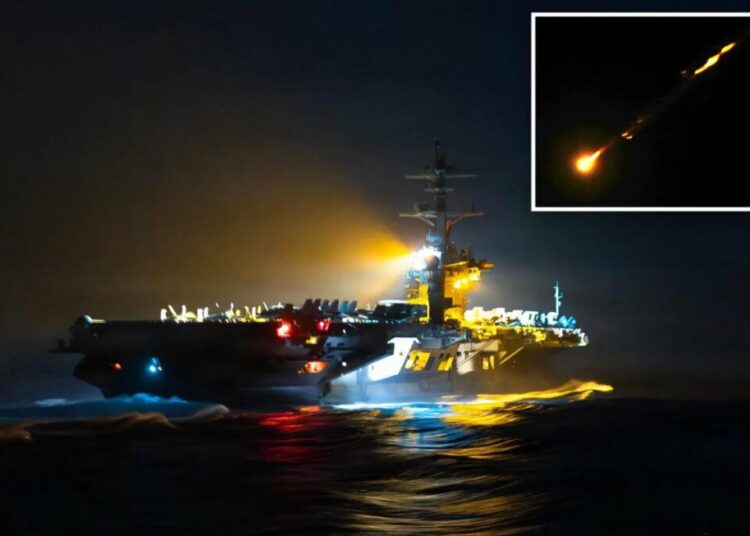
Today, the U.S. is back where it has been before, being asked to defend shipping routes in the Gulf. Operation Epic Fury may degrade Iran’s capabilities and behavior, but like Operation Earnest Will, it cannot eliminate the enduring threat to maritime commerce. As long as the world depends on a narrow waterway, energy markets will remain vulnerable to coercion and price shocks.
The answer is to build infrastructure that makes the Strait of Hormuz strategically irrelevant.
Some bypass routes already exist. Saudi Arabia operates the East-West Pipeline, which carries oil from the kingdom’s Gulf oil fields to the Red Sea port of Yanbu. The system can move roughly 7 million barrels per day, allowing Saudi oil to reach global markets without passing through Hormuz. And the United Arab Emirates built a similar bypass route. Its Habshan-Fujairah pipeline moves roughly 1.5 million barrels per day from Abu Dhabi directly to the Gulf of Oman, allowing tankers to load outside the strait.
These projects show that bypassing Hormuz is possible. But existing infrastructure is not yet sufficient.
After the 1956 Suez Crisis and subsequent closures of that canal, energy producers built alternatives to bypass chokepoints. Egypt’s Sumed pipeline, which moves more than 2 million barrels per day from the Red Sea to the Mediterranean, is one such example. Similar concerns about congestion and geopolitical risk drove construction of the Baku-Tbilisi-Ceyhan pipeline, a 1,100-mile system that carries roughly 1 million barrels per day from Azerbaijan to Turkey’s Mediterranean coast. These projects provide a clear benchmark for what is required. Major pipelines of comparable scale span hundreds to more than 1,000 miles and cost billions to tens of billions of dollars. Nord Stream 2 runs roughly 760 miles and cost about $11 billion, while the 800-mile Trans-Alaska Pipeline cost roughly $8 billion at the time, equivalent to more than $40 billion today.
Hormuz carries about 20 times the volume of a major pipeline like Baku-Tbilisi-Ceyhan. Even replacing half that flow would require a network of pipelines across multiple countries and new export terminals, likely costing hundreds of billions over time. And the challenge is geographically complex, with certain exporters more vulnerable than others. Saudi Arabia exports roughly 6 million to 7 million barrels per day and already has significant bypass capacity. The UAE produces about 3 million barrels per day, with roughly half already bypassing Hormuz. Iraq, on the other hand, exports approximately 4 million to 5 million barrels per day, and is almost entirely dependent on the Gulf. Kuwait exports about 2 million to 3 million barrels per day with no meaningful bypass capacity, and Qatar’s energy exports also remain almost entirely tied to the strait.
The objective is not total elimination of flows through Hormuz; it is reducing them to a level where Iranian disruption no longer produces global shocks. Meaningful reduction would require additional export corridors capable of moving roughly 10 million to 15 million barrels per day. Expanding Saudi and Emirati capacity could remove an additional 5 million to 8 million barrels per day from the chokepoint using existing corridors. And new pipelines from Iraq to the Mediterranean or Red Sea, along with routes from Kuwait through Saudi territory, could account for an additional 5 million to 7 million barrels per day.
History suggests the economic damage from a prolonged disruption would exceed the cost of building alternatives. Even small reductions in global supply can send shock waves through transportation, manufacturing, agriculture and financial markets. The International Monetary Fund estimates that a sustained 10 percent increase in oil prices reduces global output by about 0.1 to 0.2 percent, meaning recent price spikes translate into tens to hundreds of billions of dollars in lost global economic activity. Even a temporary disruption in Hormuz could push oil above $100 per barrel and impose losses measured in the hundreds of billions, with longer disruptions potentially reaching into the trillions.
The Strait of Hormuz is not an unavoidable fact of geography. It is a problem of infrastructure and strategy. The world has spent decades defending it. Now, the world needs to start investing in ways of bypassing it, and sustained risk should provide enough market pressure to accelerate those alternatives.
The post How to make the Strait of Hormuz irrelevant appeared first on Washington Post.