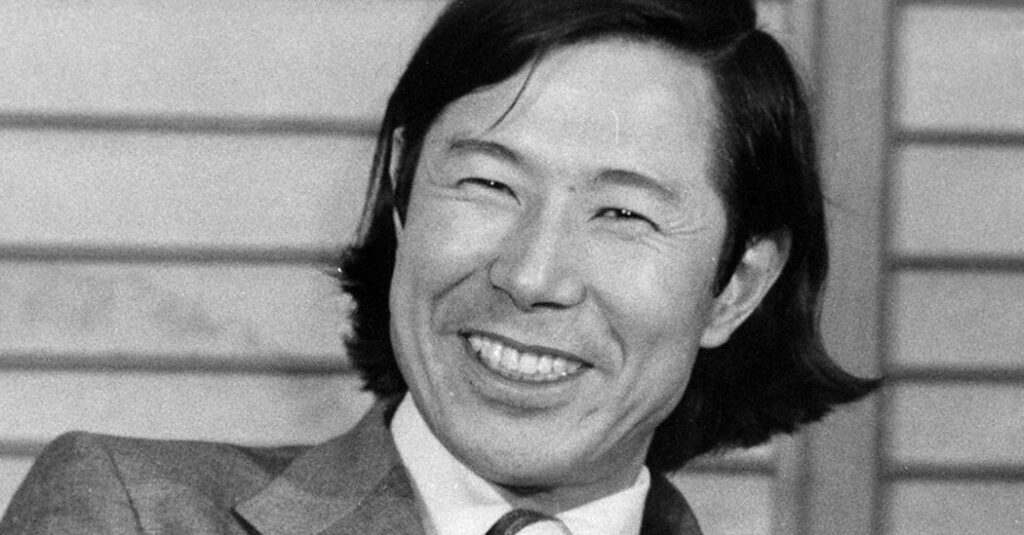
Heisuke Hironaka, an influential mathematician who received one of his profession’s highest honors for devising an algorithm to handle the sharp edges and pointy peaks of geometry, died on March 18 at his home in Tokyo. He was 94.
His death was confirmed by his daughter, Eriko Hironaka.
For smooth surfaces, the mathematical machinery of calculus, invented by Isaac Newton and Gottfried Wilhelm Leibniz in the late 17th century, works well to solve problems like calculating the motions of planets. Finding solutions is much more difficult when an equation jumps sharply or makes an instantaneous turn to another direction at a certain value or blows up to infinity — what mathematicians call singularities.
In the 1960s, Dr. Hironaka figured out how to perform “resolutions of singularities,” turning something sharp or undefined into something smooth, which can then be tackled by the tools of calculus. His technique, which generalized earlier work to dimensions higher than the three-dimensional universe we live in, now permeates many fields of mathematics.
“A singularity might be a crossing or something suddenly changing direction,” Dr. Hironaka said in an interview published in 2005 in The Notices of the American Mathematical Society. Without singularities, he added, the world “would be completely flat. If everything were smooth, then there would be no novels or movies. The world is interesting because of the singularities.”
Dr. Hironaka explained the general idea of his work through an example of a roller coaster. “A roller coaster does not have singularities — if it did, you would have a problem!” he noted in the 2005 interview. “But if you look at the shadow that the roller coaster makes on the ground, you might see cusps and crossings.”
The cusps and crossings represent singularities, but they would be understood as projections of a smooth, higher-dimensional object — the roller coaster. “You can pull back to the smooth thing, and there the calculation is much easier,” Dr. Hironaka added.
In 1970, he received a Fields Medal, an award bestowed every four years on mathematicians age 40 or younger, for his work on singularities.
Dr. Hironaka’s insights provided “a get-out-of-jail-free card that lets you bypass the problems that come from the existence of singularities,” said Ravi Vakil, a professor of mathematics at Stanford University. “The challenge of singularities can’t be overstated. Singularities are precisely where calculus breaks down, and you need to invent new tools.”
Dr. Vakil said the work of Gerd Faltings and Masaki Kashiwara, the past two winners of the Abel Prize, which is widely considered the equivalent of the Nobel for mathematics, relied on “insights built directly on Hironaka’s breakthrough ideas.”
Dr. Hironaka’s proof was “initially so complicated that famously very few people would even try to understand it, but everyone would just use it like waving a magic wand,” Dr. Vakil said.
For his part, Dr. Hironaka spoke more modestly of his achievement. “I am not so smart, so it is better that I start something where there are no techniques for the problem, and then I can just build step by step,” he said in the American Mathematical Society interview. “But actually, it was not so hard. It turned out to be easier than I thought.”
Heisuke Hironaka was born in a village in the Japanese prefecture of Yamaguchi on April 9, 1931. His father, who left school as a teenager to help support his family, was a founder of a textile company.
Dr. Hironaka received a bachelor’s degree from Kyoto University in 1954. He stayed on for graduate work when Oscar Zariski, a Harvard mathematician in the field of algebraic geometry, visited Kyoto and, impressed by work the student had done in algebraic geometry, suggested that he pursue his doctorate at Harvard.
With Professor Zariski as his adviser, he completed his Harvard doctoral thesis in 1960 and began teaching at Brandeis University. That year, Dr. Hironaka married Wakako Kimoto, a graduate student at Brandeis. He later taught at Columbia University from 1964 to 1968 and then joined Harvard, where he remained on the faculty until becoming emeritus in 1992.
While at Harvard, he also held a joint professorship at Kyoto University and served as director of the Research Institute for Mathematical Sciences in Kyoto from 1983 to 1985.
In Japan, Dr. Hironaka gave lectures and wrote popular books. An autobiographical work, “The Discovery of Learning,” which discussed his philosophy toward the study of math and science, inspired many students to pursue those subjects. “He would appear on television, on talk shows,” Ms. Hironaka, his daughter, said. “He was a household name in the ’70s and ’80s.”
In 1980, Dr. Hironaka started a summer seminar program for Japanese high school and college students. The summer seminars, now run by alumni, continue today.
In 1984, he founded the Japan Association for Mathematical Sciences to support the seminars and also an exchange program that allowed Japanese students and early career researchers to study in the United States. His aim was to offer students the kind of chances that he had been able to take advantage years ago — that enabled a young man from rural postwar Japan to rise to the highest levels of mathematics.
From 1996 to 2002, Dr. Hironaka was the president of Yamaguchi University.
In addition to his daughter, who is also a mathematician, he is survived by his wife, a writer and a politician who served in the House of Councillors, the upper house of Japan’s legislature; a son, Jo; four sisters, Michie Sakaguchi, Takako Matsunaga, Okamoto Kikue and Ohmine Haruko; two brothers, Hikosaburo and Unosuke Hironaka; and four grandchildren.
When Dr. Hironaka was a visiting professor at Seoul National University in 2008 and 2009, one student who signed up for a class he was teaching was June Huh, an aspiring science journalist.
The class proved too hard for most of the students, and the enrollment dwindled to a handful from about 100. Dr. Huh, then an undergraduate, was one of those who persisted, and he started talking regularly with Dr. Hironaka after the lectures.
“Looking back, I am deeply grateful that he spoke to me so generously and so regularly, despite how little I understood then,” Dr. Huh said.
Dr. Huh decided to become a mathematician. In graduate school, he started working in the field of combinatorics, an area of math that figures out the number of ways in which things can be arranged. He found that the singularity theory was key in proving a mathematical conjecture that had been proposed in the 1960s.
Dr. Huh, now a mathematics professor at Princeton University, received the Fields Medal in 2022. The following year, when Dr. Huh lectured at a conference of the Korean Mathematical Society, Dr. Hironaka joined virtually and gave a congratulatory speech.
“There is a special happiness in being able to please one’s old teacher after many years,” Dr. Huh said.
Kenneth Chang, a science reporter at The Times, covers NASA and the solar system, and research closer to Earth.
The post Heisuke Hironaka, Groundbreaking Mathematician, Is Dead at 94 appeared first on New York Times.