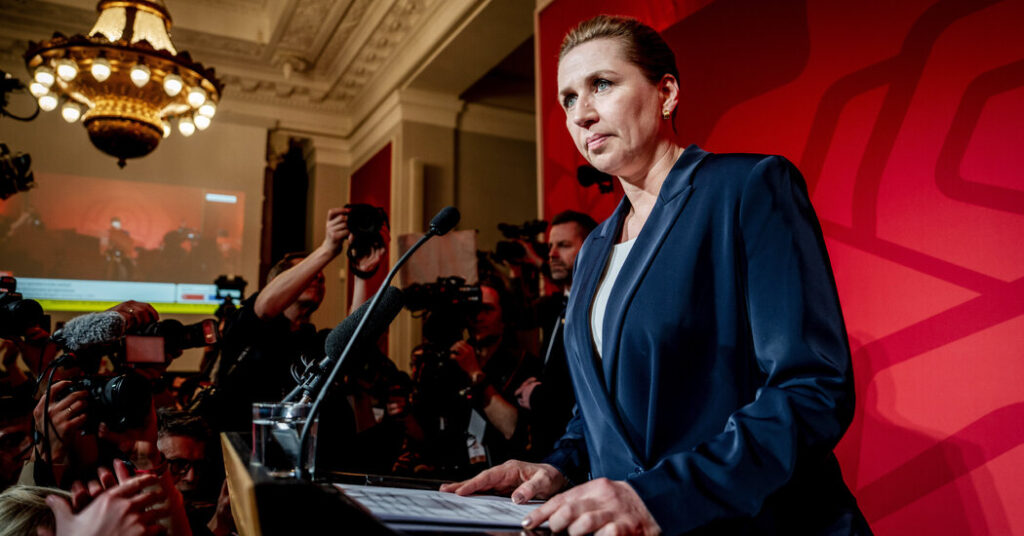
Denmark held a closely contested parliamentary election Tuesday, with the party of the incumbent prime minister, Mette Frederiksen, winning the most votes but far from a majority. Ms. Frederiksen, who has made a name for herself internationally for standing up to President Trump over Greenland, now faces the challenge of assembling a coalition government.
Here’s what to know about the election:
Voters Had Incumbent Fatigue
Ms. Frederiksen, in office since 2019, has become the most dominant force in Danish politics for decades. If she succeeds in securing another term she could be the country’s longest serving leader since World War II. While she is widely admired, many voters also wanted change.
“She has done a good, good job, but we are getting tired of Mette,” said Lars-Peter Boel, a chicken farmer. “When she speaks, she is talking like a mom, like she is talking down to people.”
Domestic Issues Outweighed Trump
Most Danes give Ms. Frederiksen high marks for how she blocked Mr. Trump from acquiring Greenland, a gigantic Arctic island that has been part of the Danish kingdom for more than 300 years and that Mr. Trump covets. (He says it’s important for national security reasons, but Greenland also has a lot of glittering resources like critical minerals.)
Ms. Frederiksen called in European allies to back up Denmark’s sovereignty. The Danish military even laid plans to blow up airfields to prevent American troops from landing.
But Danes give the credit for protecting the kingdom to other politicians as well, including the foreign minister, Lars Lokke Rasmussen, and Troels Lund Poulsen, the defense minister. Both hail from different parties. In the end, Ms. Frederiksen didn’t get much of a Trump bump.
Instead, voters were focused on divisive domestic issues such as how much regulation to impose on Danish farmers and if the country should come up with a wealth tax.
Political Landscape Continues to Fracture
Ms. Frederiksen is the face of her party, the Social Democrats, and on Tuesday they had their worst election performance in a century, with just 22 percent of the vote.
It was indicative of the declining fortunes of many mainstream, establishment parties across Europe as the political landscape continues to fracture.
In Denmark, 12 parties won seats in the next Parliament, and many of them are distinguished by only subtle differences. Venstre, the other historically strong party, known as the farmers’ party, won 10 percent. The rest of the votes were split among 10 other parties.
A Tricky Road Ahead
Fragmentation means that whoever governs Denmark will need to work with many different parties to form a coalition in Parliament. That gives smaller parties, like the Green Left and the Moderates, substantial power.
Mr. Rasmussen, the gruff but popular leader of the Moderates, is expected to play a kingmaker role. His support will be crucial to building a majority.
Most analysts believe Ms. Frederiksen will prevail and form a center left coalition but that it won’t be easy.
“This could take time,” said Bent Winther, one of Denmark’s leading political analysts. “Possibly weeks, even months.”
Jeffrey Gettleman is an international correspondent based in London covering global events. He has worked for The Times for more than 20 years.
The post Four Takeaways From Denmark’s Election appeared first on New York Times.