Your name has come up as a possible James Bond, but you have always been down the list, behind Idris Elba then and Callum Turner now. What could you do to improve your chances? How about writing and starring in a satirical mini-series about an actor who flubs his audition to be the next James Bond but finds himself touted as a favorite anyway? It’s what they call manifesting, right?
That would be the cynical view to take of “Bait,” written by and starring the gifted British actor Riz Ahmed, which premieres Wednesday on Amazon Prime Video. In reality, though, it’s more a case of Ahmed’s respectfully taking himself out of contention. The Bond producers would not want audiences to have Ahmed’s character — a paranoid, hallucinating basketcase who carries on a dialogue with a severed pig’s head — in the back of their minds while watching the next 007. No matter how good Ahmed looks in a dinner jacket.
Ahmed plays Shah Latif, a London-based performer of unspecified but no better than B-list renown, who is allowed to audition for Bond as a favor to a friendly director. In the opening scene, he repeatedly blanks out on his big line, to the director’s great exasperation. It feels like the setup for a story about an overthinking actor who sabotages himself, ground that was recently covered by “Wonder Man.”
“Bait” is not primarily about acting as profession or practice, however; it’s about acting as metaphor. Shah, the son of immigrants from Pakistan, is having an identity crisis, unsure of what role he can or should or might be allowed to play in Western society (and in the country of his ancestors’ former colonizer, to boot). Bond would be a career triumph, but at what cost to his soul?
That thematic weight gradually pushes “Bait,” across its six half-hour episodes, in darker and heavier directions. It starts out as a reasonably sharp comedy: After Shah opportunistically sparks a flurry of memes falsely portraying him as a Bond front-runner, the effect on his family and community (Shah’s parents live in Wembley, where Ahmed was born) is immediate and amusingly down to earth.
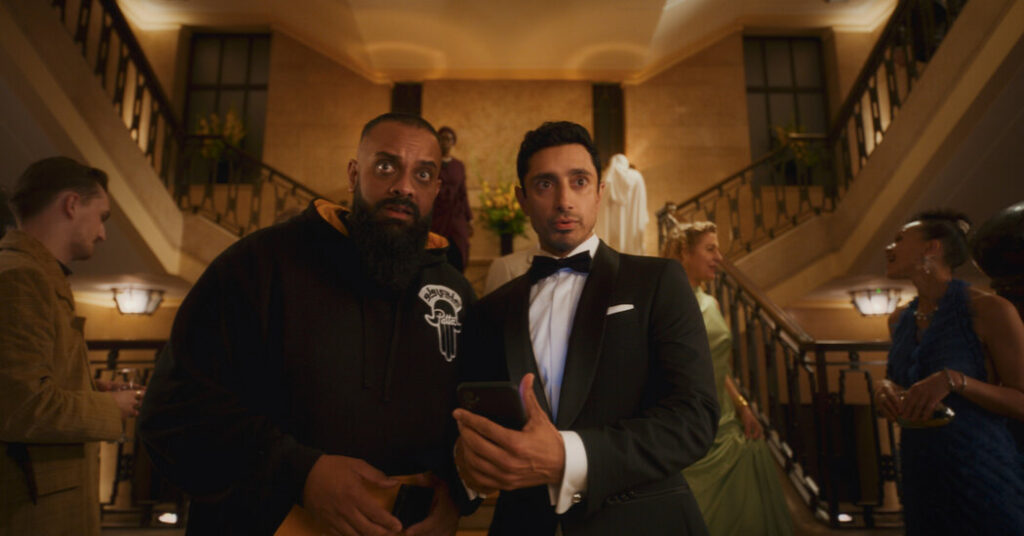
For his mother, Tahira (Sheeba Chaddha), who named him Shahjehan after the Mughal emperor Shah Jahan, the news is long-awaited validation. For his cousin and best bro, Zulfikar (Guz Khan), who is trying to get his Muslim car service off the ground, it’s a marketing opportunity. For many, including Shah’s ex, Yasmin (Ritu Arya), a maker of virtuous documentaries — her latest is about ship breaking — it represents a predictable sellout.
The satire of these characters with their multifarious agendas (the only thing all parties agree on is that Shah is too short for the part) is deft and affectionate, and it does not suffer too much from the obviousness of the character types: the impatient parents, the busybody aunties and uncles, the hustling sons and daughters, the smug militants.
Ahmed is trying for something more serious with Shah himself, however. The result of Shah’s culturally dissonant British upbringing — which incorporates a primal boyhood scene of a schoolyard beat down — is that he’s an empty vessel. In crucial moments, he passes off lines of dialogue from his screen roles as his own thoughts. He wears his insincerity as comfortably as Bond wears his black dinner jackets; while he cries that he doesn’t know who he is, we see that he is, if nothing else, a selfish and negligent friend, an unreliable romantic partner and a distant son.
This side of the story does suffer from the familiarity of Ahmed’s conceptions; the show feels thinner and less engaging as psychology, and family melodrama, take a greater hold. (This kind of material was presented with more resonance and feeling in the flurry of 1980s and ’90s British movies, many involving the writer Hanif Kureishi, that included “My Beautiful Laundrette,” “Sammy and Rosie Get Laid,” “East Is East” and “My Son the Fanatic.”) As Shah’s mental state deteriorates, and he flounders toward some kind of reconciliation with himself and his past, he imagines scenes as Bollywood spectacles or as Bond action sequences; these mostly fall flat.
But then there is that pig’s head, delivered to his parents’ house as part of a hate campaign. (Mild spoilers follow.) Shah begins to talk to it; it becomes his conscience, his tough-love therapist and, as he becomes more paranoid, his guardian angel. This was an objectively bad idea on Ahmed’s part, but he, or someone, also had the brilliant idea of casting Patrick Stewart as the pig. Stewart’s voice echoing in Shah’s head, like a stentorian, foul-mouthed leprechaun hectoring him to “think, you gimp, think!” never fails to be hilarious.
Casting is the strength of “Bait”: In addition to Stewart, the many people doing nice and often hilarious work include Chaddha, Khan, Arya, Sajid Hasan as Shah’s father and Nabhaan Rizwan as an irritatingly successful cousin.
Ahmed is probably the most accomplished of the group — witness his work in “Sound of Metal,” “Nightcrawler,” “The Sisters Brothers” or “The Night Of” — but in “Bait” he has hemmed himself in. His script doesn’t make us care about Shah or his redemption, and his performance can’t bridge the gap.
Mike Hale is a television critic for The Times. He also writes about online video, film and media.
The post ‘Bait’ Review: Bond. Shahjehan Bond. appeared first on New York Times.