The egg masses, sticky and menacing, clung to a grape vine at the Zephaniah Farm Vineyard in Northern Virginia, warning of an aspect of summer that D.C.-area residents have come to dread.
Spotted lanternflies. Thousands of them.
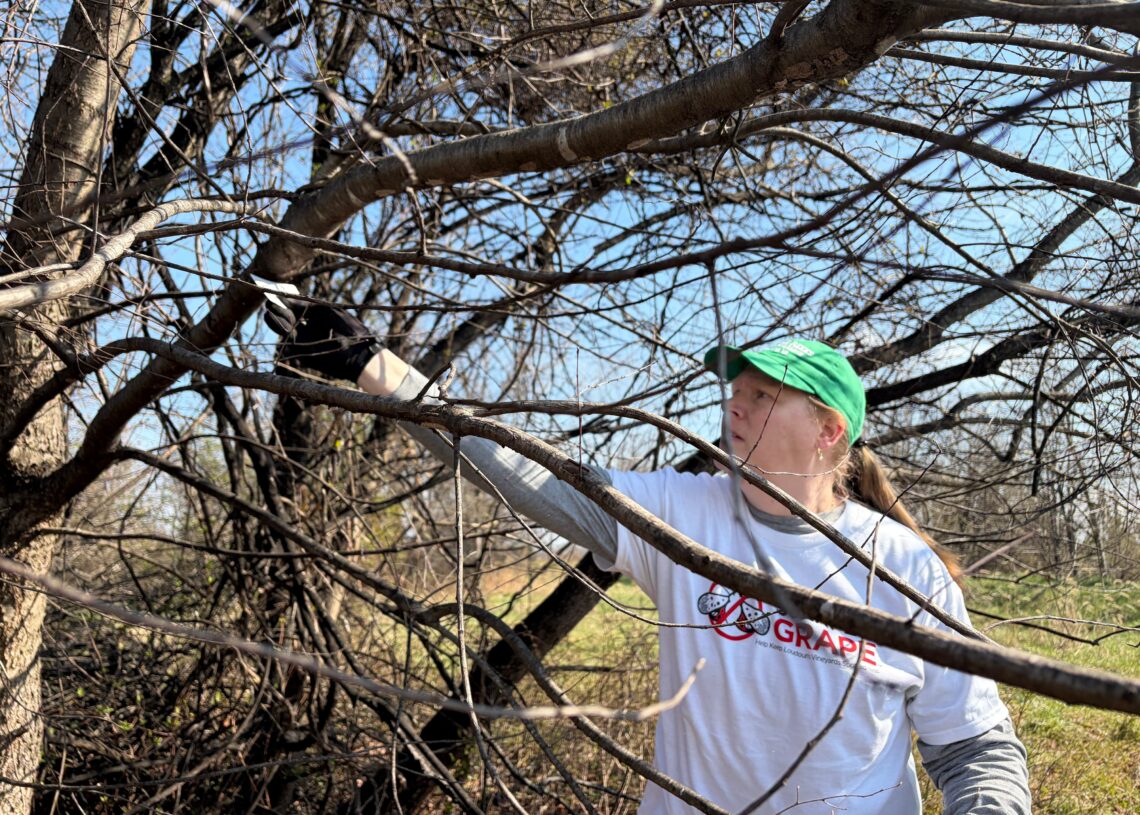
Jaime Akin and her mother, Deb Hollingsworth, each held what looked like a credit card and gently scraped the vine’s underbelly. They, along with about 20 other volunteers, showed up on a recent Saturday at the Loudoun County farm and hunched over or knelt, at times, to battle what has become a danger to local plant life, haunting farmers, park managers and homeowners.
“They’re scary,” said Hollingsworth, 69, as the mother and daughter from Round Hill, Virginia, worked row by row to rid the vines of lanternfly egg masses. “There’s so many of them.”
First detected in the United States in 2014, lanternflies have spread from their initial home in Southeastern Pennsylvania to nearly 20 states. In the D.C. region, they showed up in about 2018, eventually gravitating to the sweet nutrients of the vines that are part of Virginia’s $8.37 billion wine industry.
In an effort to kill the insects before they hatch, more than 400 volunteers showed up at a dozen spots in Loudoun County for an annual Scrape for the Grape campaign.
The operation, now in its third year, has two more sessions planned at various locations in the county in April and expects to draw about 600 more volunteers. The goal: to smash and kill as many egg masses as possible before the lanternflies hatch later this spring, wreaking havoc on trees and other plant life while fluttering across neighborhood streets, sidewalk cafes and playgrounds.
Known by the scientific name Lycorma delicatula, lanternflies are what scientists call planthoppers. Experts say they probably arrived on a shipment of stone headed to Berks County, Pennsylvania.
A lanternfly has a life cycle of “one generation per year” — hatching in late spring or early summer. It goes through four nymphal stages and one adult stage with various cycles of molting, laying eggs in the fall before the winter freeze kills them. In its first three nymphal stages, the lanternfly is black with white spots. In its fourth stage, it is red with white spots. Adults are about one inch long and have black-spotted, pinkish-tan wings.
Because the bugs fly and jump and are good at hitchhiking, it’s impossible to know how many there are in the D.C. region. Adults hop a ride by flying into an open window of a vehicle or on the back of a truck. They lay eggs quickly, in what scientists call a mass — which looks like a patch of dried mud — on an outdoor surface or vine or branch and move to a new spot.
While some naturalists say they are pretty, scientists see them as pests. They’re drawn to the invasive tree of heaven, which also hails from Asia. The lanternfly then moves to grapevines and fruit trees as it feeds on the sap of plants and excretes a sugary liquid that’s also messy, called honeydew.
The sticky residue probably is harmful to grapevines, bees and fruit crops because it triggers the growth of a black mold that stops sunlight from getting to plant leaves, hindering photosynthesis, according to scientists. Growers typically don’t like to use grapes polluted by lanternflies’ honeydew to make wine. And bees that feed on honeydew make a dark honey with a smoky, earthy flavor that few people find appealing.
At Zephaniah Farm Vineyard, Carol and Jim Duda scraped at the egg masses after arriving from their home in Herndon.
“We wanted to come out and do our part to help fend them off,” Carol Duda said. “We feel like we’re making a difference.”
“And,” her husband jokingly added, “we’re hoping there’s wine at the end of the line.”
For vineyards, a high level of lanternflies is bad news. While grape growers sometimes spray government-approved insecticides, the populations are so hardy that the bugs come back within a few days from nearby tree canopies, experts say. There’s a stigma attached to using any chemicals to rid vines of the pests, and growers worry about any insecticide residue on fruits. Drew Harner, a viticulturist at Virginia Tech, said, “You mention the word insecticide and there’s a perception that it comes from a tainted product.”
Bill Hatch, the owner of Zephaniah whose family has been farming for more than seven decades in Loudoun County, said last year was “pretty awful” with lanternflies on his property’s thousands of vines, so he was eager to have volunteers help scrape the vines.
“They’re vampires,” Hatch said of lanternflies. “They go into the vine and suck the sugar water out.”
“Eventually, that can take the grapevine down and take down the crop yield,” he said.
One of the biggest problems, scientists said, is that the lanternfly has few natural predators other than the praying mantis, which can’t keep the invasive insects in check if the population gets too big. And there is no permanent solution to rid farms and vineyards of spotted lanternflies, although scientists at Virginia Tech and U.S. Agriculture Department are working on developing a native fungus that causes the decline — and eventual death — of the tree of heaven, the insect’s favorite host.
“If you take out one of their favorite hosts, then you’re probably helping to level the playing field a bit more and we can reduce their impact,” said Tracy Leskey, an entomologist at USDA who’s involved in the research.
At Ida Lee Park, just a few miles from Hatch’s vineyard, about 70 volunteers came to hunt and scrape lanternflies’ masses.
“They drive me nuts,” said Nancy Walker, 66, a retired administrator who lives in the Ashburn area, as she scraped a tree branch at the park. “I’m a nature lover and they’re pretty, but I want to kill them.”
Some experts are doubtful that scraping off the egg masses of lanternflies actually works to prevent their spread. But others said any effort to help get rid of them is helpful.
For novices, finding their egg masses — and reaching them — is sometimes challenging, experts said, because they can be tricky to spot if they’re hidden under flat rocks and logs or higher up in the tree canopy of a park or near a vineyard.
Mike Littman, founder and president of the Loudoun Invasive Removal Alliance — a coalition of 86 homeowner associations and communities in the county — said the Scrape for the Grape events are meant to raise public awareness about the lanternflies. By the end of one weekend day, Littman and his crews estimated volunteers had scraped about 87,000 egg masses.
“These are sap-sucking insects,” he told a crowd at the park. “They go after vines, fruit trees and native trees. For young saplings, that’s a big problem. Because of these invasive bugs, our wineries — which are a large part of a rural economy — are in trouble.”
After three hours of scraping rows of vines, the volunteers at Hatch’s farm washed their hands and sat down on benches in the vineyard. Hatch thanked them for their efforts with a few tastings of his award-winning wines, no lanternflies in sight.
The post At a Virginia vineyard, volunteers are fighting to eliminate this invasive pest appeared first on Washington Post.