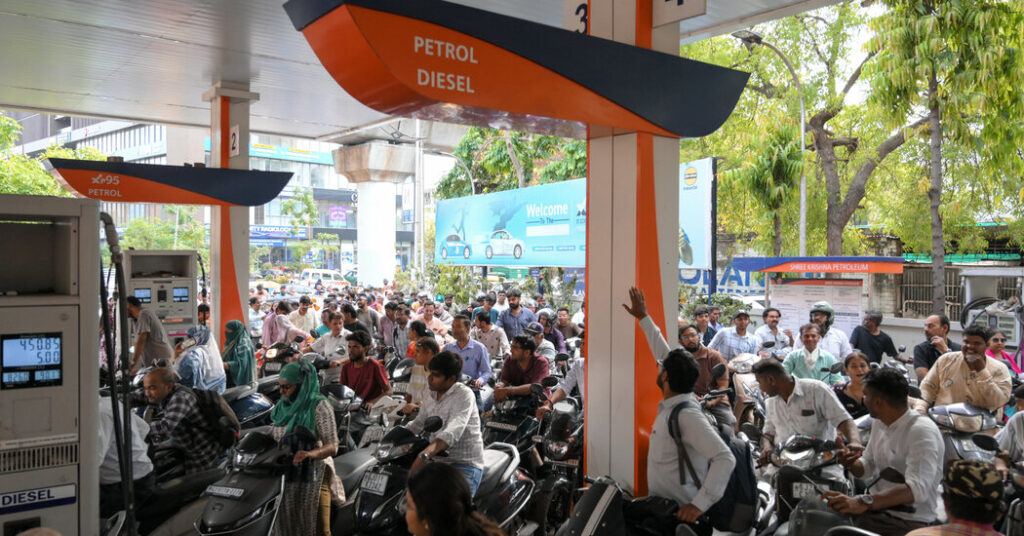
Across Asia, countries already vulnerable to the sustained disruption in energy supplies from the Persian Gulf are also contending with an ominous side effect. Their currencies are being suffocated by a dollar that is surging in value.
The war in the Middle East has effectively cut off oil and gas that travel through the Strait of Hormuz, a narrow channel that has become the world’s most dangerous bottleneck.
The fighting has revealed a second painful choke point. About 90 percent of international trade in goods — including the oil and gas that are skyrocketing in price — uses the American currency.
And as often happens in times of global turmoil, investors are taking money out of riskier regions and putting more money into U.S. assets. That is driving up the dollar, which is approaching its highest value against Asian currencies in the past two decades. A result is that many currencies are growing weaker just when their buying power is most needed.
The combined effect of these pressures has debilitated economies across Asia, where some local energy costs are even higher than global benchmark prices and stock investors are running scared.
On Monday, India’s main stock index lost 2.5 percent of its value in the hours before President Trump announced a five-day delay in his plan to bombard Iran’s energy infrastructure — having fallen almost 13 percent since the war started. Those stock market losses have pulled money out of India, pressing its currency, the rupee, lower. South Korea’s currency, the won, had just matched its lowest-ever exchange rate against the dollar, for the first time since the global financial crisis of 2008.
Both countries have seen some easing of the financial strain in the past few days, keying in on signals that Mr. Trump is seeking an offramp for the war. But deeper risks have taken root.
In the Philippines, higher oil prices and a weaker Philippine peso present a “double whammy that will double inflation in the coming months, hitting millions of poor Filipino families the hardest,” the IBON Foundation, an economic research group, said in a note on Friday. The country’s president, Ferdinand R. Marcos Jr., declared a national energy emergency on Tuesday. The Philippines imports 90 percent of its oil from the Middle East.
In South Korea, President Lee Jae Myung started a nationwide energy-saving campaign on Tuesday. Nearly 70 percent of that country’s supply of crude oil passed through the Strait of Hormuz.
The whole world is struggling with the new scarcity of oil, which analysts have estimated to be worse than the 1970s’ shocks.
Even in the United States, which became a net energy exporter during the oil-shale boom, the average gallon of gasoline has climbed to $3.98, more than a dollar higher than before the war.
Compare that with what is happening to Asia. First, the shortage of supply is worse. The price of a barrel of Brent crude oil traded across the Atlantic Ocean is now about $100, up from $70 a month ago. But because Asian countries buy so much of their oil from the Middle East, the intense demand for the suddenly smaller supply has driven prices even higher.
The second whammy strikes when those prices are converted into currencies that are shrinking in comparison with the dollar. India’s rupee has been weakening for the past year, even when the dollar itself was shrinking relative to most currencies. One dollar now costs 93.2 rupees, 8 percent more than a year ago.
So Indian buyers must pay 14,748 rupees to get exactly as much energy as they got for 6,087 one year before the war.
“Having the oil price go up when their exchange rates are already weak is doubly painful,” said Kenneth Rogoff, an economist at Harvard.
Spending so much on an essential commodity is a cold reality across Asia.
Thailand’s truck drivers, for example, have said they lack diesel, which like gasoline is refined from crude oil and has leaped in price, to drive goods to and from ports.
The currency of any country that spends more on imported goods while earning less from exports is losing value to the rest of the world. And when anxious investors shift their capital — often to the dollar, traditionally the safest store of value — that further depreciates the struggling currency.
Thailand’s currency, the baht, had started this year on a stronger footing than India’s rupee. But it has quickly fallen to a 10-month low and is expected to keep sinking as long as the war lasts.
Thailand’s tourism and export industries usually benefit from a weak baht. This time, however, jitters over global travel have led to canceled vacations.
The question for nervous governments becomes: How best to distribute the pain? Tradeoffs abound.
Jahangir Aziz, an economist at JPMorgan Chase in New York, said that for any country, “the question is, how do you want to absorb the hit?” Governments and central banks must make decisions that end up determining who is hurt the worst.
On the one hand, a country’s central bank could stand pat and let the currency’s value shrink. Then the country’s imports become more expensive, but its exports become cheaper. Cheaper exports helps some local businesses, and workers who earn dollars abroad can send home more in remittances to support the domestic economy.
However, more costly imports mean a country’s households and consumers must bear higher prices. And that can destabilize society and even topple governments. Bangladesh and Sri Lanka ousted political dynasties during recent financial crises. The Asian currency crisis of 1997 ended a 31-year autocracy in Indonesia.
When a government sets out to defend its currency from a surging dollar, Mr. Aziz said, it faces a stark choice: “The only way you do that is by spending very large amounts of foreign reserves — or you let interest rates rise.”
The crisis affecting countries today is nothing like the Asian currency crisis, Mr. Aziz said, in part because of lessons learned back then. Exchange rates are now allowed to float, meaning that currencies’ values fluctuate in sync with supply and demand. And countries have piled up large reserves of dollars and other foreign assets they can use in times like this.
Governments are also starting to cut spending, making hundreds of small and large adjustments to redirect money. Countries have ordered government employees to work from home, for example, and imposed fuel rationing.
Maybank Philippines, a bank, published a report on Monday saying it was crucial to watch how “authorities respond to rising fuel costs, which could influence inflation expectations and currency stability.”
Even the governments of Asia’s richer countries will not have the resources to spare its citizens from all the effects if this crunch persists.
South Korea’s finance minister, Koo Yun-cheol, warned on Sunday that expensive oil and the weak won would push up prices in general. Korean farmers who need heating to grow tomatoes, tangerines and bell peppers in greenhouses were already complaining about the rising fuel prices.
Still, Mr. Koo vowed to maintain price caps on gasoline, diesel and heating kerosene — costs that hit ordinary voters where they live. He also promised to freeze public utility prices and subsidize some consumer goods.
A mixed approach like this is expected to characterize all of these governments’ responses for many months to come, even if the war ends soon.
India’s prime minister, Narendra Modi, had avoided discussing the crisis with his country’s Parliament until Monday, when he announced that the situation was dire but under control. Indians would deal with it, he said, as they did with the Covid-19 pandemic.
Mr. Rogoff of Harvard said the pain borne by Asia this year was likely to make the dollar less attractive in the future.
“Anything that poses obstacles to global trade and creates geopolitical fracturing is bad for a currency that claims to dominate the whole world,” he said.
But the need of the hour across Asia is to scare up enough hard currency to buy urgently needed energy. The future of the dollar’s role, Mr. Rogoff said, will be answered later by a question “about trust in the U.S.: Is it still a safe haven and a safe partner?”
Alex Travelli is a correspondent based in New Delhi, writing about business and economic developments in India and the rest of South Asia.
The post Asia Is Getting Crushed Between Oil Prices and the Dollar appeared first on New York Times.