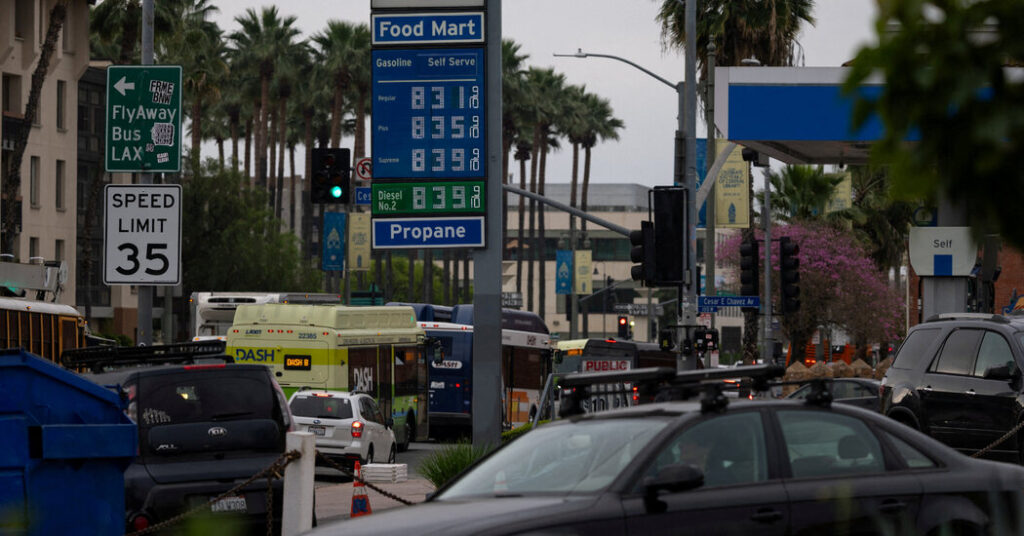
As gasoline prices have risen since the war in Iran began, no state has felt the pinch at the pump more than California, where a gallon costs nearly $2 more than the national average.
Gasoline prices have long been higher in California because the state uses a special fuel blend that releases less pollution when it is burned. California also imposes higher taxes and environmental fees than other states.
But the war has highlighted another major issue for the state and its economy: California has lost almost three dozen oil refineries since the early 1980s, forcing it to import fuel from as far away as Asia.
On Tuesday, a gallon of gasoline averaged $3.98 nationally and $5.82 in California, according to AAA. Those prices were up from $2.95 and $4.63 a month earlier.
Some of the difference is a result of California’s higher taxes and fees. An analysis by the federal Energy Information Administration last March showed that the state’s 60-cents-a-gallon excise tax was more than twice the average for all states. In addition, other California taxes and environmental costs add up to 66 cents a gallon.
“California was going to have a crisis before the crisis,” said Paul Sankey, president of Sankey Research, an oil and gas research company. “They strangle their supply side.”
The sharp increase in prices has reanimated a long-running debate about who is to blame for these high costs. Many state lawmakers and consumer groups say oil companies are taking advantage of a global crisis by raising prices more than is justified. But energy executives say California’s government is to blame for levying high taxes and making the state inhospitable to refineries.
California’s Democratic governor, Gavin Newsom, has blamed President Trump’s decision to attack Iran.
“Trump’s Iran war is costing Americans $1.5 billion more at the pump this week alone, and what are Americans getting in return?” Mr. Newsom said in a recent statement. “Not better roads. Not cleaner air. Just higher prices as corporations pocket the higher prices and cash in on Trump’s chaos.”
Anthony Martinez, a spokesman for Mr. Newsom, added that California’s gas prices had been stable and below $5 a gallon for about two years, until the start of the war. The war “is affecting gas prices in red states and blue states, regardless of whether they pump oil or have refineries,” Mr. Martinez said.
A White House spokeswoman, Taylor Rogers, said in a statement that California’s “gas prices have consistently been some of the highest in the country for years, averaging well above $4 per gallon before Operation Epic Fury when gas prices in most other states were around $2 per gallon thanks to President Trump.” She blamed Mr. Newsom’s “so-called ‘green energy’ policies” for the high prices.
An executive at Chevron, which operates two refineries in California, said the state should declare a state of emergency to prevent more refineries from shutting down.
“California has had, I think, very poor energy policy,” said the executive, Andy Walz, who is president of downstream, midstream and chemicals for Chevron. “They’ve put a climate agenda ahead of reliable and affordable energy, and the consequences of that are that energy in California — any form of it — is unaffordable.”
Chevron moved its headquarters from San Ramon in Northern California to Houston in 2024.
In December, Phillips 66 closed a large refinery in Southern California, and Valero Energy plans to close a refinery in Benicia, north of San Francisco, next month.
Another refinery near San Francisco, owned by PBF Energy, was damaged in a fire last year. PBF said in January that it aimed to restart the plant in February, about two months later than its previous plan. The company did not respond to requests for comment about the status of the refinery.
Oil executives have generally blamed California’s high costs, taxes and environmental rules for refinery closures. But analysts say companies have also shut down refineries because demand for gasoline in the state has been slowly declining for years — it was down about 16 percent in 2024 from two decades earlier — as more residents have switched to electric and hybrid cars.
As refineries have closed, California has had to import more gasoline from other countries, which exposes it to higher global prices for the fuel.
The higher costs are increasingly a source of frustration and anger.
“Californians really get stuck,” said Joseph Herzberg, a Pasadena resident filling up at a Chevron station in Northeast Los Angeles, where a gallon of regular gas was $6.
Mr. Herzberg, 68, said he generally did not mind paying more than residents of other states because he remembered the smog that choked Los Angeles when he was growing up. But the recent price spike has left him feeling “powerless,” he said.
In the Central Valley, Joe Del Bosque, who owns a 1,800-acre melon farm, said rising fuel costs would make it more expensive to operate his business’s tractors and pickup trucks.
Mr. Del Bosque said some of those higher costs could be passed on to his customers, making produce more expensive at stores. “Consumers then may buy less produce,” he said.
Mr. Del Bosque said he was also exposed to higher prices for fertilizers, which are closely linked to the cost of natural gas and other commodities.
Higher fuel prices could have ripple effects across California’s economy, including transportation, agriculture, tourism and hospitality, said Christopher S. Tang, a distinguished professor at the University of California, Los Angeles, who studies supply chains. “Discretionary spending often drops when pain at the pump increases,” he said.
In 2023, Mr. Newsom and state lawmakers tried to address high fuel prices by establishing penalties for price gouging. They also set minimum inventory levels for refineries. But Mr. Newsom delayed the penalty provision, and the rules for inventories have yet to be established.
Jamie Court, president of Consumer Watchdog, a Los Angeles-based nonprofit, said that although oil companies complained about California, refineries in the state tended to make profit margins of around 40 to 50 cents a gallon. During crises or refinery outages, those profits can more than double.
“We’re getting hit from all sides,” Mr. Court said. “That’s when you know there’s extreme profit making.”
Ivan Penn is a reporter based in Los Angeles and covers the energy industry. His work has included reporting on clean energy, failures in the electric grid and the economics of utility services.
The post As Gas Prices Spike, California Is Hit Hardest appeared first on New York Times.