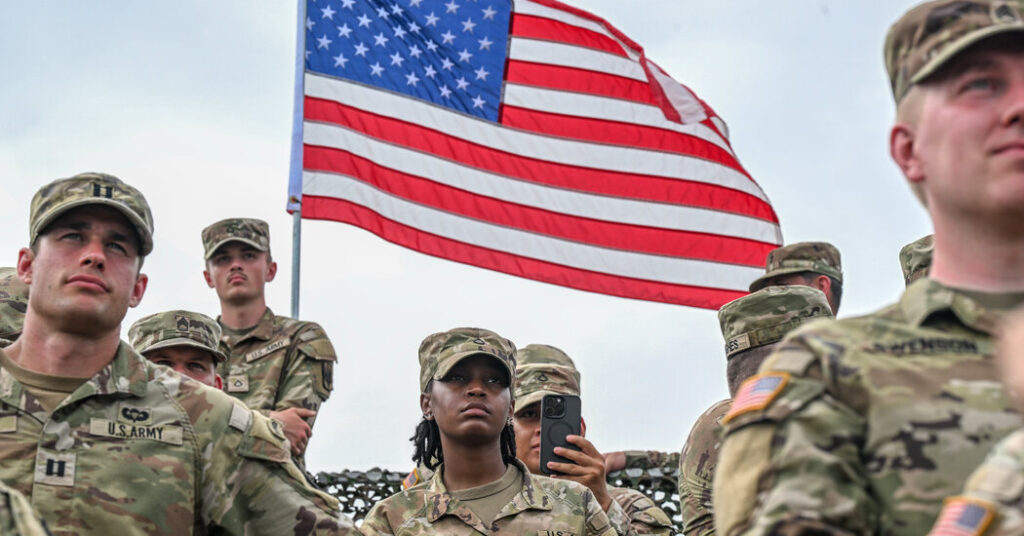
The United States Army has officially raised its enlistment age limit to 42 from 35 and eased restrictions for people with marijuana convictions, a move that comes years after a period in which it struggled to meet its recruitment goals and as the country is engaged in a war with Iran.
The updated enlistment requirements, published last week, bring the service’s age requirements more in line with other branches of the military, including the Air Force, which raised its maximum age for recruits to 42 from 39 in 2023, and the Navy, which increased its age cap to 41 from 39 in 2022.
The updated requirements, which go into effect on April 20, also allow recruits with a single prior conviction of possession of marijuana or drug paraphernalia to forgo procuring a waiver from Army officials in order to enlist. Under the previous requirements, recruits with low-level marijuana convictions typically had to wait two or three years and pass a drug test to receive a waiver.
While the policy for the regulations was first issued in 2023, the Army codified it last week in a regulation, which is an official, mandatory policy document, the Army said in a statement.
Katherine Kuzminski, the director of studies at the Center for a New American Security and an expert on military recruitment, said the Army most likely increased its age cap to match other military branches and to tap into a larger pool of people with needed skills, including experts in cybersecurity, logistics and transportation.
Ms. Kuzminski was an author of a 2022 report issued by the RAND Corporation that examined the outcomes of older recruits in the Army. The experts found that older recruits were more likely to fail out of basic training, but if they passed, they were promoted more quickly and re-enlisted at higher rates than recruits under 20.
“Mature soldiers who are the beginning of their careers might be a real value add to those around them in the barracks, and might add a lot of value back to the Army, especially in some of these technical skills,” Ms. Kuzminski said.
The changes to the marijuana regulations, she said, are most likely an effort to speed up the waiver process, which can stretch on for months, during which a potential enlistee might lose interest. The military also has to adjust to the society around it, she said, as nearly half of the states in the country have legalized recreational marijuana use.
Military service members, however, are still barred from using illegal drugs. In a statement, the Army said it did not “condone or authorize the use of illegal substances among our formation.”
The Army has struggled for years to meet its recruitment goals.
It faced a significant enlistment crisis in 2022, missing its goal of 60,000 new recruits by around 15,000 people. In 2023, the Army again missed its target by around 15,000 recruits. In 2024, the Army lowered its goal to 55,000 recruits, which it reached by a thin margin.
Last year, however, the military reported its best numbers in years, recruiting more than 62,000 people, surpassing its goal of 61,000, the Pentagon said. In a statement, the Army said it was on track to meet this year’s recruitment goals. Defense Secretary Pete Hegseth has credited support for President Trump as a factor behind the strong recruiting numbers.
Army officials, however, have linked it to a higher unemployment rate among people aged 16 to 24 and a training program started three years ago that prepares prospective soldiers to meet the Army’s minimum academic and body-fat standards. The U.S. military also spent billions on recruitment efforts after 2022 to address its enlistment crisis.
The United States is in the fourth week of its war with Iran, and as the Pentagon has ordered about 2,000 soldiers from the Army’s 82nd Airborne Division to deploy to the Middle East, according to Defense Department officials briefed on the effort.
But Ms. Kuzminski said the new regulations probably had little to do with the Iran war and were more likely an effort to address flagging recruitment numbers, noting demographic data that shows an aging U.S. population.
She added that only 23 percent of young Americans meet the standards for military service without a waiver, and only around 10 percent of young Americans think the military is a viable career path for them.
“This is much more an answer to the recruiting environment challenges that we saw over the last four years than it is to a particular conflict,” she said. “Tapping into the largest pool of people we can, which includes not only 18-year-olds, but also 42-year-olds who might meet a very specific need in the military, is going to be more important.”
Jonathan Wolfe is a Times reporter based in London, covering breaking news.
The post Army Raises Enlistment Age Limit to 42 and Eases Marijuana Rules appeared first on New York Times.